
Seventeen dollars an hour, because that's what the listing above yours said. That is how most dog sitting and boarding businesses set pay: not a number built from their own revenue, but a number borrowed from whoever posted a job first. It works, for a while. Then the sitter finds out what a gig app pays for the same overnight, or a competitor two miles away offers two dollars more, and you are re-hiring in the middle of your busiest month.
It is a strange gap for an industry built on precision. You already know, to the dollar, what you charge for a thirty-minute drop-in and what you charge for an overnight. Ask the same operator what they pay the person actually doing the visit, and the answer gets vague fast: “around eighteen, more for overnights, we're still figuring it out.” The client rate is a decision. The pay rate is a reaction.
That gap costs more than it looks like it does. A sitter who is underpaid relative to what the business collects does not usually quit loudly. They quit quietly, six months in, right after they have learned your dogs, your routes, and your regulars, right at the point when replacing them is most expensive.
01 / The real problemSitter pay is the number nobody builds, they just copy it.
Ask ten operators how they set their client rate and you'll get ten versions of the same method: look at what the market charges, adjust for experience and overnight risk, round to a number that doesn't look cheap. Ask the same ten how they set sitter pay and the method disappears. Most default to whatever a job board suggests, or whatever the last hire negotiated, with no link back to what the business actually keeps per visit.
The market data doesn't help much either. National averages put pet sitters and dog walkers at somewhere around $16 to $17 an hour, and the spread underneath that average is wide: the middle half of earners land between roughly $29,000 and $40,000 a year, a range that covers everyone from a college student doing weekend drop-ins to someone running a full boarding caseload. A number that wide is not a rate. It's a napkin.
That last number is the one worth sitting with. Eleven and a half thousand dollars of spread between two ordinary sitters, doing what looks like the same job. Some of that is location and experience. A lot of it is that most operators never ran the math at all.
The cost of guessing wrong runs in both directions. Underpay, and you lose the sitter clients actually ask for by name, usually to a competitor or a gig app, usually right before a holiday week when you can least afford the gap. Overpay without meaning to, because nobody checked the number against realized revenue, and the business quietly funds a wage it can't actually support. Neither mistake shows up on a Tuesday. Both show up on the day you try to hire your fourth sitter and the math no longer works.
02 / The real ceilingThe 30% myth, and the 45% line that replaced it.
For years, the rule of thumb in pet care was that labor should run about 30% of revenue. Set pay so total labor costs land near that number, the thinking went, and the rest covers rent, insurance, software, and margin. It is a tidy rule. It is also out of date.
Wages, payroll taxes, and workers' comp have all moved up since 2020, and most consultants working with pet care businesses now put the honest fully-loaded number closer to 45% of revenue: not the take-home wage alone, but wages plus payroll tax, workers' comp, and whatever benefits you offer, all in. Operators still pricing pay against 30% aren't being disciplined. They're working from a number that stopped being true a few years ago, and either underpaying without realizing it or running a margin that looks fine on paper and evaporates at tax time.
Fully loaded matters here. A $15-an-hour sitter does not cost you $15 an hour. Once you add payroll tax, workers' comp, and processing, the real number is usually closer to $18 to $19. If your pricing assumed the smaller figure, your margin was never as healthy as the spreadsheet said.
Price pay against your fully-loaded cost, not the number on the paycheck. The gap between the two is usually 20% to 25%, and it is the gap that quietly kills margin for operators who never account for it.
03 / The frameworkThe 45% Line: pay built from your own numbers.
Here's the fix, and it takes about twenty minutes with your own numbers instead of a job board's. Call it the 45% Line.
- Find your realized rate, not your listed rate. Pull last month's actual collected revenue per visit type (drop-ins, walks, overnights), not what your price sheet says. Discounts, referral credits, and the odd short visit usually pull the realized number a few dollars below the listed one.
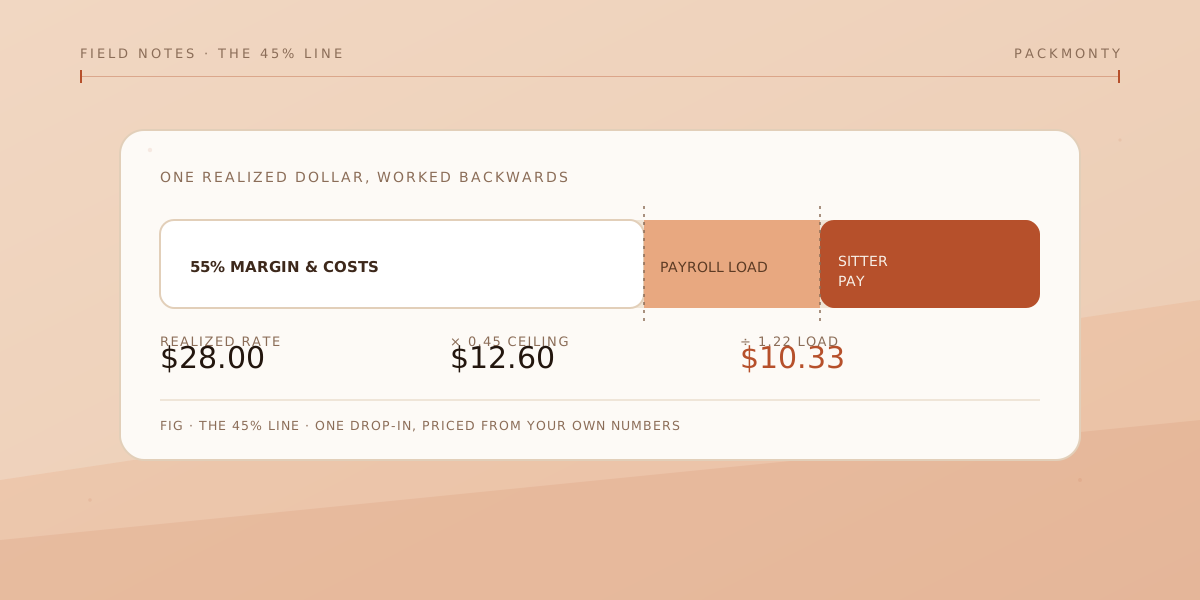
- Multiply by 0.45. That's your total labor ceiling per visit, the most you can spend on that sitter, fully loaded, before margin starts to disappear.
- Divide by 1.22. That backs out payroll tax, workers' comp, and processing, leaving the actual wage or per-visit pay you can put in front of a candidate.
- Add the kicker. Set a base for the first 90 days, then a fixed bump once someone is proven: a dollar or two an hour, or a flat premium on overnights. The kicker is what turns a rate into a reason to stay.
If you can't tell a candidate why the number is what it is, you don't have a rate. You have a guess with a dollar sign on it.Devon Russo, Field Notes Editor
04 / ApplicationRenata's Denver numbers, worked in full.
Renata runs a nine-sitter drop-in and overnight operation just outside Denver. Her realized rate for a 30-minute drop-in, after discounts and the occasional short visit, is $28. For an overnight, it's $92.
Run the line on the drop-in: $28 × 0.45 = $12.60 total labor ceiling. Divide by 1.22 and the actual pay comes out at $10.33 per visit, call it $20 an hour once drive time is built into the schedule, which lands just above the national median and gives her room to compete.
Run it on the overnight: $92 × 0.45 = $41.40 ceiling, divided by 1.22 is $33.93. Renata rounds to a flat $34 a night for the first 90 days, $37 once someone has covered ten overnights cleanly.
Two numbers, built from her own revenue, not from a listing three states away. When a candidate asks why the rate is what it is, she has an answer better than “that's what we pay.”
The same line works at two sitters or twenty. A solo operator hiring their first part-time help runs the identical three steps on a single service type, maybe just drop-ins, and gets a single honest number instead of a guess split between what feels fair and what feels affordable. The only thing that changes with scale is how many service types you're running the line against, not the math itself.
05 / StructureThe W-2 question, and where the kicker actually goes.
One decision the 45% Line doesn't make for you: whether the person on the other end of it is a W-2 employee or a 1099 contractor. In most states, dog walking and pet sitting fail the independent contractor test: you set the schedule, you set the route, you set the rate, and the work happens inside your business, not alongside it. Treating a sitter as a 1099 contractor when the relationship looks like that is one of the more common ways pet care operators end up with a Department of Labor letter. It also leaves a real gap: 1099 contractors usually aren't covered by your general liability policy the way a W-2 employee is, which matters the day someone gets hurt on a walk.
The overnight premium deserves its own line, not a percentage bump. Overnights carry more responsibility (a sitter alone in someone's home for eight or twelve hours, on call for anything that happens), and pricing it as a flat dollar amount rather than a multiplier of the hourly rate keeps the math honest as your client rates change.
On raises: give the 90-day bump on the date, not when someone asks. A sitter who has to ask for a scheduled raise has already started keeping a list of every other reason to leave.
06 / Anti-patternsWhat not to do when you set sitter pay.
- Don't copy a platform's advertised sitter earnings. What a gig app shows a sitter they could earn is built on that platform's own fee structure, not yours. Your realized rate and your costs are different numbers entirely.
- Don't set one flat rate for every service type. A drop-in and an overnight carry different risk and different realized revenue. Pricing them the same either overpays the drop-in or underpays the overnight, usually the second, which is the one more likely to go wrong.
- Don't leave pay unreviewed after a price increase. If you raise client rates 8% and never touch sitter pay, your margin looks better on paper for about a quarter, right up until the team notices and starts asking why.
- Don't recruit on wage alone. A rate built with the 45% Line is table stakes, not the whole pitch. Sitters who stay two years usually name the schedule, the routes, and being treated like staff rather than an app notification, ahead of the extra dollar an hour they could get elsewhere.
07 / TakeawaysTake this with you.
If you do nothing else this week, run the 45% Line once, on your actual numbers, for your two or three main service types. It takes less time than writing the job post you were about to copy from someone else.
And if a sitter ever asks how you landed on their rate, you'll have a better answer than a shrug.
– DR, Portland, running payroll before the morning drop-ins