Somewhere around the thirtieth time an owner asked, “do you also do training?”, Gareth stopped saying no. He runs an 18-run boarding kennels outside Leeds, and last year he counted 31 boarding clients asking some version of that question. Each of them wanted the same thing: residential dog training, the dog dropped off for a fortnight and collected better. Each of them went and spent £1,700 to £3,000 with someone else. This is the guide Gareth wanted when he finally decided to say yes.
If you run a dog boarding or daycare business, residential dog training, what the Americans call board and train and some owners still call a dog boot camp, is the most natural extension of your service menu that exists. You already have overnight custody, intake paperwork, vaccination checks, a boarding licence, insurance for dogs in your care, and, crucially, the dog, for a consecutive block of days. That consecutive block is exactly what training needs and exactly what a weekly one-hour class never gets.
What you probably don't have is a trainer, a transfer plan, and a way to charge for either. That's what this piece covers.
01 / The opportunityWhy residential dog training is the best week in boarding.
Start with the money, because the money is the reason to take the operational risk seriously. A plain boarding night in most of the UK bills £25 to £40. A residential training week bills £850 to £1,550 at 2026 published rates, priced by the experience level of the trainer working with the dog, so a two-week programme typically lands between £1,700 and £3,000, and four-week stays with senior trainers clear £5,000. Same kennel. Same building. Three to four times the revenue.
Demand is moving the same direction. The dogs bought in the pandemic years are now adolescents and adults with entrenched habits, owners are back in offices, and the top-ranking UK providers publish waiting lists, not vacancies. The busiest of them assign each trainer only one to three dogs at a time, which caps national supply hard. Owners increasingly expect the place that keeps their dog to also improve their dog. The question is not whether someone in your county will sell them that. It's whether it will be you.
There's a second, quieter benefit. Programme dogs fill runs in your soft weeks. Boarding demand spikes around school holidays and collapses in the gaps between them; training demand doesn't care about term dates. Gareth schedules his programme intakes for the exact weeks his occupancy historically dips. The run that would have sat empty in late January now bills like August bank holiday.
02 / The objectionsThe trust problem you inherit on day one.
Before you design anything, understand what owners read before they ring you. The UK conversation about residential dog training is dominated by one anxiety: the kennel. The biggest home-based providers lead their marketing with “no kennels here!”, promising the dog lives in the trainer's home as part of the family. Facebook groups exist solely to swap warnings about send-away training gone wrong. And the standard critique is everywhere: dogs don't generalise, so a dog trained in one building hasn't learned anything about your kitchen; be wary of anyone who promises to fix fear, reactivity, or aggression in a fortnight; ask where the dog actually sleeps.
Every word of that critique is aimed at bad programmes, and every word of it is correct. The miracle fix sold over the phone, the dog trained exclusively inside one facility, the owner handed a lead and a smile at collection with no instructions, the trainer with no credentials because the industry requires none. Dog training in the UK is unregulated. Anyone can print business cards tomorrow. Owners know this, and the wary ones, the ones doing the research, are precisely the high-value clients you want.
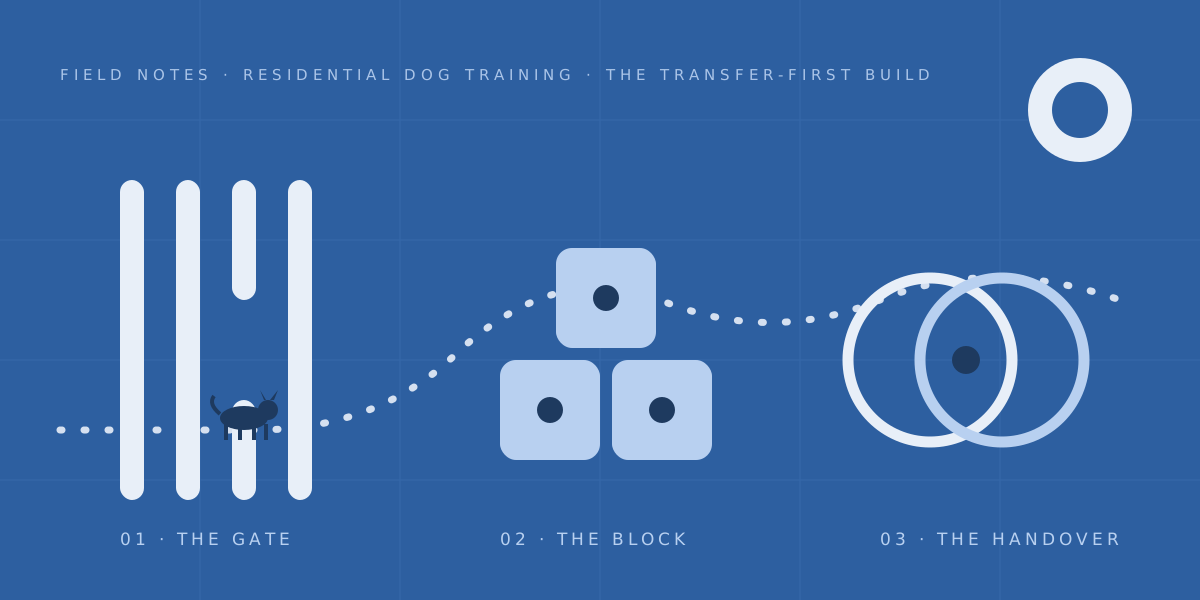
So read the critique the way an operator should: as a design spec. Every published objection to residential training is an instruction for how to build yours. Dogs don't generalise? Train in varied environments and teach the owner. Kennels are stressful? Show your setup, your licence, and your star rating before they book. Guarantees are a red flag? Don't make them, and say why. The framework that follows, the transfer-first build, is that spec turned into a programme. It has three parts: the gate, the block, and the handover. You design them in that order, but you sell them backwards, because the handover is the product.
03 / The frameworkThe gate: residential dog training starts with who you refuse.
The gate is your intake standard, and it determines everything downstream: your margins, your staff's safety, your reviews, and whether your trainer still works with you in six months. A programme that accepts every deposit is a programme that will eventually board a dog it cannot help, and that dog's owner writes the review everyone reads.
Take, happily: adolescent manners cases, roughly 6 to 18 months old, with the everyday problem behaviours. Pulling on the lead, jumping up, door dashing, unreliable recall, crate resistance: the problems every owner recognises. These are the bread of the business. They respond well to a two-to-three-week block, they finish on schedule, and their owners can see the change in the car park. Puppies under six months are a different product: a short head-start stay built around socialisation, confidence in new environments, and the foundation basics, sold as a running start on obedience commands, never as a finished dog. The pup leaves with a foundation; the owner leaves knowing what comes next.
Refer out, politely: separation anxiety, which a kennel environment tends to make worse, not better; deep fear-based issues that need a longer arc than any boarding stay; serious bite-history aggression, unless you work with a genuinely qualified behaviourist and your insurance knows about it; and any dog whose medical needs your overnight staff can't confidently manage. Behaviour modification is a different product, at different prices, with different liability. Home-based trainers who take those cases exist in every county. Send them the referral. It costs you one programme fee and buys you a reputation for honesty that no advertising spend can.
The licence, and the trainer: the gate's other half
Two UK-specific checks before you sell a single week. First, the paperwork. In England, boarding is licensable under the Animal Welfare (Licensing of Activities Involving Animals) Regulations 2018, whether dogs stay in kennels or in someone's home, so as a boarding operator you're licensed already; ring your council's licensing officer and confirm your conditions cover the training activity, and if you ever use the home-based model, where the dog lives with the trainer, their home needs its own home boarding licence in their name. Your star rating is marketing now, too: a five-star, higher-standards licence answers the kennel anxiety better than any brochure copy. Scotland and Wales run their own schemes, so check locally.
Second, the human. Training itself is unregulated, which means a dog trainer's credentials are the only signal owners can verify, and your programme inherits its trainer's reputation entirely. Look for ABTC registration, IMDT or APDT membership, or equivalent assessed qualifications, plus hands-on experience you can put a number on. Gareth didn't hire a trainer; he contracted Sophie, an IMDT-qualified trainer who had been renting a field across the valley, on a per-programme revenue split. She got a licensed facility and a client pipeline. He got a programme he could put a real name on.
Run a paid trial day before you accept any programme dog. Temperament evaluation, vaccination verification, a behaviour history form that asks about fear, reactivity, and resource guarding, and a meeting with the trainer where the owner sets goals, asks questions, and hears honest expectations. If anything about the dog surprises you on the trial day, it will surprise you worse on day 9.
The trial day fee credits toward the programme if the dog is accepted. If it isn't, you were paid for the assessment and the owner got a professional opinion. Nobody wasted a fortnight.
04 / The frameworkThe block: two weeks of reps, trained past the kennel.
The block is the training stay itself. UK programmes run 2 to 4 weeks; for manners and obedience, two to three weeks is the honest sweet spot. Under two weeks, the amount of repetition isn't enough for new habits to hold. Past four, you're charging a lot of money for diminishing returns and the sell gets much harder.
The daily routine matters less than most operators think, and the ambient structure matters more. Formal training sessions are short: two or three per day, 10 to 15 minutes each, because that's the amount of focused attention a dog can give before the energy drops. Everything else is the real curriculum. Every feeding is an impulse-control rep. Every doorway is a threshold rep. Every walk to the paddock is a loose-lead rep. Which means your boarding team is part of the training programme whether you plan for it or not, so plan for it: every programme dog gets a one-page handling sheet on its run, and every staff member uses the same commands and cues the trainer does. Consistency is the whole curriculum; a kennel assistant who says “down” for “off the fence” can undo a week of work in a weekend.
Variety, distractions, and real exercise
Then there's the part the sceptics are right about, and the part that decides the home-versus-kennel debate: dogs don't generalise. A dog that sits beautifully in your training barn has learned, in fact, to sit in your training barn. The fix is variety, scheduled rather than hoped for. From the middle of week one, sessions move into new environments: the car park, the lane, the village high street, a garden centre, a country park on a Saturday, each one adding distractions the dog learns to work through. This is how a kennel-based programme answers the “no kennels here” objection honestly: the dog may sleep in a licensed run, but it trains in the real world. Gareth's programme books three off-site sessions per dog per week, and Sophie logs the location of every session so no two consecutive days look the same.
The rest of the day matters as much as the methods. Programme dogs still need real exercise: a dog with unspent energy can't concentrate, and a long sniffy walk before a session buys you ten better minutes inside it. And whatever techniques your trainer prefers, reward-based methods that start with food and toys transfer best, because owners can practise them at home without specialist knowledge or tools, and because the UK market increasingly expects force-free handling as the default.
Document as you go. A one-line note per dog per day, and a 30-second progress video to the owner twice a week, on WhatsApp, because that's where UK owners live. The notes protect you if anything is ever disputed. The videos do something better: they let the owner watch the dog succeeding for two weeks before collection, which quietly builds their belief that this will work at home. That belief is half the handover.
05 / The frameworkThe handover: the 72 hours that decide your reviews.
Here is the uncomfortable truth about residential dog training: the dog is the easy part. Dogs in a structured environment with a professional trainer improve almost embarrassingly fast. The hard part is that the dog goes home to its real life, a home environment full of old triggers and soft sofas, with people who didn't take the course, and behaviour that isn't reinforced at home decays within weeks. Every horror story that ends with “the training wore off” is actually a story about a missing handover.
So the transfer-first build reserves the final 72 hours of the block, and the four weeks after it, for transferring the training from your trainer's hands to the owner's. Not a demonstration at collection. A working session where the owner handles the dog and the trainer coaches the human.
Two rules make this work. First, the owner session is mandatory; you explain its importance at booking and repeat it at drop-off. An owner who won't attend a one-hour session is telling you, in advance, how the training will end. Second, the handover is bundled into the programme price, never sold as an add-on. The moment follow-up becomes optional, the most price-sensitive clients skip the one component that determines whether they leave you a five-star review or a “it wore off in a month” one. The best UK providers already bundle two to four follow-up lessons into every stay; match that or beat it.
What the owner actually buys in that session is a working relationship with their own dog: the communication habits, the knowledge of why each command is cued the way it is, and the handful of tools they'll practise for the dog's lifetime. Training holds when the bond does the reinforcing, and the bond is built at home, in the daily routine, not in your building. Hand over a system simple enough to survive real life. That is the success metric, and it's the reason the follow-up sessions exist.
We stopped selling two weeks of training. We started selling week six, when the dog is still doing it at home. That's the product.– Gareth H., boarding operator, West Yorkshire
06 / The mathsPricing the programme: Gareth's numbers.
Gareth priced his two-week programme at £1,900, mid-market for Yorkshire in 2026 and a price level he can defend, deliberately not the cheapest in the county. Here's his per-dog maths. The run the programme dog occupies would have earned about £392 as plain boarding over the same 14 nights (£28 average net nightly). Sophie takes 40% of programme revenue, £760, which covers roughly 16 hours of dedicated training plus the owner session and the day-28 follow-up. Consumables, the insurance uplift, and off-site session fuel cost about £100. That leaves £1,040 to the house, roughly 2.7 times what the run would have earned, before counting the trial-day fees and the refresher days that follow.
With two programme dogs running at any given time, the programme adds around £1,300 a month to the bottom line against his boarding baseline, on capacity he already owned. It also feeds the rest of the menu: programme graduates board with him, use his daycare, and refer Sophie's group classes. The programme is the most profitable service in the building and the best marketing he's ever paid for, and it's the same line item.
Three pricing mechanics worth copying. Take a 50% deposit at booking, non-refundable once dates are confirmed, because a fortnight of your trainer's calendar is inventory you can't resell on short notice; the established UK providers all do exactly this. Publish your weekly rate by trainer level if you have more than one trainer; it makes the price feel earned rather than plucked. And ring your insurance broker before the first intake: you want care, custody, and control cover that explicitly contemplates training, on-site and off-site, and you want your council licence conditions and your policy telling the same story. The premium bump is small compared to one uncovered incident in a garden centre aisle.
07 / Anti-patternsWhat sinks residential dog training programmes.
- Guaranteeing results. Every credible organisation in the industry tells owners that a guaranteed-results promise is a red flag, for good reasons: dogs are individuals and learn at their own pace. No ethical trainer guarantees identical results for every dog, and the good UK providers say so on their own pricing pages. A guarantee attracts the clients you least want and hands your review score to the dog. Sell the process, the credentials, and the follow-up, never the outcome.
- Taking behaviour cases to fill runs. A slow month makes a bite-history intake look tempting. Resist it. Aggression work needs a different professional, different insurance, a longer programme, and a different price. One incident can cost more than a year of programme revenue, and in the worst cases it puts your boarding licence in the room with the council.
- Running it as boarding-plus. If the plan is, for example, “the kennel staff will work on sit when things are quiet,” you are selling boarding with a surcharge, and the owner will notice at collection. A programme without a named, credentialed trainer and a written curriculum is a refund waiting to be requested.
- Skipping the handover to save a session. It's the first thing operators cut when the calendar gets tight and the single most expensive cut available. The handover is where the reviews come from. Protect it like revenue, because it is.
08 / TakeawaysTake this with you.
If you're a boarding operator sitting on the same question Gareth sat on, start with the gate, this week. Write down which dogs you'll take, which you'll refer out, who your credentialed trainer will be, and what your licence needs before residential dog training goes on the menu. Don't sell a single programme until those four lines exist on paper. Then run one dog, at full price, with the full handover, and measure success by the review that says “three months later, he's still doing it.” None of this is a list of tips; it's a build order. That sentence in that review is the whole business.
And write to me. I'm collecting residential training numbers, programme lengths, trainer splits, and handover protocols from operators across the UK for a follow-up piece. Yours might make it in.
– EM, watching a handover from a farm gate, somewhere outside Leeds