Renée called me last spring because she was busy and still broke. She had a full book in Tampa, walked dogs eight hours a day, and could not work out why the money never matched the hours. We pulled up her price list and the problem was right there in the first line. She offered one thing: a “dog walk, $20.” That was it. One service, one number, for a Maltese around the block and a husky in the rain and a household of three that needed feeding too.
The phrase dog walking services hides a trap. Type it into a search bar and you get a single average price, as if there is one thing called a dog walk that costs one amount. There is not. What clients actually want is a menu: a short walk, a long walk, a group walk, a visit while they are away for the day, a place for the dog to stay the night. Each of those is a different service with a different cost to deliver and a different price it can carry. Sell them as one line and you leave money on every booking and confusion in every inbox.
This guide is the full menu, built the way an operator should build it. Seven services, ranked from the lightest commitment to the heaviest, with a 2026 price band for each and the logic that connects them. I ran a four-walker operation in Brooklyn for six years and rebuilt this menu three times before it paid. You can skip the first two rebuilds.
01 / The problemWhy one price quietly costs you money.
When you list a single service, you price for the average dog and the average visit. The trouble is that nobody books the average. The client with the easy spaniel who just needs a potty break feels overcharged at your flat rate and drifts to the neighbor's kid. The client with the reactive rescue who needs a solo walk in a quiet park is underpaying, and you absorb the difference in stress and risk. A flat rate is a promise to lose at both ends.
A menu fixes this by matching price to what the visit actually demands. It also does three quieter things. It lets a client choose up, so the spaniel owner who wants enrichment can buy it instead of leaving. It gives you a clean way to raise prices, because you raise one rung at a time rather than touching everything. And it tells a prospect, in five seconds of scanning, that you are a business and not a favor. The menu is the most underrated piece of marketing you own.
02 / Why it mattersWhat a professional dog walk actually does.
Before the menu, the why. Dogs are social animals, and a walk is not a luxury bolted onto their day; it is most of the day's point. The majority of dog owners know their dog needs exercise, yet underrate how much a single midday walk changes the afternoon that follows. The link between a lack of regular walking and problem behaviors is not a theory. It is the chewed sofa, the barking, the restless energy with nowhere to go.
A good walk delivers four things at once. Physical exercise that protects weight, joints, and long-term health. Mental stimulation, the chance to sniff, read the neighborhood, and use the brain. Socialization, the controlled interaction with other dogs and people that keeps a dog steady. And for nervous dogs, a calm outlet that slowly reshapes behavior over weeks. A walker with a real feel for dog behavior turns each of these into a small daily gain rather than a box ticked.
There is a benefit on the human side too, and it is the one that sells the service: peace of mind. Knowing your dog is not alone for ten hours, that someone with knowledge of your dog and your area is handling the day, is worth real money to a working household. A professional walker is not selling you convenience. They are selling back the part of your day you would otherwise spend worrying.
03 / The frameworkThe Service Ladder.
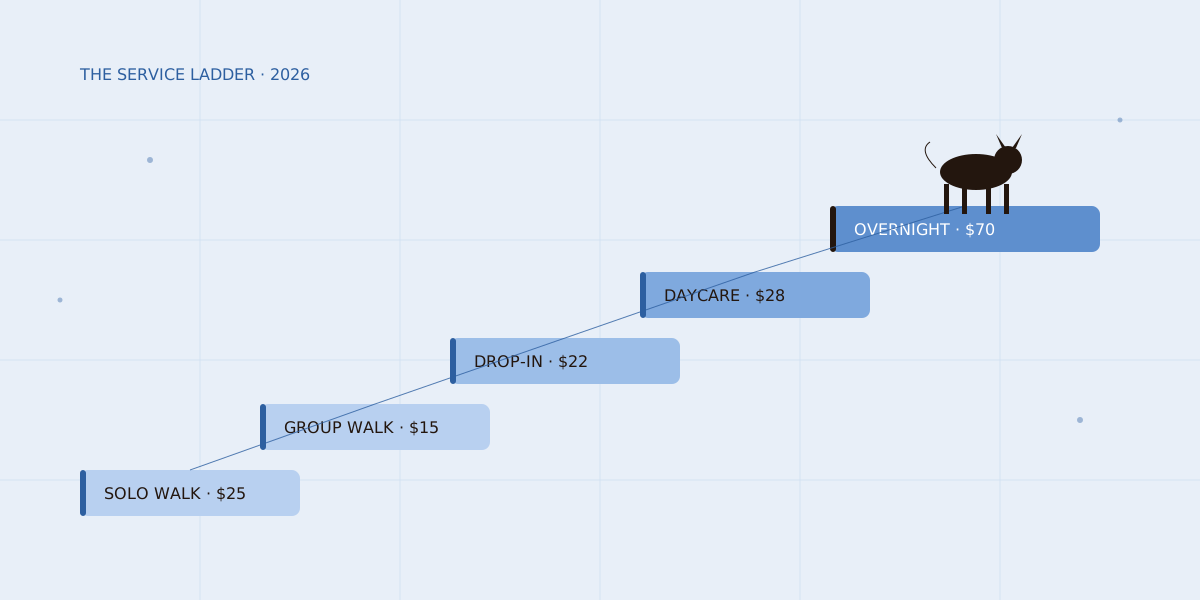
Picture your services as rungs on a ladder. At the bottom sit the light, fast, high-volume services that fill your day. At the top sit the heavy, scarce, high-commitment services that fill your evenings and your calendar weeks ahead. Each rung costs you more to deliver than the one below it, in time, in space, or in liability, so each rung carries a higher price.
The point of the ladder is not just tidiness. It is that every price relates to the price below it. You do not invent seven numbers from thin air. You anchor one rung to your real cost, then step up or down from there in deliberate increments. A client can read the whole ladder and feel the logic, even if they never see your spreadsheet. Here is the full ladder, bottom to top.
Most operators never offer all seven, and they should not on day one. The ladder is a map of what is possible, not a checklist. What matters is that when you do add a rung, you know exactly where it sits and what it should cost relative to its neighbors.
04 / The coreThe core three: solo, group, drop-in.
These three rungs will carry most of your business in the first year, and for many dog walkers, forever. They share the same insurance, the same routing, and the same daytime hours, which is why they belong together at the foundation of the ladder. Each delivers the same core good a dog needs between owner check-ins: exercise, mental stimulation, a toilet break, and calm human company. Those are the real benefits behind every booking, the dog's well-being on one side and the owner's peace of mind on the other. Get these three right and the rest of the menu is just variations on them.
The solo walk
One dog, one walker, full attention. This is the rung you anchor everything else to, because it is the cleanest unit of work you sell: a known dog, a known route, a known half hour. In 2026 a 30-minute solo walk runs $20 to $30 across most US markets, with a national average a touch above $21, and 1.5 to 2 times that in New York, San Francisco, Seattle, and Boston. A 60-minute solo runs $40 to $60 with an experienced handler. The solo walk is also the right home for reactive, recovering, or anxious dogs, so treat it as the premium tier rather than your default rate. These are the dogs that need a steady hand on the leash and a dog walker who reads the breed in front of them, which is exactly what a solo buys.
The group walk
Two to four dogs from different households, walked together. The group walk is the only rung that prices below the solo per dog, usually $12 to $18 each, because the client buys shared attention rather than sole attention. Do not let that lower number fool you. A group of four at $15 earns you $60 for the same occupied half hour a single solo earns $25. The group walk is the single biggest lever on your hourly rate, which is exactly why it sits at the bottom of the ladder as your volume engine. A good group is calm, leash-trained canines moving together, not chaos on six leashes, so screen every dog for temperament before you fold it into a pack. The dogs that cannot share belong on solo walks, not in your group.
Marcus, who runs six walkers in Denver, builds his whole weekday around groups and reserves solos for the dogs who genuinely cannot share. His per-walker revenue is nearly double the solo-only operators in his city. The math is not subtle.
The drop-in visit
A scheduled home visit, usually 20 to 30 minutes, covering a potty break, fresh water, a feed, and a short walk or play. The drop-in looks like a walk but behaves like sitting, because the owner is away for the day rather than at work, and you are entering and securing a home. Price it close to the solo walk, $18 to $25, and confirm your insurance covers home entry when the owner is absent. The drop-in is the rung that quietly bridges dog walking and pet sitting, the rung professional pet sitters know well, and it is often the first taste a client gets of trusting you with their keys.
Anchor your whole menu to the solo 30-minute walk. It is the rung you understand best and price most accurately. Every other number on your list should be a deliberate step away from it, up or down, for a reason you can say out loud.
05 / The heavy rungsThe commitment rungs: daycare, sitting, boarding.
The top of the ladder is where the money per booking is largest and the cost to your life is highest. These rungs do not just take more time. They take your evenings, your space, and a heavier slice of liability. Add them only when you have the capacity and the cover to do them well.
Daycare
The dog spends the working day with you or at a facility, usually $25 to $40 per day. Daycare is the natural step up from the group walk, because it serves the same socially confident dogs for a longer window. For a home-based operator it is a strong rung: one drop-off, one pickup, no midday driving, and a full day of revenue. The constraint is space and numbers, so know your safe capacity and your local rules before you advertise it.
House sitting
You stay overnight at the client's home, caring for the dog in its own space, typically $40 to $75 per night. House sitting carries the overnight premium without turning your home into a kennel, which is why many walkers add it before boarding. It suits anxious dogs and multi-pet homes that travel badly. The trade is your own bed, so price the inconvenience honestly and add a clear rate for additional pets in the same home.
Overnight boarding
The dog stays the night at your place, $35 to $85 per night nationally and up to $150 in major metros. Boarding is the top rung for a reason: it is the highest revenue per booking and the highest demand on your household. Holiday weeks command a surcharge of $5 to $15 per night and book out first. If you offer boarding, treat it as a real product with house rules, a meet-and-greet, and a cap on numbers, not as a spare room you fill when asked.
The top of the ladder pays the most per booking and costs the most per night of your life. Charge for both.– Devon Russo, six years in Brooklyn
06 / The marginThe margin layer: add-ons.
Add-ons are the rung that lives sideways. Instead of a new visit, they bolt extra value onto a visit you are already making, which means they add margin without adding a single mile of travel. This is the most overlooked profit on the whole menu, because each one feels too small to bother with until you count them across a month.
- Medication administration, $3 to $8 per visit. Pills, drops, or a managed feeding routine. Higher for injections. Many owners of senior dogs will pay this happily and book you specifically because you offer it.
- Extra walk time, $5 to $10. Bumping a 30-minute walk to 45 or 60. The cleanest upsell you have, because the dog is already with you.
- Enrichment session, $10 to $20. A focused half hour of sniffing games, puzzle work, structured playtime, or training instead of a standard walk. Sells well to owners of high-energy dogs stuck indoors who need mental stimulation more than another lap of the block.
- Pet taxi, priced by distance. Vet runs, grooming drop-offs, daycare transfers. Charge a base fee plus mileage and you turn dead driving time into paid time.
- Key holding and home checks, a small monthly or per-visit fee. Bringing in mail, rotating lights, watering a plant. Trivial for you, valuable to a traveling client.
- Holiday surcharge, $5 to $15 per night or visit. Not an add-on the client chooses, but a clear line that protects your most demanded days.
The trick with add-ons is to make them frictionless. List them as small, fixed line items a client can tap once, never a conversation they have to start. A multi-pet discount of 15 to 25 percent for the second dog in the same household belongs here too, working in the other direction: it costs you almost nothing extra and wins you the whole household.
Selling the menu: packages and plans
How you sell the menu matters as much as what is on it. Most established operators move clients off one-off walks and onto a plan: a weekly bundle of five, ten, or twenty walks, a monthly subscription, or a block of prepaid visits. A 10 to 20 percent loyalty discount on a bundle looks generous to the client and still lifts your monthly revenue, because it locks in the booking and smooths your week. Pair it with a policy a client can read in one line: a 24-hour cancellation window, walks that roll over rather than vanish, and a holiday surcharge that is never a surprise. Packages turn a casual buyer into a standing client, which is the difference between a full diary and a hopeful one.
07 / Match the dogWhich service does your dog actually need?
The menu only helps once you can match a dog to a rung. Most owners pick a service by price, and most new walkers sell whatever is asked for, and both get it wrong as often as right. The better question is not what a walk costs but what this animal needs this week. Four signals decide it: energy, age, behavior, and the owner's schedule.
Energy and breed
A border collie, a working spaniel, or a young lab burns energy faster than a single street loop can spend it. High-drive breeds do better on a longer group walk or an enrichment session that works the brain rather than just the legs; as a rough guide, a high-energy dog wants 60 minutes or more of real activity a day, a medium-energy dog 30 to 45 minutes, and a low-energy or senior dog 15 to 20 minutes a couple of times a day. A low-energy or older dog often needs the opposite, a gentle solo stroll and a quiet check that the body is moving well. Reading energy level by breed and age is the first cut, and it decides which rung fits.
Age: puppies and seniors
A puppy needs short, frequent visits rather than one long walk: a drop-in every few hours for potty breaks, a little play, and the first lessons in leash manners. A senior dog needs the reverse, a slow solo walk with any medication handled and a close eye for signs of pain or illness. Both belong at the gentle end of the menu, for opposite reasons.
Behavior and temperament
Behavior overrides the rest. A social, settled dog thrives in a group or at daycare, where the interaction with other dogs is the whole point. A reactive, anxious, or recovering dog belongs on a solo walk, no matter how much cheaper a group looks. Watch the signs: a dog that greets others with loose, waggy excitement is a group candidate; one that stiffens, fixates, or hides is asking to stay solo until that changes.
The owner's week
The last signal is the human one. A dog left alone for ten hours needs more than a single midday walk, so two drop-in visits or a daycare day. A dog whose owner travels needs house sitting or boarding, not a string of short visits. Match the service to the gap in the week, not to an old habit, and change it when the week changes.
08 / How oftenHow often does your dog actually need walking?
The honest answer is that it depends, and the factors that decide are the same four from the matching section, age, breed, energy, and health, plus the shape of the owner's week. As a rule, most dogs need at least one proper walk a day on a daily basis, and high-energy dogs need two. A lot of behavior problems trace straight back to a dog walked three times a week when it needed seven.
Age tilts the decision. Puppies do best with little and often, several short visits rather than one long march. Senior dogs want gentle and regular, a steady routine over intensity. Breed sets the floor: a working line needs far more than a lap of the block, while a flat-faced or low-energy dog can overheat on the same route a collie would shrug off. Match the frequency to the animal, not to a habit or a price.
Then there are the spikes. Holidays, travel, and life events, a new job, a house move, a new baby in the family, even a child starting school, all change the week overnight, and with it the dog's needs. These are the situations where a string of drop-ins is not enough and boarding or house sitting takes over. Good services see them coming and ask at booking, because the information and details you share, your schedule, your travel, your dog's requirements, are what let a walker plan instead of react when something changes.
Where you live shapes the options too. In dense cities a walk is a street loop and a visit to a small dog park; in suburban areas there is more room and longer routes. Neither is better, but it changes what good looks like, so it is worth asking what a typical walk in your location actually involves before you book.
09 / Choosing wellHow to choose and vet a dog walking service.
Once you know which rung your dog needs, the next job is choosing who delivers it. This is where the real research happens, and where most generic tips articles stop short. Here is the operator's view of what separates a safe service from a risky one, whatever city or neighborhood you are in.
An independent walker, or a company?
Plenty of dog owners start by asking a friend or a neighbor, and for a calm dog and a light week that can be a perfectly good idea. Once the need is regular, though, the choice is usually between an independent walker and one of the local dog walking companies, and both kinds of business have a case. A solo walker gives you one consistent person, one phone number, and a real relationship; the risk is what happens when they are sick or away. A company gives you cover, a team, insurance as standard, and backup, which is the reliability a solo walker cannot promise, at the cost of some of that personal feel. Neither is better. Decide which trade matters more for your dog, then judge the individual business on the points below rather than on its size or how many customers it lists.
The questions worth asking
A short list separates the professionals from the side-hustlers. Ask them, and listen for specific answers rather than reassurance.
Insurance, credentials, and emergencies
The non-negotiables are boring, and they matter most. Confirm the walker is properly insured, and know that two covers do different jobs: liability insurance pays out when the walker, or a dog in their care, injures someone or damages property, while bonding protects you against theft or loss when they hold your keys. Ask for both where your state expects them. Ask about background checks, qualifications, and any credentials, a body like Pet Sitters International or NAPPS, and whether the walker holds pet first aid training. Then ask the question almost no one asks: what happens in an emergency. A real answer names the nearest vet, who they call, and how fast you hear about it. Knowing that plan before anything goes wrong is most of the value you are buying.
Communication, weather, and the small things
The day-to-day tells you as much as the paperwork. Good services send updates after each visit, usually a photo and a line on how the dog was. They walk in most weather and have a clear policy for the extremes, the heatwave afternoon or the icy morning when a walk becomes a quick garden break. They bring their own gear and materials: water, waste bags, treats, a spare leash. None of it is glamorous, and all of it is the difference between a service that lasts and one you replace inside a month.
The red flags
Notice the signs that should end a conversation early: no insurance, no contract, vague answers on emergencies, no references or reviews you can check, or a walker who will not do a meet and greet before the first booking. One red flag is a question. Two is an answer.
10 / The pricing ruleHow to price each rung off the one below.
Here is the rule that makes the ladder hold together: anchor one rung to your real cost floor, then set every other price as a deliberate step from it. Never price a service in isolation, and never set your rates by copying the cheapest listing in your local Facebook group. Our US dog walker pricing guide works the full method, number by number.
Start with your cost floor on the solo walk. Add up what an hour of your working time has to earn to cover your vehicle, your insurance, your phone, your taxes, and a wage you can actually live on. In the US that last point is the one operators miss: after self-employment tax, a headline rate is not take-home. Once you know the floor, the rest of the ladder falls into place by relationship rather than guesswork.
- Group walk = solo, minus shared attention. Price it 20 to 35 percent below the solo per dog, then fill the group so your hourly rate climbs above the solo anyway.
- Drop-in = solo, plus home responsibility. Similar headline price to a solo, because the lost walking distance is offset by the added duty of entering and securing a home.
- Daycare = a full day of group value. Price it against the day it replaces, not against an hourly rate, and protect your capacity.
- Overnight rungs = day value, plus the night premium. The premium is for the part of your life the booking occupies, not just the dog's care. Hold the line on it.
- Add-ons = pure margin. Price them by the value to the client and the near-zero extra cost to you, since you are already on site.
Done this way, a price rise is painless. You move the anchor rung, and the whole ladder shifts with it in proportion, so a client never sees a single service jump out of line with the rest.
Three pricing traps to avoid
First, do not match the platform rate as if it were your floor. Rover and Wag take a cut and set a market ceiling, not your cost floor, and building your menu against them is how you end up busy and broke, the way Renée was. Second, do not bury add-ons inside the base price to look cheaper. You train clients to expect everything for the lowest number and you lose the margin layer entirely. Third, do not offer a rung you cannot reliably staff. An overnight you cannot cover is not a service, it is a future apology.
None of these rates hold up if clients do not trust you with the leash and the keys. Pet parents research before they book. They read reviews, ask for references, and arrive with a list of questions, so the services that carry the top of the ladder are the ones backed by the boring proof of a professional: liability insurance, bonded where your state expects it, background checked, reference ready, and credentialed through a body like Pet Sitters International or NAPPS, with pet first aid training behind them. Pet parents are not really buying a walk. They are buying peace of mind, the safety of handing their dog and their front door to someone reliable, and they will pay a clear premium for it. Put that proof on your menu next to the prices, because it is the quiet thing that justifies every number on the list.
11 / Build orderWhat to launch with, and what to add later.
If you are starting or rebuilding your pet care services, launch with the core three and nothing else: solo walk, group walk, drop-in visit. They share insurance and hours, they teach you your real costs, and they cover most of the demand you will meet in year one. Add a small handful of add-ons from day one, because they cost nothing to list and they lift the average booking immediately.
Add the commitment rungs only when two things are true: you have steady, repeat bookings on the core three, and you have reliable cover so an overnight does not chain you to your house. House sitting usually comes before boarding, because it earns the night premium without rearranging your home. Daycare fits whenever your space and your local rules allow it.
Renée rebuilt her one-line price list into a five-rung menu over a weekend. Same dogs, same hours, same city. Within two months her average booking value was up by a third, not because she raised the solo walk, but because clients could finally see what else they could buy. The menu did the selling she had been too busy to do.
Two thoughts to leave you with. Not every dog, and not everyone, needs the top of the ladder; most owners are best served by two or three rungs done well, chosen for the dog in front of them. And whichever side of the leash you are on, the menu is only ever as good as the match behind it.
Start with the anchor. Get the solo walk honest. Then build up the ladder one rung at a time, and let every price you set point back to the one below it.
– DR, somewhere with a notebook full of price lists, Brooklyn