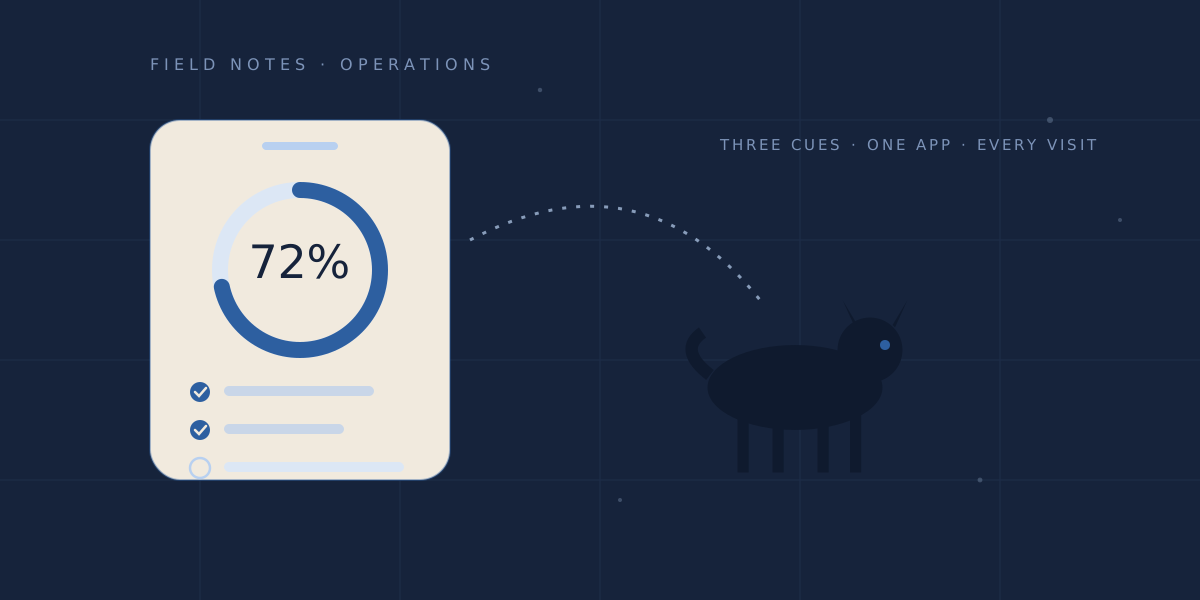
Maya has a text open on her phone and a Labradoodle named Biscuit pulling toward a squirrel. The text is from Biscuit's owner, mid-vacation, and it reads: “Can you keep up his training while we're gone? We just started him on an app.” Maya is a sitter, not a trainer. She has eleven visits today. And she has about four seconds to decide what “keep up his training” is going to mean for the next ten days.
If you walk or sit dogs for a living, you have had some version of that message. Owners are training their dogs more than they used to, and most of them are doing it through an app on their phone. When they hand you the leash, they increasingly hand you a half-finished training project too. The question is not whether you should get involved. It is how to get involved without pretending to be something you are not.
Search “dog training app” and you get a wall of reviews. Every single one is written for the owner training their own puppy at home. None of them are written for the professional standing on the sidewalk with someone else's dog and someone else's training plan. This piece is that missing review. It is the framework I use, the five apps worth knowing, and the exact line where a walker's job ends and a trainer's begins.
01 / Who the reviews forgetEvery dog training app review is written for the wrong reader.
Read four or five roundups back to back and the pattern is obvious. They compare the same apps, Dogo and Puppr and Pupford and Zigzag, on the same axes: which one is friendliest for a first-time owner, which has the cutest interface, which teaches “sit” fastest. Useful, if you own one dog and have all evening. Useless if you handle nine dogs a day and each one belongs to somebody else.
A professional has a completely different set of needs, and no review addresses them. You are not choosing one app for one dog. You are walking into a different training system with every client. Your constraints are consistency across a rotating cast of dogs, the fact that you legally and practically are not a certified trainer, and the reality that your hands are full of leash and poop bags, not a phone. The best dog training app for you is defined by those constraints, not by which one a blogger liked.
Those numbers matter because they tell you where the demand is going. Pet services are the fastest-growing part of the industry, running 8 to 12 percent a year, and within services, training and enrichment grow fastest of all. Owners already spend on this. They already have the apps open. A walker who can plug into that, carefully, is meeting demand that is walking toward them, not away.
02 / The frameworkThe reinforcement layer.
Here is the reframe that makes all of this safe and simple. You are not adding training to your service. You are adding a reinforcement layer: a thin, consistent habit that keeps a dog's existing cues sharp between the owner's sessions. Reinforcement is not training. Training changes behavior. Reinforcement keeps a known behavior from rusting. That distinction is the whole game, and it has three rules.
Rule one: use the app the owner already uses.
Do not bring your favorite app to someone else's dog. Ask which one the owner runs at home and use that. A dog does not care about your opinion of the interface. It cares that the marker word and the reward are identical whether the owner or you is holding the leash. Consistency of cue beats every feature on every comparison chart. If the owner uses Dogo, you use Dogo for that dog. This one rule removes ninety percent of the ways a walker can accidentally undo an owner's work.
Rule two: agree three cues, no more.
Sit down with the owner, in person or over text, and pick a maximum of three behaviors to reinforce. Three. Not the whole curriculum. For most dogs the right three are a sit, a hand touch or “look at me,” and a recall cue. These are the everyday skills that make a walk safer and calmer, they are almost always already established, and they are impossible to get wrong. When you cap it at three, you cannot drift into actual training, which is exactly the point.
Rule three: end every session with proof.
Ninety seconds at the start of the walk, high-value treats, the same marker word every time. Then log it: one line in your visit note saying which cue, how many reps, and how the dog did. Where the app allows a shared clip or photo, add one. The visit note stops being “walked Biscuit, all good” and becomes “3 sits, 4 touches, one clean recall off the squirrel, clip attached.” The owner comes home to evidence. That evidence is what they are really paying for.
The app is not the training. You are the reinforcement. The app is just the tool that makes sure the same three words, in the same order, with the same reward, reach the dog on every single visit.
If you remember one thing from this article, remember that consistency, not the app you pick, is the product you are actually delivering.
03 / The shortlistFive dog training apps, judged like a business owner.
You still need to know the apps, because clients will ask you which one to get, and because some clients arrive with no app at all. I judge them on the criteria a professional cares about: does it use positive reinforcement, will an owner likely already have it, how much does it cost, and can a client actually follow it. Here are the five worth knowing in 2026.
Dogo is the safe default and the one most of your clients will already own. More than 10 million households use it, it is built entirely on positive reinforcement with over 100 exercises, and it offers video feedback from real trainers on the paid tier. It starts free, which means you can ask a client to download it without a sales conversation. If you only learn one app well, learn this one.
Pupford is the one to recommend to budget-conscious clients. Its 30-day foundation course is genuinely useful and much of the app is free, with an Academy subscription around $10 a month for owners who want more. For a walker, its value is that you can suggest it to a new client without asking them to spend anything, and it still teaches clean, reward-based mechanics.
Puppr earns its place on enrichment. Built around a large, well-produced trick library, it is the app I reach for when a dog needs mental work more than obedience, the anxious herding breed who settles better after learning “spin” and “paw.” It runs about $12.99 a month or $99.99 a year, so it is a recommendation, not a default.
Zigzag is purpose-built for puppies, zero to twelve months, with an age-based program that new owners find easy to follow. If you do puppy visits, this is the one to know, because it maps to exactly the developmental window your youngest clients are in. It keeps a nervous first-time owner on rails, which makes your reinforcement job easier.
GoodPup is different in kind, and I include it deliberately. It is not a self-guided library; it is roughly $29.99 a week for live, one-to-one video sessions with a certified trainer. That price tells you what it is: the app you point an owner toward when the dog needs real training, not reinforcement. When you hit the edge of your role, GoodPup, or a good local trainer, is the referral.
The best dog training app for a walker is almost always the one the owner already pays for. Your job is to make it consistent, not to have a favorite.– Marcus T., six years walking and boarding, Denver
04 / Anti-patternsWhen the app is not the answer.
The reinforcement layer works because it is narrow. The fastest way to get into trouble is to let it get wide. Three mistakes turn a helpful add-on into a liability, and each has a clean rule to avoid it.
- Do not contradict the owner's trainer. If a dog is working with a professional trainer or behaviorist, your job is to follow that plan exactly, not to layer your own ideas from a different app on top. Two conflicting systems confuse a dog faster than no system at all. Ask for the trainer's notes and stay inside them.
- Do not market yourself as a trainer. Reinforcing three known cues is a value-add. Advertising “training” when you hold no certification is a different thing, and it can breach your insurance and, in some states, licensing rules. Say what you actually do: you reinforce, you report, you refer. Never promise behavior change.
- Do not let the phone replace the dog. A walk is a safety job first. A handler staring at an app is a handler not watching the road, the other dogs, or the body language in front of them. Do the 90 seconds, pocket the phone, and walk the dog. The app supports the visit; it never runs it.
There is a fourth, quieter line worth naming. Some dogs do not need reinforcement; they need help. Fear, reactivity, resource guarding, and separation anxiety are not obedience gaps, and no app fixes them. When you see one of those, the professional move is not to open Dogo. It is to write a calm, specific note to the owner and recommend a certified trainer or a veterinary behaviorist. Knowing where your job stops is part of doing it well.
05 / The servicePutting the reinforcement layer on the invoice.
Marcus, quoted above, runs a four-walker operation in Denver. Two years ago he started offering the reinforcement layer as a named add-on: a “focus walk” that costs $6 more than a standard visit and comes with a logged training note and a short clip. About a third of his regulars take it. The math is not the point, though the extra revenue is real. The point is what it did to retention.
Clients who can see progress in their visit reports cancel far less often. A training note is proof of care in a way that “had a nice walk” never is, and it gives the owner something to show a partner or a family member who is footing the bill. Owners who feel the value stay, and they refer, because a walker who is visibly helping the dog get better is a story people tell their friends at the dog park.
You do not have to charge for it on day one. Build the habit first: use the reinforcement layer on a few willing clients, get the visit notes looking sharp, collect a couple of clips owners loved. Once you can point to results, the add-on sells itself, and you can price it as the small, real piece of value it is. Reinforcement done consistently is one of the few upsells in this business that makes the dog's life better and your revenue higher at the same time.
06 / TakeawaysTake this with you.
If you do one thing this week, adopt rule one: for every dog whose owner uses a dog training app, install the same app and cap yourself at three cues. That single move turns a vague “keep up his training” text into a clear, safe, repeatable job you can do in 90 seconds a visit.
Maya, back on the sidewalk with Biscuit, texted the owner two questions: which app, and which three cues. By the end of the week her visit notes had clips of Biscuit nailing a recall off a squirrel he used to chase. The owner came home to proof, renewed for the fall, and told two neighbors. None of it required Maya to be a trainer. It required her to be consistent, which is the one thing an app is genuinely good at helping you be.
– DR, at a picnic table in Prospect Park, Brooklyn