Forty products hang on the training wall of any big pet store, and at least thirty of them exist to be bought, not used. Head halters next to no-pull harnesses next to five kinds of clicker next to a shelf of “calming” sprays. A new walker or a first-time owner stands there, wallet open, with no way to tell the two tools that will change a dog's behavior from the thirty-eight that will sit in a drawer.
The lists online do not help, because most of them are written to sell the products in them. Count the affiliate links in any “top 12 dog training tools” roundup and you have found its real purpose. They rank tools by how photogenic they are, pad the count to reach a round number, and never once ask the only question that matters: what does this thing actually do?
I am not a trainer. I ran a small walking, sitting, and boarding operation in Brooklyn for six years, and I hired one, a trainer named Renata, in year four. Her working kit fit in a waist pouch and a small canvas bag, and it never changed no matter which dog she was handling. Watching her use it taught me that every training tool worth carrying does one of four jobs, and that once you sort them that way, the wall of forty collapses into a short, honest list.
01 / The problemWhy the tool lists mislead.
The typical dog training tools article makes three mistakes, and they compound. It mixes categories, so a clicker (a communication device) sits in the same numbered list as a ramp (a mobility aid) and a chew toy (an enrichment item), as if they were interchangeable. It optimizes for length, because “top 12” reads more authoritative than “the 5 that matter,” even though the extra seven are filler. And it writes for a person with one dog, not for an operator who has to make the same tool work safely across a schedule of very different animals.
That last point is where the consumer advice and the operator reality split hardest. A tool that suits dog owners working a single calm Labrador at home is a completely different proposition in the hands of a walker managing eight dogs, or a daycare handler meeting a nervous new intake for the first time. A first-time owner running a puppy through basic obedience training can tolerate a fiddly gadget. The operator needs a tool a new staff member can pick up and use without a disaster. Those are not the same shopping list.
So this guide throws out the count and the affiliate links, and sorts instead by function. Four jobs, in the order you use them.
02 / The frameworkThe Four-Job Toolbox.
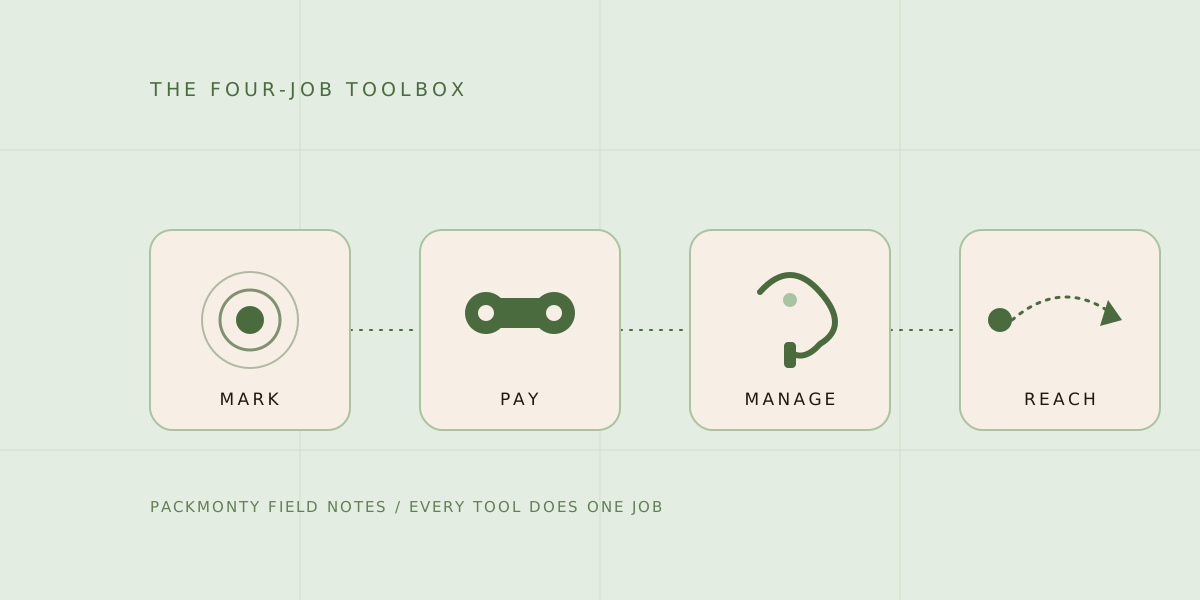
Every training tool that earns a place in a working kit does exactly one of four things. It marks a moment, it pays for a behavior, it manages the dog's body, or it reaches past arm's length. That is the whole taxonomy. A tool that does none of those is decoration. A tool that claims to do all four is usually a gimmick.
- Mark. Tell the dog “yes, that,” the exact instant it happens. The marker is the tool that makes every other tool work.
- Pay. Make the marked behavior worth repeating. Food, mostly; play, sometimes.
- Manage. Control where the body is and what it can do, without a fight. Collars, harnesses, leashes, crates, muzzles.
- Reach. Keep control and reliability once the dog is at distance or off-leash. Long lines, whistles, a portable place to send them.
Before a tool goes in the bag, Renata ran it through what I came to call the Toolbox Test, three gates every kit tool has to clear:
- One job. It does one of the four things well. A tool that tries to be a clicker and a leash and a treat dispenser does all three badly.
- Many dogs. It works across the range of animals you actually handle, not just the easy ones.
- Safe handover. You can put it in a new handler's hands and trust them not to hurt a dog or themselves with it on day one.
Most of the pet-store wall fails at least one gate. What survives is a surprisingly short kit. Here is each job, and the tools that pass.
03 / MarkJob one: mark the moment.
The single most important tool in training is also one of the cheapest: a marker. A marker is a signal, a click or a short word, that tells the dog the precise instant it did the thing you want. It works because of classical conditioning. Pair the sound with a treat enough times and the sound itself becomes meaningful, a promise that pay is coming. After that, the marker lets you capture a behavior in the exact millisecond it happens, then deliver the treat a second later without blurring which action earned it.
That timing is the entire point. A dog lives in the moment. If you reward three seconds after the sit, you may be rewarding whatever the dog did three seconds later, which is often standing back up. The marker closes that gap. It is the difference between a dog that learns a clean sit in a week and one that stays confused for a month.
Two tools do this job.
- The box clicker. A few dollars. Its advantage is consistency: the sound is identical every time and carries no emotion, so it is slightly more precise for teaching brand-new behaviors. Keep one on a wrist coil so it is never buried in a pocket.
- The marker word. A short, sharp word you say the same way every time, “yes” or “good” being the usual picks. It costs nothing, is always with you, and cannot be dropped in a puddle. The trade is that your tone varies, so it is a hair less precise than the click.
For a working kit, carry both: the clicker for teaching new commands and tricks where precision earns its keep, the marker word for everyday cues on the move. Clickers cost so little that keeping several charged around the van or the facility is worth it, so a lost one never stops a session. Neither tool is better in the abstract. Your timing is what matters, and timing is free.
The clicker in my pouch cost three dollars. It has taught more dogs than every gadget I ever regretted buying.— Renata, on the cheapest tool in the bag
04 / PayJob two: pay for it.
A marker is a promise, and the promise has to be kept. The paying job is reinforcement: giving the dog something it wants the instant after the marker, so the behavior is worth repeating. For the overwhelming majority of dogs, that means food, and not just any food.
The currency has to be worth working for. A dry biscuit the dog gets in its bowl anyway will not compete with a passing squirrel. High-value treats, small, soft, smelly, and reserved for training, are what hold attention in a distracting environment. Soft matters because the dog can eat it in a second and get back to work; a crunchy treat that takes twenty seconds to chew kills the rhythm of a session. Small matters because you will give a lot of them and you do not want to overfeed. A good rule is to cut everything to pea-size and to reduce the dog's regular meal on heavy training days.
The delivery tool is the treat pouch. It sounds trivial until you have tried to run a session digging treats out of a jacket pocket while a dog loses focus. A pouch that clips at the waist, opens with one hand, and shuts with a magnetic hinge so treats do not spill turns reward delivery from a fumble into a reflex. For a handler moving between dogs all day, that speed is the whole value.
One more paying tool earns a place for some dogs: a tug toy. A minority of dogs, many working breeds among them, will work harder for a game of tug than for any treat. For those dogs, a sturdy tug on a handle is a reinforcer you can carry, and it doubles as a way to burn energy that food never will. Keep such toys for the dogs who light up at them; forcing tug on a dog that does not care for it just wastes a hand. Fancier reward toys exist, from squeaky launchers to treat-dispensing balls, but one good tug covers the job for the dogs that want it.
05 / ManageJob three: manage the body.
The managing job is the biggest category and the one where the pet-store wall does the most damage. Management tools control where the dog's body is and what it can do: they prevent the dog from practicing the behavior you do not want while you teach the one you do. The guiding principle, and the one the profession has settled on, is to use the least intrusive tool that keeps everyone safe.
The core managing kit is short and unglamorous.
- A flat collar. For ID and everyday attachment. Not for correction, just for holding a tag and clipping a leash on a mannerly dog.
- A well-fitted harness. A Y-front harness that clears the shoulders spreads pressure across the chest instead of the throat. A front clip gives you a gentle steering point for dogs that pull, without teaching pain.
- A six-foot leather or BioThane leash. A fixed length you can work at, easy on the hands, and consistent every session. This one leash handles the vast majority of training.
- A crate. Not a cage. A den for rest, for safe travel, and for house-training, introduced slowly so the dog chooses to settle there.
- A basket muzzle, for the dogs that need one. A well-conditioned muzzle lets a dog pant, drink, and take treats while keeping a handler safe during vet visits or reactive-dog work. Muzzle training is a kindness, not a punishment.
Then there is the argument everyone lands on eventually: the aversive tools. Prong collars, choke chains, and electronic collars are the training collars that manage the body by adding discomfort, and they are the most divisive subject in the trade. The honest state of play in 2026 is that the profession is split. The Certification Council for Professional Dog Trainers holds that positive reinforcement should be the primary approach and that aversive tools should only be considered after reinforcement-based options have been genuinely exhausted, with evidence-based justification. A large body of research links aversive tools to raised stress and, in some dogs, increased aggression.
For a business, there is a cleaner test than the ethics debate, and it points the same way. Any tool you put on a client's dog is a tool you have to explain: to a nervous owner watching, to a new staff member you are training, and to your insurer if something goes wrong. A prong or an e-collar is a tool you have to defend. A flat collar and a harness are tools nobody questions. In a service where trust is the product, a tool you cannot comfortably defend is a liability whether or not it works in expert hands.
Match the tool to the least intrusive thing that keeps everyone safe, then stop. The kit that a nervous client watches you use, and a new hire can use on their first day, is the kit that scales.
If a tool only works in expert hands, it is the wrong tool for a team.
06 / ReachJob four: reach past arm's length.
The job the consumer lists forget entirely is reach: keeping control and reliability once the dog is beyond the length of a normal leash. A dog that sits perfectly at your side and ignores you completely across a field has not generalized the behavior. Bridging that gap is its own job, and it needs its own tools.
- The long line. A fifteen to thirty-foot line, usually biothane or nylon, that lets a dog explore at distance while you keep a physical safety net. It is the single best tool for building reliable recall, because it lets you practice at real-world distances long before you trust an off-leash cue. It is emphatically not a retractable leash, which we will get to.
- The recall whistle. An acme whistle carries further than your voice, sounds identical whoever blows it, and never gets tired or frustrated the way a shouted name does by the fifth repetition. Charge it like a marker, whistle then treat, and you have a recall cue any handler on your team can use consistently.
- The place mat. A portable mat or bed that means one thing: settle here until released. Because it travels, the dog generalizes “place” to any environment, which is worth its weight in a busy home, a boarding setup, or a cafe stop on a long walk.
These three are what turn a dog that behaves in the living room into a dog that behaves in the world. For an operator, the whistle in particular is a quiet superpower, because it makes recall a tool the whole team shares rather than a trick that only works for the one handler the dog happens to love.
07 / By problemThe tool for each problem.
Most people do not shop by job. They shop by a problem: the dog pulls, it will not come back, it ate the couch. So here is the same kit mapped the other way, from the behavior to the tool that actually helps, with each one pointing back to the job it is really doing.
Pulling on the leash. The management fix is a front-clip or no-pull harness that turns the dog gently back toward you instead of rewarding the forward lunge; for a strong dog, a head halter gives you power steering, and a martingale collar tightens a little without choking. A slip lead is the quick-control option handlers keep for intakes. But none of those teach loose-leash walking on their own. The real fix is marking and paying the dog for the moments the leash goes slack.
Ignoring recall. This is the Reach kit doing exactly its job: a long line keeps the dog safe while you practice, and a charged recall whistle gives you a cue that carries and never sounds annoyed. Distance is a training problem, and the long line is the tool that lets you solve it before you trust the dog off-leash.
House-training accidents. Potty training is a management problem, not a discipline one. A correctly sized crate and a playpen set the boundaries that make accidents unlikely in the first place, so you can reward the dog for getting it right rather than scold it for getting it wrong. No gadget substitutes for the crate here.
Barking and reactivity. The honest tool is distance plus a basket muzzle for safety where a dog needs one, paired with treats to counter-condition the trigger. A bark collar treats the symptom and often raises the dog's stress; the management-and-pay approach treats the cause.
Chewing and mouthing. Redirect the mouth onto something legal. Chew toys, tugs, and treat-dispensing dog toys give the dog an outlet and buy you a little enrichment while you teach an off switch. The tool is not a punishment for chewing; it is a better thing to chew.
Jumping up. This is the honest one: no tool fixes jumping. A leash to manage the dog and a marker to pay four paws on the floor is the whole kit. Anyone selling you a device for it is selling you a device.
Notice the pattern. Every problem routes back to one of the four jobs, usually manage-and-pay. The behavior just tells you which job to lean on hardest.
08 / RepsThe reps behind the tools.
A perfect kit does nothing sitting in a bag. Tools amplify training; they never replace it. The clicker does not teach the sit, you do, and the dog only learns it through repetition. A few numbers govern how the kit actually earns its keep.
Keep sessions short. Ten to fifteen minutes, two or three times a day, beats one long grind every time. Dogs learn in reps, not marathons, and short training sessions keep focus high and frustration low for both of you. The pouch and the clicker are built for exactly this: quick, frequent, low-friction exercises you can run between other things.
Proof against the three D's. A cue the dog nails in the kitchen falls apart in a park, and that is not disobedience, it is a training gap. Raise difficulty one variable at a time: Distance, Duration, and Distraction. The long line and whistle exist precisely to proof recall against distance and distraction, which is why they belong in the kit and a fancier collar does not.
Reward more than feels necessary. Early in a behavior, pay every single rep. The treats and the marker are how the dog decides the exercise is worth doing; thin the rewards only once the behavior is solid. Under-paying is the most common reason a promising skill stalls.
Reach for reps, not a stronger tool. When a dog gets stuck, the operator temptation is to escalate the hardware. Almost always the real fix is more reps, cleaner timing, and the same cue every time. Consistency is a tool. So is patience. Neither shows up on the pet-store wall, and both matter more than anything that does.
There is a quieter reason the reps matter: the bond is built in them. That bonding, not the hardware, is what makes a dog want to work with you. A dog that works for you because the sessions are worth its while is steadier than one that works to avoid discomfort, and that relationship is what makes the whole kit reliable. Once the basics hold, structured outlets like agility and scent work are a good place to send all that focus, a different aisle of equipment worth buying only after the four jobs are second nature.
09 / Anti-patternsWhat stays on the shelf.
Knowing what to leave behind is half of a good kit. Three categories of tool look useful and rarely are.
Retractable leashes. They fail the framework twice over. They teach a dog that pulling extends the leash, which is the exact opposite of the loose-leash walking you want, and they are a genuine safety hazard. US emergency rooms treat over sixteen thousand dog-leash injuries in a year, and roughly a quarter of leash injuries involve a finger, often caught in a thin cord suddenly pulled taut. For a handler managing more than one dog, a retractable leash is close to disqualifying. Use a fixed leash for control and a separate long line for distance; never split the difference with a retractable.
Gadget tech. The smart clicker that pairs with an app, the treat-dispensing camera, the wearable marker bracelet. Most of these solve a problem you do not have while adding a battery, a subscription, or a failure point. A three-dollar box clicker does the marking job as well as a fifty-dollar connected one. Spend the difference on better treats.
One tool per problem. The instinct to buy a new device for every behavior, a special collar for pulling, another for barking, a spray for jumping, ends in a drawer of single-use gadgets and a dog no better trained. Almost every common problem yields to the same four-job kit used with better timing. The tool was rarely the missing piece.
10 / ApplicationBuild the kit.
Marcus runs a thirty-dog daycare and boarding operation outside Austin, and when he added structured training as a paid service he made the mistake everyone makes: he bought the wall. Two hundred dollars of collars, three brands of clicker, a head halter nobody knew how to fit. Six months later, his handlers were using a flat leash, a treat pouch, a clicker, and a long line, and everything else was in a bin in the back.
The kit that survived is the one to start from. Built for one handler, it costs less than a single premium collar, and it covers all four jobs.
Buy one kit per handler, not one kit for the business. Tools that get shared between people go missing, and a marker only works if the person holding it trusts it. Standardizing the kit across a team also means any handler can step into any dog's session and use the same cues, which is the operational version of the whole point: a system, not a personality.
Where the kit lives matters too. The treats, the clicker, and the whistle belong on the handler's body, reachable in under a second. The crate, the place mat, and the spare long line live at the facility or in the van. And the record of which dog responds to what, which treat holds a fussy eater, which dog needs the muzzle conditioned, belongs somewhere every handler can see it, which is exactly the kind of note we built PackMonty to keep so it does not live in one person's head.
11 / BuyingBuying the kit without the upsell.
Knowing the four jobs is half the work. The other half is buying the gear without the store talking you into forty things you do not need. A dog training equipment shop is built to sell, and its whole layout works against a short list. Four habits keep you honest.
Ignore the sort order. The store wants you sorting a collection alphabetically or by price, because the a-to-z and z-a-by-price toggles exist to slide you off the item you came for and onto an accessory or a bundle. Search the specific product, add it to the cart, and check out. Those toggles are merchandising, not buying advice.
Time the deals, do not chase them. Every store runs a sale, a newsletter discount, and a rotating deals banner. If you are equipping a team, it pays to sign up for one shop's newsletter and place your orders when clicker two-packs and long lines go on sale. Just never let a discount add items to the kit that were not one of the four jobs to begin with.
Judge the company, not the catalog. The difference between a long line that lasts and one that frays in a month is the seller, not the price. Look at how the company handles shipping and returns, read the reviews on the actual product rather than the homepage, and glance at their Instagram to see whether real trainers and dog owners use them. A shop that takes Visa and ships overnight but sells junk straps is worse value than a slower one whose gear survives a full season of daily use.
Buy for the goal, not the aisle. A puppy learning its first commands and a little socialization needs the mark-and-pay half of the kit far more than the manage-and-reach half; a dog you are drilling on obedience training, recall, and a few useful tricks needs the long line and whistle most. Let the training goal, not the store's categories, set the order you buy in. The accessories aisle will still be there next month.
12 / Start hereTake this with you.
If you buy one thing this week, buy a three-dollar clicker and a bag of soft treats, and spend ten minutes charging the marker: click, treat, click, treat, until the dog's head snaps toward you at the sound. That single tool, used with good timing, will out-train every gadget on the wall. The rest of the kit fills in the other three jobs as you need them.
And if you run an operation and you are reading this to equip a team rather than one dog, the four jobs give you a buying policy: one marker, one way to pay, the least intrusive way to manage, and one way to reach past arm's length, per handler, standardized. Skip the wall. The dogs never needed most of it, and neither do you.
The FAQ below covers the quick questions, from what a starter kit should cost to where clickers beat a marker word. Everything else is just timing and reps.
— DR, charging a clicker on a Brooklyn stoop