Priya was forty minutes into a Tuesday morning walk in Salford when a refuse lorry reversed out of a side street directly behind her. The Lurcher she was walking, a quiet six-year-old called Cooper, tucked his tail, dropped low, and started to pull hard for home. He had walked past that exact junction every morning for eight months. Today it was different.
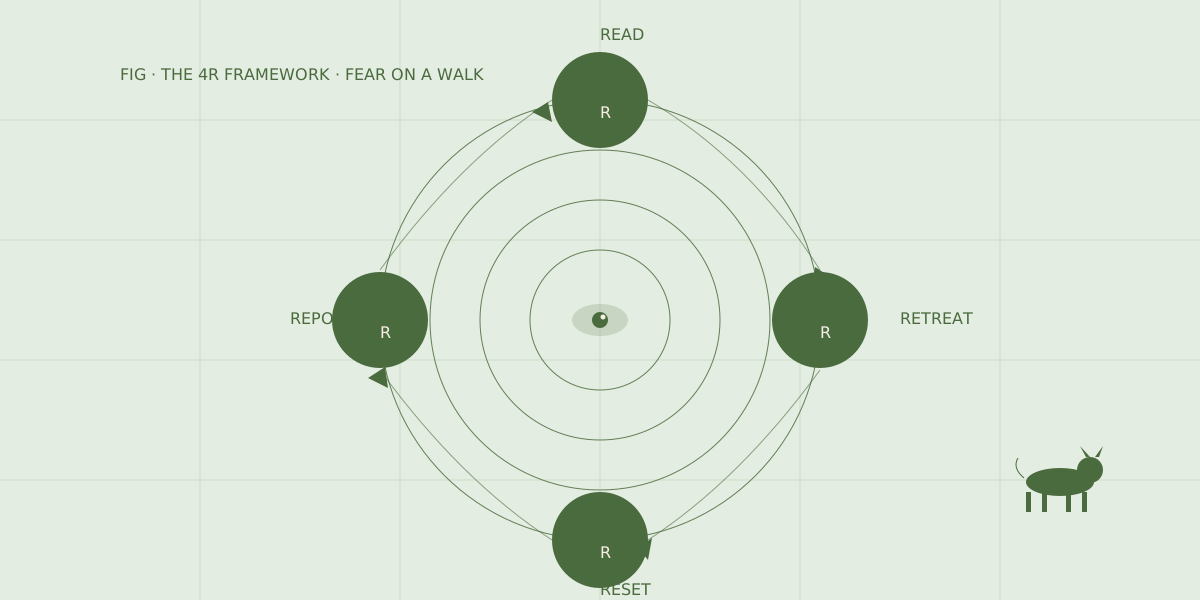
What happened in the next ninety seconds is the difference between a walker who keeps the client for two more years and a walker who loses them in a polite email on Friday. Priya did four things in sequence: she read the signals as they appeared, she retreated to a calmer distance, she reset Cooper with a known cue and a high-value treat, and she wrote it up properly in the report. None of it was complicated. All of it required her to know what she was looking at, and to know what to do before her own adrenaline got in the way.
This piece is the operational guide for that ninety seconds. The framework works for puppies, adult pets, and senior dogs; for the dog you have known for two years and the dog you met for the first time this morning; for the chronically anxious rescue and the confident senior who has just developed a new fear late in life. It works on busy roads, in quiet parks, at the veterinarian's door, and on the unexpected day when something familiar suddenly becomes terrifying. The signs to read, the methods that work, and the process for handling fear are the same across breeds, environments, and life stages. If you are earlier in the work, our dog tricks article covers the foundation cues that the “Reset” step of this framework depends on, and the tips in both pieces stack.
01 / StakesWhy this matters for walkers and sitters.
Almost every walker we work with has a story like Priya's. Most have several. The dog who was fine on Monday and refused to leave the front step on Tuesday. The puppy who used to love the post van and now flinches at every white vehicle. The rescue who was managing for six months and then met a particular man in a particular hi-vis vest and never quite forgot.
Fear, and the spectrum of fears that come with it, is the single most common behaviour (or behavior) problem walkers face on the job. It is also the most under-trained: most walker training, where it exists at all, covers leads and leashes, harnesses, recall, and basic obedience. The signs of fear, the behaviors fear produces, and the methods for managing it all sit outside that standard syllabus. Fear handling shows up in week one of the job and gets handled by instinct. Instinct is uneven, and lots of damage gets done in the gap.
The dogs you work with can be fearful for several reasons: genetic predisposition (some lines and breeds are simply more anxious; the Siberian Husky, Greyhound, German Shorthaired Pointer, Bernese Mountain Dog, Border Collie, and Standard Poodle are over-represented in published behaviour research on idiopathic fear), undersocialisation (or undersocialization, depending on your part of the world) during the puppy window of roughly 3 to 14 weeks, trauma from a specific incident, or an underlying medical issue. The last category is worth pausing on: pain (hip dysplasia, dental disease, ear infection), vision or hearing loss, thyroid disease, and age-related cognitive decline can all reduce a dog's tolerance for the world. A dog who was confident a month ago and is now fearful has, more often than not, something physical going on first. Owners and vets should rule out medical causes before assuming the change is behavioural.
You will rarely know which cause it is, and it does not change what you do in the moment. But it is worth saying out loud because it explains why fear is not a training failure on anyone's part. It is a brain doing its job in a way that is now inconvenient.
The common triggers on a walk are predictable enough to memorise. Strangers, particularly tall men in hi-vis vests. Loud noises and unfamiliar sounds: refuse lorries, motorbikes, sirens, fireworks, a backfire. Unfamiliar sights: a sudden flash of high-vis at the bend in the road, a kite, a wheelchair, a parked van where there has never been a parked van before. Other animals: dogs, cats, foxes, livestock through a fence. Unfamiliar environments: a new park, a building site, a road closure. And rarely-encountered surfaces: shiny floors, metal grates, glass walkways. Untreated fear can also escalate into reactive aggression, where the dog snaps, lunges, or air-bites; the same dog can be confident in one environment and fall apart in another. Calling a dog timid, shy, frightened, or uneasy across the board is rarely useful. Better to know which triggers, in which order, and at what distance.
The cost of mishandling a fear incident is not just the moment itself. It is the next walk, and the walk after that, and the slow generalisation of one bad experience into a permanent association: lead means anxiety, walker means anxiety, leaving the house means anxiety. A dog who is dragged toward their trigger learns that their walker is unsafe. A dog whose fear is read early and respected learns that their walker is the most reliable thing in the world.
The job during a fear incident is not to fix the dog. It is to keep the dog sub-threshold long enough that the fear does not generalise. Fix is a behaviourist's job. Manage is the walker's job. The 4R framework below is a management protocol, not a treatment plan.
02 / The first RRead the signals before they escalate.
Most dogs telegraph fear in a sequence of small signals starting eight to fifteen seconds before they fully react. The window is short but it is real, and once you train your eye to spot it the rest of the framework becomes possible. The classic ladder, as published by the late Kendal Shepherd, runs roughly from quietest to loudest in this order: yawn, lip lick, head turn, body turn, walk away, freeze, growl, snap, bite. Most of the dogs you work with will stop at the first three or four signals if you give them the chance.
The seven signals to memorise. These are the ones you will see most often on a walk, in roughly the order they tend to appear.
- Whale eye. The whites of the dog's eyes showing sideways as they keep their head fixed but track the trigger with their pupils. This is the single highest-precision early signal.
- Lip licking outside of food contexts. A quick tongue flick across the lips when there is no food in the room. Often paired with a head turn. Sometimes you will also see brief flashes of front teeth in a closed-mouth grimace, an early appeasement signal.
- Yawning when not tired. A small displacement behaviour. Often missed by walkers who assume the dog is just sleepy.
- Low, slow tail wag. Tail down, wagging at maybe one or two beats per second. Fear tails do not look like happy tails; the speed, height, and direction all tell you different things.
- Ears pinned back. Particularly in breeds with naturally erect ears. The ear position tells you fast.
- Sudden freezing. The dog stops dead and stares. Sometimes for a fraction of a second, sometimes longer. Always meaningful.
- Shaking off when not wet. A full body shake on a dry day is the dog discharging stress. Treat it as a marker that something has just stressed them.
- Panting, pacing, drooling, or hypervigilance. The fuller-body symptoms. If a dog is panting on a cool day, pacing in tight circles, drooling outside of food contexts, or scanning constantly with dilated pupils and shallow breathing, they are already stressed and on the way to a reaction. Whining, whimpering, soft grumbling, trembling, or trying to hide behind your legs all belong on this list too.
You do not need to see all seven. Two of these signals appearing within five seconds of each other is enough to act. Three is enough to act fast.
The other concept worth knowing is trigger stacking. A dog who can normally walk past the postwoman with mild interest may lunge at her after they have already met a loud van, a barking spaniel, and an unsteady toddler in the previous ten minutes. Stressors compound. The cortisol from one event has not yet cleared when the next one arrives, and the dog reacts at the level the stack predicts, not the level any single trigger would. If a dog seems to be over-reacting to something small, look back five minutes. The real cause is usually behind you.
03 / The second RRetreat to a sub-threshold distance.
The single most useful behavioural concept on the walk is the distinction between sub-threshold and over-threshold. A dog at sub-threshold can see the trigger, hear it, smell it, but is still capable of thinking, taking food, looking at you, breathing normally. A dog over-threshold cannot do any of those things; they are fully into a fight, flight, freeze or fawn response, and learning has stopped.
Your job in step two is to move the dog from over-threshold (or pre-threshold) back to sub-threshold by changing distance. The cleanest moves are physical, simple, and require no apologising:
- Cross the road. Usually enough. Doubles the distance immediately, breaks the visual line, gives you a sight-block from passing traffic.
- U-turn into a side street. Better than crossing if the trigger is mobile (an approaching dog, a runner). Removes the trigger from view entirely.
- Position yourself between the trigger and the dog. Step in so your body breaks the sight line. Useful when distance is not possible (narrow pavement, queue at a crossing).
- Stop walking. Plant your feet and wait. Surprisingly often the right answer. Movement is part of the stimulus.
Distance is the universal currency of behaviour work. There is no situation on a walk where adding distance from the trigger (other humans, other animals, traffic, environmental noises) is the wrong move, and there are many where it is the only move. Your aim is not zero distance from the trigger, ever. Your aim is the distance at which the dog (or any pet you handle) can still take a treat from you and turn their head when you cue. Each interaction with the trigger sets the next one's baseline; the more distance you can buy in a single moment, the easier the rest of the walk gets. Other people are particularly common triggers in city walks: men more than women, men in uniform more than men in casual clothes, children running more than children walking, and faces obscured by hoods or hats more than visible faces.
Distance is the universal currency of behaviour work. Spend it generously.PackMonty Field Notes, editorial position
04 / The third RReset with a known cue.
Once at sub-threshold distance, your goal is to reroute the dog out of the fear circuit and into the learning circuit. The cleanest way to do that is to ask for a behaviour they already know well, in a tone they already trust, and reward it with something genuinely high-value. The cue does not need to be clever. It needs to be reliable. Positive reinforcement is the only mechanism that builds progress here; anything else just compounds the dog's discomfort and slows their recovery to a calm state of mind.
The four cues that work best, in rough order of reliability under stress:
- Touch. Nose to closed fist. Mechanical, simple, hard to get wrong. The single most useful reset cue on a walk.
- Find it. Scatter five to ten high-value treats on the ground and let the dog sniff them out. Sniffing is calming in itself; the act of low-intensity scent searching shifts the nervous system out of arousal in about thirty seconds.
- Watch me. Eye contact on cue. Works well when you have time but harder to get if the dog is over-threshold.
- Sit, or hand target into a sit. Useful when you need the dog to stop moving and settle in place for a moment.
Use a high-value treat. Not kibble. Freeze-dried liver, plain cooked chicken, whatever the owner has approved as a high-reward food. The treat does two jobs at once: it pays for the cue, and it pairs the trigger with something positive (counter-conditioning), which is exactly what a proper behaviour modification programme would be doing in a controlled session. You are giving the dog a small, useful dose of the same medicine in the moment.
05 / The fourth RReport the incident in the visit notes.
Most walkers handle the moment well and then under-report it. The visit note ends up as “Cooper was a bit unsettled today, all fine,” which is almost useful but not quite. The owner does not see the pattern, the next walker does not know to watch for it, and the behaviourist (if one ever gets involved) has no usable data.
Five facts in five lines is the right level of detail. When, where, what triggered it, how the dog reacted, what you did. No interpretation, no apology, no blame. The example we use internally:
That note gives the owner three things at once: confidence that you handled it, useful pattern data for them and any future behaviourist, and a paper trail for your own insurance if needed later. Send it as part of the standard visit report on the day, not in a separate panicked text message.
06 / BetweenBuild confidence between incidents, not just during them.
The 4R framework is what you do during a fear moment. What you do between moments matters more for the long-term arc. A dog who has built five new positive experiences in the week since the last incident has a different nervous system at the next walk than one who has been left to ruminate.
Five proactive things any walker can build into the visit cadence to make the dog more resilient. None of these is a behaviour modification programme on its own, but together they raise the floor:
- Trick training in slack moments. Five minutes a day of touch, sit, watch me, or find it. The trick is not the point. The compounding bond is. Our piece on eight dog tricks any walker can teach in five minutes covers the foundation cues that double as fear-recovery resets.
- Scent work and sniffing walks. Low-intensity scent searching shifts the canine nervous system out of arousal in about thirty seconds, by published measures. A “sniffari” (a 30-minute walk where the dog leads with their nose and you follow) is one of the highest-yield welfare activities a walker can offer.
- Targeting and structured play with toys. Hand targets, nose-to-cone, simple agility-style obstacles in the garden or park, food puzzle toys, tug games with appropriate toys. The dog learns that the world contains predictable, rewardable jobs they can do. Cornell, the AKC, and most of the cohort identify these interactions as a core confidence-building tool, and a series of positive, structured interactions across the week is one of the most reliable ways to build long-term confidence.
- Safe walks at safe times. If the dog struggles with the after-school window of buggies and children, walk earlier. If a busy high street is the trigger, route round it for three weeks. Avoidance is not weakness; it is sub-threshold management at a longer time horizon.
- Predictable, consistent visit structure. Same arrival routine, same harness sequence, same departure ritual. Dogs read predictability as safety. The walker who always arrives the same way is the walker the dog runs to the door for.
- Respect the safe space the owner provides. Many owners of fearful dogs create a designated safe space at home, a crate with a blanket cover, a quiet corner, a spare bedroom, often paired with an Adaptil diffuser. Learn where it is, never call the dog out of it, and if the dog retreats there mid-visit, treat that as a successful self-regulation, not a failure of the walk. Cornell's veterinary behaviour team and most shelter rescue protocols name the safe space as one of the highest-leverage tools an owner has.
Confidence is not a quality you train into a dog. It is a side effect of repeated successful outcomes. A walker is in a privileged position to deliver that, four to ten times a week, in a controlled environment. That is the long compound bet.
07 / PatternsCommon types of fear you will see on the job.
Five named patterns make up roughly 80 percent of fear incidents we hear about from walkers. Knowing the pattern shapes the response. None of these is your fix to make as a walker, but recognising the pattern helps you have a useful conversation with the owner and the behaviourist if it gets to that point.
Noise phobia, including thunderstorm and firework fear.
By veterinary survey, somewhere between 15 and 30 percent of dogs show meaningful noise sensitivity. Common triggers include thunderstorms, fireworks, gunshots, refuse lorries, sirens, vacuums, and motorbikes. The defining sign is that the fear is not tied to a specific location, the dog can be terrified in their own garden or living room. Noise phobia is one of the categories most responsive to a combination of behavioural work and medication, so a vet-behaviourist referral is often the right next step.
Separation anxiety.
The most common specific anxiety in companion dogs, by the AAHA's 2024 estimate roughly 14 to 20 percent of dogs show some form of it. As a walker you will rarely see separation anxiety in its acute form (you arrive, the owner is gone, the dog is already past the worst of it) but you will see the aftermath: panting, drooling, destroyed soft furnishings, urine accidents, scratch marks on the door. Document what you see, ask the owner if they have CCTV footage of the early minutes, and recommend a behaviourist if the pattern repeats.
Stranger fear and stranger danger.
Dogs who are fine with their owner's family but reactive to unfamiliar people on the walk. Often worse with men than women, worse with people in uniform, worse with hi-vis, worse with hooded faces. The fear can be from undersocialisation in puppyhood, a trauma, or just heritable wariness. Management is distance, distance, distance, and the Reset cue. Treatment is a behaviourist-led counter-conditioning programme over weeks.
Vet visit fear.
A specific category worth knowing because it shows up in your handover with the owner. A dog who has had a difficult vet experience can generalise their fear to the smell of antiseptic, to people in scrubs, to the act of being in a car going somewhere new. As a walker you will sometimes be asked to handle a vet appointment as part of a sitting brief, treat it the way you would any high-stakes walk: extra distance, extra rewards, the calmest version of yourself.
Resource guarding and pain-related fear.
Two categories that are easy to mistake for general fear. A dog who growls when you reach for the lead may be guarding the lead, or in pain at the collar. A dog who flinches at a hand near the face may have an ear infection. Always ask the owner about recent medical events when fear changes pattern. A dog who was confident a month ago and is now fearful has, more often than not, something physical going on first.
08 / MistakesAnti-patterns, the four things never to do.
Four habits we see repeatedly across walkers who are otherwise excellent at their job. Each of them makes fear worse, and each is easy to avoid once you know to watch for it.
- Do not flood the dog. “Just walk them past it, they need to learn it's nothing” is the most expensive sentence in dog handling. Flooding is the technical term for forcing exposure above threshold, and it reliably escalates fear in roughly 70 percent of cases by published behaviour-modification studies. The dog learns that the trigger is unavoidable and that you are unsafe.
- Do not tighten the lead (or leash) in response to fear. A taut lead transmits your stress directly to the dog and removes their ability to add distance themselves. Keep a loose lead even when, especially when, you are working through a fear moment. Your hand position matters as much as your voice, and leash tension is one of the clearest forms of body language a dog reads.
- Do not reassure with high cooing. “It's okay, sweetheart, it's fine, you're fine” in a high anxious voice is, to a scared dog, a confirmation that the situation is not fine. Use a flat calm voice, or no voice at all. Action matters more than words; cue the touch, give the treat, move on. Comfort, in this moment, is delivered through your body language, not through your voice. Your reassurance to the dog is that you are calm enough to keep walking.
- Do not pat the dog's head from above. Reaching for a scared dog's head from above triggers the same threat response a stranger does. If you must touch, scratch the chest or shoulder from the side. Better: do not touch. The dog does not need a cuddle in the moment, they need distance and a job.
- Never use punishment for fear behaviours. No corrections, no leash pops, no “no!” in a sharp voice, no rattle cans, no spray bottles. Punishment teaches the dog that the trigger predicts both fear and consequences from you, and reliably escalates the underlying behavior. The cohort literature is unanimous on this: punishment for fear is the single most reliable way to make it worse. Calm body language, generous praise for the smallest right answer, and a great deal of patience are the only tools that work.
09 / AidsCalming aids and medications: what owners may already be using.
A walker will encounter dogs already on a calming protocol, especially for noise events, separation anxiety, and vet visits. You are not the prescriber, but knowing the landscape lets you ask the right onboarding questions and avoid undermining a treatment the owner is paying for. Five categories to know:
- Pressure wraps. The ThunderShirt is the best-known. The premise is gentle, constant pressure (like swaddling) reduces arousal. Evidence is mixed but harmless. If the owner says “put the ThunderShirt on if there are fireworks,” do it.
- Pheromone diffusers and sprays. Adaptil DAP (Dog Appeasing Pheromone) is the dominant product, available as a plug-in diffuser for the home, a spray for cars and crates, and a collar. The pheromone mimics the one a nursing mother releases and has reasonable evidence for reducing anxiety in vet, kennel, and noise contexts.
- Calming supplements. L-theanine (an amino acid found in green tea), Zylkene (a milk-protein derivative), Anxitane, and an expanding range of CBD products. These are over-the-counter and the evidence varies; treat them as part of the owner's protocol, never give them on your own initiative.
- Prescription medications, situational. Trazodone and gabapentin for noise events, vet visits, and short-duration stressors. Alprazolam (Xanax) is sometimes used for storms. These are vet-prescribed and the owner will tell you the dosing schedule on the onboarding form.
- Prescription medications, ongoing. Fluoxetine (Prozac) and sertraline (Zoloft) for ongoing anxiety and severe separation anxiety. These are taken daily, take several weeks to reach effect, and are usually prescribed alongside a behaviour modification programme led by a vet-behaviourist.
Never administer any medication or supplement to a client dog without explicit written consent from the owner and clear instructions. If the owner is using a calming protocol, ask at onboarding: “what is the dog on, when do they get it, what should I avoid?” That question alone marks you as the kind of operator owners refer their friends to.
10 / LimitsWhen to refer to a qualified behaviourist.
The 4R framework is a management protocol. It is not a treatment programme. If you find yourself running the protocol with the same dog on the same trigger for three walks in a row without improvement, that is the line at which a behaviourist becomes the right next step. Other lines:
- The dog has bitten or air-snapped at a person or another dog.
- The dog is showing fear of a wide range of triggers (generalisation).
- Fear is escalating week on week despite sensible handling.
- The owner mentions an underlying medical concern, recent illness, recent move.
- You feel out of your depth. This is itself a valid signal.
Refer to a behaviourist accredited by the Animal Behaviour and Training Council (ABTC), the International Association of Animal Behavior Consultants (IAABC), the Certification Council for Professional Dog Trainers (CCPDT), or your local equivalent qualified body. For cases where medication is likely (severe separation anxiety, noise phobia like thunderstorms or fireworks, generalised anxiety) the right route is a veterinary behaviourist rather than a non-veterinary one, because they can prescribe alongside the behaviour modification programme. Common medications in 2026 include fluoxetine for ongoing anxiety, trazodone for situational use, and gabapentin for noise events. None of that is your scope as a walker, but knowing the names lets you have an intelligent conversation with the owner about whether the right specialist is a behaviourist or a vet-behaviourist combination.
A short note to the owner that you are recommending a specialist referral is a sign of professional judgement, not failure. The owners we work with universally take this well; they were already worried, and your professional eye gives them permission to act. The qualified veterinarian and behaviourist will give them the advice and support nobody else in the dog's life can. Treat yourself as one part of a wider network of others who care about the dog (the owner, the veterinarian, the behaviourist, the dog walker on the other days of the week, the boarding sitter), and the system tends to find the right answer for everyone faster. Different situations and behaviors call for different specialists; knowing the boundaries of your scope is the most valuable thing a walker carries into a difficult case.
Five minutes of fear handling on a walk is not a behaviourist's session. It is a walker doing the job they are paid for, properly. Read, retreat, reset, report. The framework is small. The compounding effect on the dogs, the clients, and the operator's own steadiness over a five-year career, in our read, is large.
11 / Field NotesWhy this matters for walkers specifically, the PackMonty position.
Almost everything written about scared dogs on the internet is written for the owner. The vet's article assumes a clinic visit. The shelter's article assumes a foster placement. The trainer's article assumes a one-on-one session. None of it is written for the person who sees the dog four to ten times a week, in their own neighbourhood, between work calls and supermarket trips, on a Tuesday morning when the owner is already at the office. That person is the walker.
The implications are larger than they look. A few we keep coming back to:
- Walkers are the highest-frequency professional in the dog's life. The vet sees the dog two or three times a year. A behaviourist sees them four to six times across a programme. A walker, working a regular client, sees the dog 200 to 400 times a year. That frequency converts a fear management protocol into a behaviour modification programme almost by accident, if the walker knows what they are doing.
- Walkers see fear in its natural habitat. Behaviourists see fear in a clinic, where the dog is already over-threshold from the journey. Walkers see fear at the kerb where it actually happens, at the time of day it actually happens, in the lighting and weather and traffic the dog actually lives in. That is the only environment in which sub-threshold work is possible at any scale.
- Walkers carry the calmest body language in the household. Owners of fearful dogs are often anxious themselves, that is the system the dog reads every day. The walker is a fresh nervous system arriving with no history, no laundry pile, no school run to worry about. The dog reads that calm and learns from it.
- Walkers are the early warning system. Patterns visible across visits, “the lorry on Tuesday, the cyclist on Thursday, the bin lorry on Friday”, only show up to someone who is in the dog's life that often. The owner sees the dog at home and at the weekend. The walker sees the trigger in real time, three days a week, on a route. That visibility, written into a visit report, is the single most useful diagnostic data a behaviourist will ever receive.
- Walkers handle fear well retain clients, charge more, and burn out less. The commercial argument matters because operators reading this need it to. Walkers we work with who have invested in fear handling skills are demonstrably the ones with five-year client tenure, premium pricing power, and the lowest reactive-incident insurance claims. The dogs do not change the walker's business by themselves; the way the walker handles them does.
PackMonty exists because we believe the dog walking industry is professionalising, and that the operators who treat the work as a craft (with frameworks, with documentation, with proper professional referral routes) will eat the operators who treat it as a side hustle. Fear handling is one of the clearest places that distinction shows up. The 4R framework is small, the literature behind it is borrowed from veterinary behaviour science, and the walker who runs it well is doing real, measurable, behaviour-improving work that nobody else in the dog's life is positioned to do.
This is the article we wish someone had handed us, in our first week of dog walking, in 2017. Now it is in our hands to pass on.
Elena Marquez
Head of Operations · BristolElena ran a 14-walker dog walking and home boarding operation in Bristol for nine years before joining PackMonty. She writes Field Notes most weeks, mostly about operations, occasionally about her own deeply opinionated terrier, Biscuit.