Marco has a forty-five minute walk with a Vizsla named Juno, and for the first six months he spent every one of those minutes walking. Then a wet Tuesday cancelled the dog park, and he spent eight minutes under an awning teaching Juno to touch his palm. By the end of the month Juno was the easiest dog on his roster, and the owner had renewed for a year and referred her sister. That is the thing about the tricks to teach your dog: the good ones are not entertainment. They are the cheapest behavioral lever a walker has.
If you walk dogs for a living, you already own the two things trick training needs and most owners lack: regular reps and a calm hand. You see the dog three or four times a week, on a leash, in a real environment, which is exactly where skills have to hold up. You are not tangled in whether it works today, so you can run a clean session built on positive reinforcement instead of frustration. You are, quietly, the best-placed person in that dog's life to teach it something, and the bond you build doing it is the kind owners notice. Most walkers never use that advantage, because the lists they find online rank tricks by how they look in a video instead of how they pay off on a leash.
This is the playbook version. It ranks the tricks to teach your dog by function, gives you the order to teach them in, and shows you how to fit a session into the dead time of a normal walk. If you want the fast version, the eight tricks you can teach in five-minute windows, we wrote that too, and it pairs well with this one. This piece is the map underneath it.
01 / The caseWhy the walker is the one who should teach them.
Training fails for owners for boring reasons. They train when they remember, which is rarely. They train when they are frustrated, which is the worst time. They escalate to hard tricks before the easy ones are solid, because a sit feels finished after one good rep. A walker dodges all three traps by default. Your visits are scheduled, your mood is neutral, and you have no ego invested in a roll over.
There is a welfare argument too, and it is the one that should move you. Trick training is mental stimulation, and that kind of mental work tires a dog faster than physical exercise alone. A five-minute thinking session, where the dog is making choices and earning a reward, drains more energy than another lap of the block. For the anxious dog, the over-aroused dog, the dog who chews the couch by 2pm, a short trick session inside the walk is not a nice extra. It builds confidence in a shy dog, helps socialize a nervous one, and gives a bored dog a job, and all it asks of you is a pocket of treats, a predictable routine, and a little patience. It is the part of the visit that actually changes the afternoon.
And then there is retention, which is the part nobody writes about because it sounds cynical. An owner who comes home to a calmer pet that learned to spin on your watch does not shop around on price. Plenty of pets get walked; not many get taught. You have stopped being a walker and started being part of how their dog turns out. That is a much harder relationship to cancel.
02 / The frameworkThe Trick Ladder: three rungs, climbed in order.
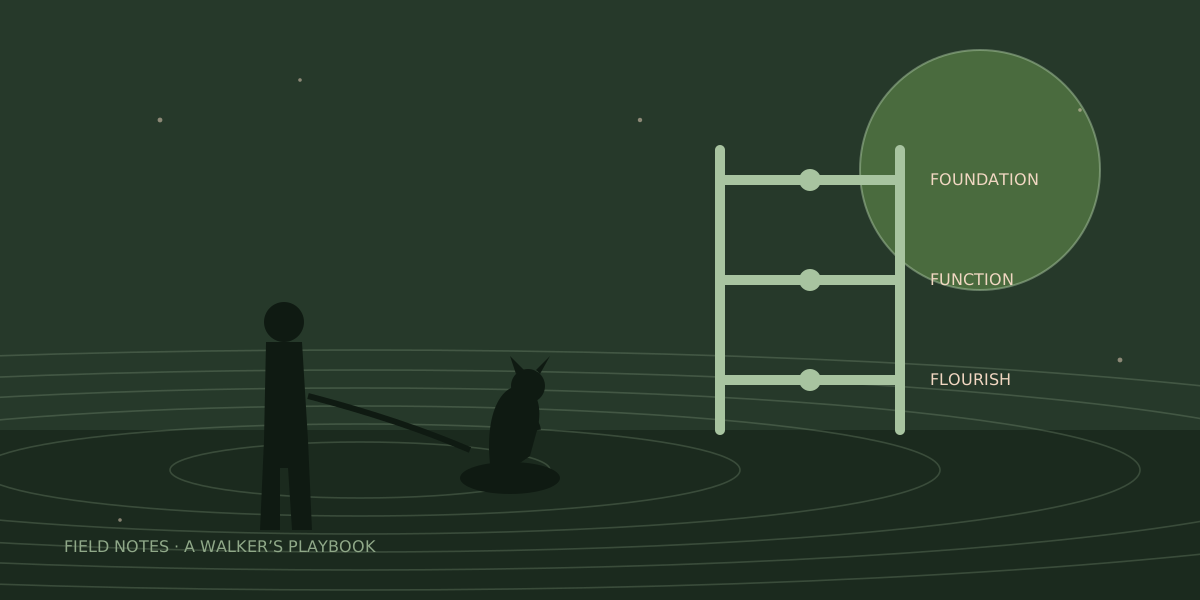
Here is the whole framework in one sentence: every trick worth teaching sits on one of three rungs, and you do not climb until the rung below is reliable. The rungs are not about difficulty. They are about what the trick does for you.
- Foundation. The attention behaviors everything else is built on. Touch, watch me, and a name the dog actually turns to. These are not impressive. They are the floor.
- Function. The tricks that make the walk itself safer and smoother. Wait, leave it, back up, middle. These are the ones you will use every single day.
- Flourish. The crowd-pleasers owners brag about. Spin, shake, bow, high five. They earn their place last, because by then the dog has learned how to learn.
The reason the order matters is that the rungs compound. A dog that owns touch will learn spin in a fraction of the time, because spin is just touch followed in a circle. A dog that owns watch me will learn leave it almost for free, because leave it is watch me with a temptation on the ground. Skip the foundation and every later trick takes three times as long. Build it once and the rest comes cheap.
Pick one trick per rung at a time. A dog working on touch is not also working on spin. Reliability is the gate, not the calendar.
You climb when the dog gives you the behavior on the first cue, in a mildly distracting place, three sessions running. Until then you stay on the rung. There is no rush, because there is no exam.
03 / Rung oneFoundation: the tricks nothing works without.
These three are not glamorous, and they matter more than any party trick. They sit a level below even the basics of obedience like sit, down, and stay, the foundation skills every other cue is built on. Teach them first, on every dog from a raw puppy to a senior, before anything else.
Touch
The dog boops its nose against your open, flat hand. Touch is the single best first trick to teach your dog, because sniffing a hand is already natural and the dog offers it in minutes. Hold your flat palm an inch from the dog's nose. The instant the nose makes contact, mark it with a word like yes and feed. Repeat ten times, then start presenting the hand a little further away so the dog moves to it. Within a session most dogs are crossing a few feet to touch. You now have a portable recall and a way to move a dog without a word of pressure.
Watch me
The dog makes eye contact on cue. Hold a treat at the dog's nose, then bring it up to the bridge of your own nose. The dog's eyes follow. The moment they meet yours, mark and feed. Add the words watch me once the dog is reliably looking. This is the trick that buys you a second of attention when a cyclist appears or another dog rounds the corner, which is to say it is the trick that prevents the lunge before it starts.
Name response
Not strictly a trick, but it belongs on the floor. Say the dog's name once, in a bright tone, and the second the head turns, mark and feed. Never repeat the name, and never use it for anything the dog dislikes. Unlike a command you enforce, a name is an invitation the dog wants to accept. A name that reliably turns a head is the cheapest safety tool you will ever build, and most dogs you walk do not have one.
04 / Rung twoFunction: the tricks that make the walk easier.
Now the tricks start paying you back on every visit. These four turn a dog that drags you through the door into a dog you can actually handle.
Wait
The dog pauses at a threshold, a curb, an open car trunk, until released. Ask for a sit position, hold a flat hand up, and say wait. Count one second, then release with a word like okay and let the dog move. Build the distance and duration a second at a time. Wait at every curb becomes second nature within a week, and a dog that waits at curbs is a dog that does not pull you into a road on a tight leash.
Leave it
The dog turns away from something on the ground. Drop a low-value treat under your shoe. The dog noses at it, gets nothing, and eventually looks away or back at you. The instant it disengages, mark and feed from your hand, a better treat than the one on the floor. Leave it is watch me with temptation added, which is why you teach watch me first. On a city walk it is the trick that keeps a dog off chicken bones and worse.
Back up
The dog walks backward on cue. Stand facing the dog in a narrow space and step gently toward it. Most dogs step back to make room. Mark the first backward step and feed. Add the word back once it is happening. Useful for tight hallways, crowded elevators, and getting a dog out of a doorway without hauling on the leash.
Middle
The dog stands between your legs, facing forward. Lure it through with a treat in both hands, mark when the head pokes through the front, and feed. Middle is a portable safe space and a positioning cue. For a nervous dog passing a barking dog behind a fence, or a dog waiting at a busy crossing, a tucked-in middle beats a tight leash every time.
The best trick on any dog I walk is the one I use thirty times a day and the owner never notices. That is function doing its job.— Devon Russo, six years walking in Brooklyn
05 / Rung threeFlourish: the tricks owners love.
By the time a dog reaches this rung, it has learned how to learn, and these come quickly. They are the tricks that get filmed and sent to the owner: a clip for the family group chat, photos to show friends, the bow your client brags about at the dog park. Some, like spin and the leg weave, double as the foundation of agility and other canine sports. They suit some breeds more than others, but every dog gets something from them. Teach them last, and they land in days.
Spin
The dog turns a full circle following your hand. Hold a treat at the nose and draw a slow circle parallel to the ground. The dog follows it around. Mark the full turn and feed, then add spin. Because the dog already owns touch, the hand following is instant. Teach it in both directions, a spin one way and a twirl the other, and you have two tricks for the price of one. Most dogs have this in two short sessions.
Shake
The dog lifts a paw into your hand. Hold a treat in a closed fist near the floor. Many dogs paw at the fist to get it. The moment a paw touches your hand, mark and feed from the other hand. Add shake once the paw lifts on its own. A bonus: a dog used to having its paws handled is far easier at the groomer and the vet.
Bow
Front end down, back end up, the play-bow stretch. From a stand, lure the nose down and slightly back between the front legs. As the dog drops into the bow position, elbows down and rear up, mark and feed. If the dog folds into a full down, lure the nose back toward the chest instead. Bow doubles as a genuine stretch, which makes it a nice way to end a walk.
Roll over
The full roll, and the one owners ask for by name. Start in a down position. Lure the nose slowly toward one shoulder until the dog tips onto its side, mark that, then keep the lure travelling over the spine until the dog rolls all the way around. Name it roll over once the motion is smooth. Skip it, or stop at the side, for any dog with hip, back, or joint issues, the twist is not worth the strain on an older body.
High five
A raised paw to a raised hand, built straight off shake. Once shake is solid, raise your arm so the palm faces the dog and hold it a little higher. The paw lifts to meet it. Mark, feed, name it high five. It is shake wearing a different coat, which is the whole point of teaching in order.
06 / Going furtherThe advanced dog tricks worth adding once the ladder is solid.
Once a dog owns all three rungs, you can teach it almost anything, because every advanced trick is just foundation tricks chained together. These are the ones owners ask about by name, and each is a short stack of steps the dog already knows. Teach them the same way: lure or capture, mark, reward, fade.
- Play dead. From a down, lure the dog onto its side, then flat, and add a cue like bang. It looks dramatic and it is a quiet study in impulse control, the dog has to hold still to earn the treat.
- Crawl. From a down, drag the treat slowly forward along the ground so the dog inches after it without standing. Good for tight spaces, and it builds real coordination, core strength, and body awareness.
- Speak and quiet. Teach them as a pair. Capture a natural bark and name it speak, then reward silence on the cue quiet. Taught together, this pair is how you fix nuisance barking rather than feed it.
- Wave. Built straight off shake. Ask for the paw but pull your hand back so the paw lifts into the air without landing. Most dogs have it in a session because the skill underneath is already there.
- Fetch by name. Name two toys, reward the dog for touching the right one, then build up to retrieving specific items from across the room. A genuine test, for example, of how much vocabulary a dog can hold.
- Tidy up the toys. Chain fetch and drop it over a box. The dog puts its own toys away, and it is the trick owners refuse to believe is real until they watch it.
None of these are harder than the ladder, they are just longer. If a dog stalls on one, the problem is almost always that an earlier step was not solid, so drop back a rung and rebuild.
07 / Problem solvingMatch the trick to the problem.
Here is the part most lists of dog tricks miss: the function rung doubles as a behavior toolkit. Most of the problems owners complain about are not character flaws, they are a missing cue. Map the problem to the trick that solves it, and trick training stops being a party piece and starts being the cheapest behavior work you can do.
- Jumping on people. Reward four paws on the floor, then a sit and wait at the door. The dog cannot jump and sit at once.
- Pulling on the leash. Watch me and leave it reset the dog's attention onto you instead of the squirrel.
- Door-darting. A solid wait at every threshold turns the most dangerous second of the walk into a calm one.
- Scavenging and counter-surfing. Leave it, practiced in low-stakes situations first, holds up when it matters.
- Reactivity to other dogs or animals. Middle and watch me give the dog a job and a place to be, instead of a target to fixate on.
- Nuisance barking. Quiet, taught as the other half of speak, gives you an off switch you can actually use.
None of this is separate from training. It is the same handful of skills, aimed at the situations where a dog usually fails. A walker who thinks this way fixes problems other people pay a behaviorist for.
08 / The methodHow to teach one in 90 seconds of walk.
You do not need a training session. You need ninety seconds of a walk you are already doing. The mechanics are the same for every trick on the ladder, and they come down to four words: mark, reward, and then either lure, capture, or shape.
A marker is how you tell the dog the exact instant it got it right. Use a clicker if you carry one, or a short word said the same way every time. After ten to twenty pairings of marker then treat, the dog learns the sound means food is coming, and you can mark a behavior the moment it happens instead of fumbling for a treat a second too late. That second is the whole game.
Every trick on the ladder is taught with positive reinforcement: you mark the behavior you want and pay it, and you ignore the rest. No corrections, no leash pops. Trainers argue about cues versus commands, but the distinction that matters on a walk is small. A cue is information, do this and a reward follows, and tricks and basic obedience both run on those same rails. The reward does not have to be food, either. For a toy-driven dog, a quick game with a favorite toy can beat any treat.
You can teach every trick here with a pouch of small, soft treats and your hands. Three things make it faster: a clicker or a consistent marker word, a treat pouch so rewards arrive in under a second, and one or two toys for the dogs that work harder for play than for food. A leash and a low-distraction environment cover the rest.
The three ways to get the behavior in the first place are worth knowing by name, because you will use all three:
- Luring guides the dog with a treat at the nose, the way you draw a spin or lift a head for watch me. It is the fastest method and the one to fade soonest, or the dog ends up waiting for a hand full of food before it does anything.
- Capturing waits for the dog to offer the behavior on its own and marks it. This is how you teach things a lure cannot reach, a shake, a bark, a stretch. You become a photographer waiting for the moment.
- Shaping rewards closer and closer approximations until the whole behavior chains together. A nose toward the target, then within a foot, then a touch. Slower, but it builds a dog that thinks instead of waits.
Three things carry every trick, and none of them are skills you buy: patience, consistency, and repetition. Short reps, the same cue word every time from every walker, and the patience to stop before the dog sours. That is the entire method, and it is why a dog with three reliable cues beats a dog its owner shouted ten commands at. Think of it less as discipline and more as habit: a few minutes of practice folded into a walk you already do.
Then you fade. Once the dog follows the lure plus the cue reliably, say the cue first, pause, and let the dog do it before the hand moves. Shrink the hand signal over a week until the word alone works. Fading is the step most people skip, and it is the difference between a dog that knows a trick and a dog that performs it only when it sees a treat.
End early, and end on a win, a jackpot of treats and lots of praise. The session should finish while the dog still wants more, not when it has lost interest. Research on short structured training keeps landing on the same point: brief, frequent, upbeat training sessions beat long grinding ones every time. That is the quiet appeal of trick work as dog training, two good minutes today and two tomorrow build a trick faster than ten minutes once a week.
09 / When it stallsWhat to do when a dog gets stuck.
Every dog plateaus, and the worst thing you can do is repeat the cue louder. A stall is information: the dog is telling you the last step was too big, or the space was too busy, or the reward was not worth the effort. Lower the difficulty, do not raise your voice. Five resets cover almost every stall:
- Make the step smaller and pay more often. Reward halfway to the goal. A dog learning roll over gets paid for tipping onto its shoulder long before the full roll.
- Raise the value of the reward. Swap kibble for chicken. The amount matters less than how much the dog actually wants it.
- Cut the distractions. Drop back to a quiet space with no other dogs or people, get the trick solid, then add the world back one piece at a time.
- Split the trick into smaller steps. Most stalls are a step you skipped. Break the behavior down further and rebuild it in order.
- End on success. Always finish on a rep the dog can win, even an easy one, so the last thing it remembers is getting it right.
Keep a rough success rate in your head. If the dog is getting it right about four times in five, the difficulty is set well. Much lower and you have jumped ahead; much higher and you can push on. That ratio is the single most useful number in dog training, and it costs nothing to track.
10 / The operator bitKeeping the trick with the dog, not the walker.
Here is where a solo walker and a team diverge, and where most teams quietly waste the work. Priya runs eight walkers in Austin. One of them taught a Cattle Dog called Boon a flawless touch over a month. Then that walker took two weeks off, a different walker covered, and nobody knew touch existed. Two weeks of reps, gone, because the trick lived in one person's head instead of in the dog's record.
The fix is unglamorous and it is the whole job: the trick has to travel with the dog. That means three things, and they cost you almost nothing.
- One cue per behavior, agreed across the team. If one walker says touch and another says boop, the dog is learning two things slowly instead of one thing fast. Write the cue word down once and everyone uses it.
- A trick line in the handover note. You already leave a note after each walk. Add one clause: working on leave it, reliable at home, shaky near food. The next walker picks up exactly where the last one left off.
- The rung in the dog's profile. Foundation, function, or flourish, and which trick is in progress. A covering walker reads it in five seconds and does not undo a month of work by jumping a rung.
This is the part where a system beats a group chat. A note that lives on the dog's record, where every walker sees it, is the difference between a team that compounds skill and a team that resets it every time someone takes a Friday off. It is the same logic as the rest of running a walking business: the work only scales if it stops living in one person's memory. A walker with real experience and a few reliable training techniques gives an owner more than a one-off visit from a dog trainer the dog meets once, especially for a rescue still learning to trust.
11 / Anti-patternsWhat not to do.
Four mistakes I see constantly, on good walkers who just never had it laid out:
- Do not skip rungs. A roll over on a dog that cannot do watch me is a parlor trick on a shaky floor. It looks like progress and it teaches the dog nothing transferable. Build down before you build wide.
- Do not train a tired or overheated dog. The last ten minutes of a long walk is the worst time to teach. A hot, panting, foot-sore dog cannot think, and you will pair the trick with the feeling of being done. Train near the start, when the brain is fresh.
- Do not repeat the cue. Saying sit, sit, siiit teaches the dog that the word means nothing until the third time. Say it once. If nothing happens, you went too fast, so back up a step, do not say it louder.
- Do not push a dog that says no. A dog that ducks a trick, especially a physical one like roll over or high five, may be sore, not stubborn. Yawning, lip-licking, and turning away are the dog telling you it is done. Respect it, and you keep a willing student for next time.
12 / TakeawaysTake this with you.
If you do one thing this week, teach touch to the next dog on your roster that does not have it. It costs you five minutes, it is the easiest of all the tricks to teach your dog, and it is the rung everything else stands on. Once a dog owns touch, the rest of the ladder is downhill.
Then write the cue down where the next walker can see it. The trick that lives in the dog's record outlasts the walker who taught it, and that is the difference between a clever dog and a business that gets better every month. Teach in order, end early, and let the dog tell you when to climb.
— DR, somewhere off Prospect Park with a Vizsla who now spins