Type “dog walking jobs” into Google on a wet Tuesday morning in Bristol and you get back roughly the same five places you got back in 2019. Indeed listings. Rover UK. A Lantra careers page. A handful of pet sitting marketplaces. The headline pay numbers look fine. The job you actually do, and what you take home from it, is wildly different from one path to the next. Nobody runs that maths for you on the sign-up page.
I'm writing this in 2026, after nine years running a 14-walker dog walking and home boarding operation in Bristol. I started solo at twenty-six, built up via Rover for a year, walked away from it in month thirteen, and spent the following eight years figuring out what a UK dog walking business actually looks like once you take the platform tax out of the equation. This piece is the article I wish someone had written for me when I typed “dog walking jobs” into Google for the first time.
Below: the five UK paths, with their honest 2026 numbers, the HMRC and council bits everyone forgets, and the question each path really answers. If you skim, skim the ledger in section three, that is the one that changed how I thought about it.
01 / The premiseWhy “dog walking jobs” is actually five jobs.
The phrase “dog walker” describes the act, not the employment. The act is roughly the same in Bristol or Brixton: clip on a lead, walk a dog for half an hour, log the visit. The employment around the act is the part that changes everything. There are five distinct structures in the 2026 UK market, and they reward different things.
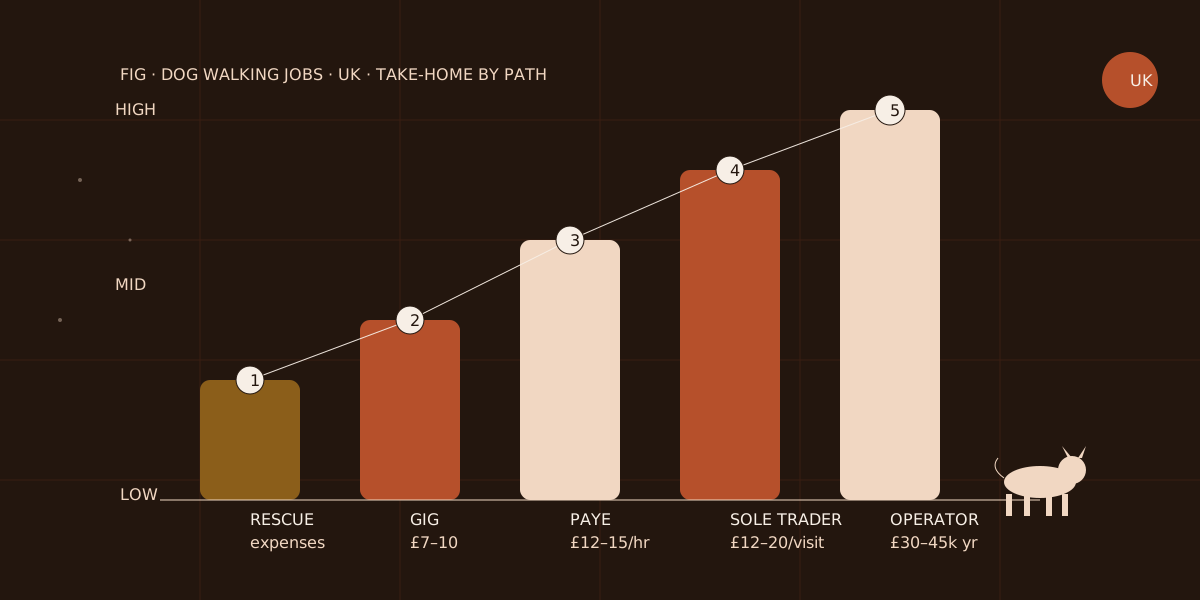
The five, ordered roughly by how much of your time the structure consumes for a pound of take-home, lowest to highest:
- Rescue volunteer or kennels assistant. Little or no cash, the highest learning per hour. The RSPCA, Dogs Trust, Battersea and most local rescues run regular walking rotas. The right entry point if you have never handled an unfamiliar dog and you want to find out fast whether you actually enjoy this work.
- Gig platform walker (Rover UK, Tailster, Pawshake). Fast to start, low ceiling, and the platform takes a structural slice of every booking forever. The right answer for short-term cash if you have a 12-month plan to leave.
- PAYE employee at an established dog walking business. Rarer in the UK than the US, but real. A small handful of multi-walker operations in London, Manchester, Bristol and Edinburgh hire on PAYE with payslips, NI, holiday and sick. The single most underrated path.
- Sole trader with direct clients. The UK default. Your own clients, your own pricing, your own schedule, your own Self Assessment return. Slower to start (60 to 90 days of consistent local marketing) and the only path with a real ceiling.
- Sole trader with subcontractors. The next step from path four, usually 18 to 24 months in. Hire your first walker (PAYE-style or via a properly-structured subcontractor arrangement) once your overflow is consistently a day or more per week. The only structure that survives you being unwell.
Most career-advice articles treat these as one category. They are not one category. Treating them as one is the single most expensive mistake people make at the start of this work in the UK, because the path you pick at sign-up usually sets your ceiling for years.
02 / The frameworkThe five paths, ranked by take-home and ceiling.
Here are the five paths with their honest 2026 numbers. Where I give a take-home figure, it is after the platform fee (if any), after mileage at HMRC's 45p/25p rates, after Class 4 NICs and basic-rate income tax, and rounded to a working operator's rough monthly take-home in a mid-tier UK city.
Path 1, Rescue volunteer.
Almost every UK rescue runs a regular dog walking rota for volunteers. The cash is non-existent or expenses-only. The training is excellent: rescue dogs are over-represented in “dogs I have never met before with unknown reactivity,” which is exactly the muscle every paid walker eventually needs. Two months at your local Dogs Trust or RSPCA will tell you honestly whether dog walking is a career or a passing fantasy. If you find yourself dreading Saturday at the rescue, the rest of this article will not save you.
Path 2, Gig platform walker.
Rover UK, Tailster, Pawshake, Cat in a Flat. Sign-up is fast (an application, a profile, a verification check), the work is real, and your first walk can be inside a fortnight. The maths is the part the marketing tucks out of sight, and it deserves its own treatment, which is the next section.
Path 3, PAYE employee at a real dog walking business.
This is the path the platforms work hardest to make invisible. In every major UK city there are established dog walking and home boarding operations (often 4 to 12 walkers, often founded by someone who left Rover years ago) that hire on PAYE with payslips, holiday pay, pension auto-enrolment and a real route handed to you so you do not have to find clients yourself. Priya runs one in Manchester with eight walkers; she pays £12.50 an hour plus mileage and her senior walkers clear £24,000 a year on PAYE. Indeed UK, Reed and your local Facebook groups all list these, but they are buried under the platform listings. Search “dog walker PAYE” explicitly, or apply directly to the small operators in your city.
Path 4, Sole trader with direct clients.
The UK default and, on the maths, often the best. Your own clients, your own pricing, no platform between you and the owner. The hardest path to start (60 to 90 days of consistent local outreach before you have a workable book) and the only one with a real ceiling. A solo full-time sole trader in 2026 grosses £24,000 to £36,000 in a city like Bristol or Manchester, and takes home £18,000 to £27,000 after expenses, Class 4 NICs and income tax. The biggest predictor of success here is not how good you are with dogs (most people are fine with dogs). It is whether you do the boring marketing work in months one to three before you have anyone telling you it is working.
Path 5, Sole trader with subcontractors or employees.
The next step from path four, usually 18 to 24 months in. Hire your first additional walker once your overflow is consistently more than a day per week. A two-walker UK operation in a mid-tier city grosses £55,000 to £80,000 and the owner takes home in the £30,000 to £45,000 range. Not life-changing money on its own, but it is the foundation of every multi-walker UK business that exists today, and it is the only structure that survives you being ill, on holiday, or training a new dog.
Pick your path before you sign up for anything. The path you pick matters more than the choice you make inside it. A gig walker who picks Rover UK over Tailster earns marginally more. A walker who picks PAYE or sole trader over gig earns 30 to 50 percent more, with statutory rights and no platform fee. The category beats the choice inside the category every time.
03 / The numbersThe 2026 UK platform maths, run honestly.
This is the table the platforms never put on the sign-up page. Same 30-minute walk, three different structures, after-everything take-home. I'm using a Tuesday morning in Bristol as the worked example because Bristol is roughly average for 2026 UK pricing (London is meaningfully higher, rural Wales meaningfully lower).
The sole trader takes home £10.83 against the Rover walker's £7.67 on the same physical walk. That is £3.16 per visit. At 18 visits a week, 48 weeks a year, that is £2,730 of additional take-home a year from the same labour, just because of the contract structure. The PAYE example looks lower per walk but typically comes with paid holiday, sick pay, pension auto-enrolment and no client-acquisition workload, which is why it is the right answer for a lot of people who do not want to run a business.
The numbers shift in either direction by city: London bumps the sole trader take-home meaningfully higher (£20 to £35 per hour-long walk is now standard for solo work in central London); the rural Welsh and Scottish Borders markets compress everything down. The shape of the comparison holds in every UK metro I have run it for.
The platform is not your boss and it is not your business. It is a marketing channel with a 20 percent fee, and the fee should be priced into your decision to use it at all.Priya, Manchester operator, 8 walkers
04 / The legal pieceHMRC, insurance, and the council pieces you must not skip.
The UK has fewer big classification traps than the US, but more local-authority detail. The four bits below are the ones that actually trip people up in year one.
HMRC and the £1,000 trading allowance.
If your dog walking income is under £1,000 in a tax year (6 April to 5 April), you do not need to register with HMRC at all. Above £1,000, you must register as self-employed by 5 October following the end of that tax year, file a Self Assessment return by 31 January each year, and pay Class 2 and Class 4 NICs on profits above the relevant thresholds. From April 2026, Making Tax Digital for Income Tax applies to sole traders with qualifying income over £50,000, which means quarterly digital updates rather than a single annual return. Most solo walkers will not cross that threshold in year one or two, so the old annual return still applies.
Set aside roughly 25 to 30 percent of your gross income for tax, Class 2 NICs and Class 4 NICs from day one. The single biggest year-two surprise in this industry is a tax bill the operator did not budget for.
Mileage at HMRC's approved rates.
You can claim 45p per mile for the first 10,000 business miles in a tax year, then 25p per mile after. This is genuinely meaningful: a busy solo walker doing 8,000 business miles in their car claims £3,600 of allowable expense, which usually wipes out a meaningful chunk of the tax bill. Keep a simple mileage log from the day you start, not from the day you decide it matters.
Insurance, public liability, care, custody and control.
You need three covers as a minimum: public liability (typically £5 million), care, custody and control (covers the dog itself, vet bills if it is injured in your care), and key cover (covers lost client keys). The UK specialists for dog walkers in 2026 are Cliverton (cover starts around £140 a year), Protectivity (from about £5 per month for entry cover), and Pet Business Insurance (from about £1.57 per week for basic public liability). Skip the unaccredited online-only certificates, owners cannot tell them apart and they do not change your rates. The Canine First Aid courses run by recognised UK providers do change your rates, and are worth the £80 to £120.
Council licensing and pack-size limits.
Most UK councils do not require a dog walking licence as standard, but a small handful do, and the Royal Parks have their own paid licensing scheme for commercial walkers. Lambeth Council requires a Professional Dog Walking Licence. Westminster has its own arrangements. The Royal Parks (Hyde, Regent's, Richmond, Bushy, Greenwich, etc.) cap any individual walker at four dogs at one time with a hard collective ceiling of eight dogs when walkers meet, and require a paid licence to operate commercially. Northumberland County Council limits commercial walkers to six dogs at a time. Check your borough and your usual parks before you take on a fifth or sixth dog, the fine for breaching a Public Spaces Protection Order can be £100 fixed-penalty or up to £1,000 on prosecution.
If a job listing says “dog walker, self-employed, £15 per walk, set your own schedule but show up at 7am Tuesday in our branded shirt with our client list and on our routes,” that is likely employment misclassification on the page. HMRC's Check Employment Status for Tax (CEST) tool will usually call it employment. It is a real signal that the business does not understand the rules it operates under, which is also a signal about how it will treat your insurance, your tax forms and your bonus structure.
05 / The second yearThe question every gig walker should answer by month 9.
The gig platforms recruit on the promise of flexibility. The reality, after eight or nine months, is that flexibility is exactly what gets compressed. Your best clients (the ones who book you every week, who tip well, whose dog has spent six months learning to trust you) become locked into the platform's pricing forever, and the platform takes its 20 percent of every booking with them, forever. There is no “loyalty discount” for tenure on the platform. Your £15 walks are still £15 walks in year three.
By month nine, every gig walker should answer one question: am I going to leave for path three (PAYE) or path four (sole trader), and what is the date? Most walkers I have coached through this either set the date and execute (most common outcome: they double their hourly take-home within 18 months of leaving), or they do not set the date, and they are still on the platform five years later, earning £7.67 per walk in 2031 pounds.
The cleanest way to migrate is: keep the platform account open, slowly move your repeat-booking clients to direct (most go willingly when you tell them you are losing a fifth of their booking to a fee), and use the platform only for new-client acquisition. By month 18, the platform is at most 20 percent of your week, mostly a way to fill empty slots, and the rest is direct.
06 / The first weekWhat to actually do in your first week.
Whichever path you pick, here is the seven-day starter. It is short on purpose: the people I know who do well in this industry got going fast and refined as they went, not the other way around.
- Day 1 to 2. Decide your path from section two. Write it down. Pick one, not two. Most of the regret stories I hear come from people who hedged across paths in month one and ended up doing all of them poorly.
- Day 3. If path two (gig), apply to Rover UK first. Set up your profile, pass the verification, complete the safety quiz. If path three (PAYE), search Indeed UK and Reed for “dog walker PAYE” in your city and email three local operators directly.
- Day 4. Book a Canine First Aid course with a recognised UK provider (the British Institute of Professional Dog Trainers or a local council-approved one). Book it for the next four weeks, not “eventually.”
- Day 5. If path four (sole trader), get a quote from Cliverton or Protectivity for public liability with care, custody and control. Register for HMRC Self Assessment if you expect to cross the £1,000 trading allowance this tax year. Both are 30-minute jobs.
- Day 6. Spend two hours at your nearest rescue or Dogs Trust as a volunteer walker. Even if path five is your eventual goal. The dogs at a rescue teach you in two hours what a year on Rover with friendly cocker spaniels in Notting Hill will not.
- Day 7. Write your one-page client agreement. Even for gig work. Knowing what you will and will not do (off-lead in public spaces? aggressive dogs? key handling? emergencies?) is the difference between a clean year and the year you spend rehashing one bad incident.
07 / TakeawayWhat to take with you.
Dog walking jobs are not one job. They are five jobs with very different maths, and the path you pick at sign-up sets your ceiling for a long time. If you take nothing else from this piece, take this: the PAYE path is the most underrated, the gig path is the most overrated, the sole trader path is the most lucrative if you can stand 90 days of marketing before it pays. Pick deliberately. Run the maths before you sign up. Register with HMRC the moment you cross £1,000. And whichever path you pick, write the date in your diary for the second-year question, that is the decision that compounds.
As always, write to me. I read every reply. Tell me what your path looks like, what surprised you, what broke. I am collecting cases for the next piece on hiring your first PAYE walker, and yours might make it in.
EM, somewhere in Bristol, June 2026