Search “dog walking jobs” on a Tuesday morning and you get back the same five companies you got back in 2019. The wages look almost identical. The marketing language is identical. The job you actually do is wildly different from one path to another, and the difference in your take-home, after fees and gas and self-employment tax, can be double. Nobody runs that math for you on the sign-up page.
I'm writing this in 2026, six years after I left Rover. I spent two years on the platform in Brooklyn before I figured out that “dog walker” isn't one job, it's at least five, and that the path I picked at twenty-three was structurally the worst of the five for what I actually wanted. This piece is the article I wish someone had written for me when I typed “dog walking jobs near me” into Google for the first time.
Below: the five paths, with their honest 2026 numbers and the question each one really answers. If you skim, skim the ledger in section three, that's the one that changed how I thought about it.
01 / The premiseWhy “dog walking jobs” is actually five jobs.
The job-board phrase “dog walker” describes the act, not the employment. The act is roughly the same: clip on a leash, walk a dog for 30 minutes, log the visit. The employment around the act is the part that matters. There are five distinct structures in the 2026 US market, and they reward different things.
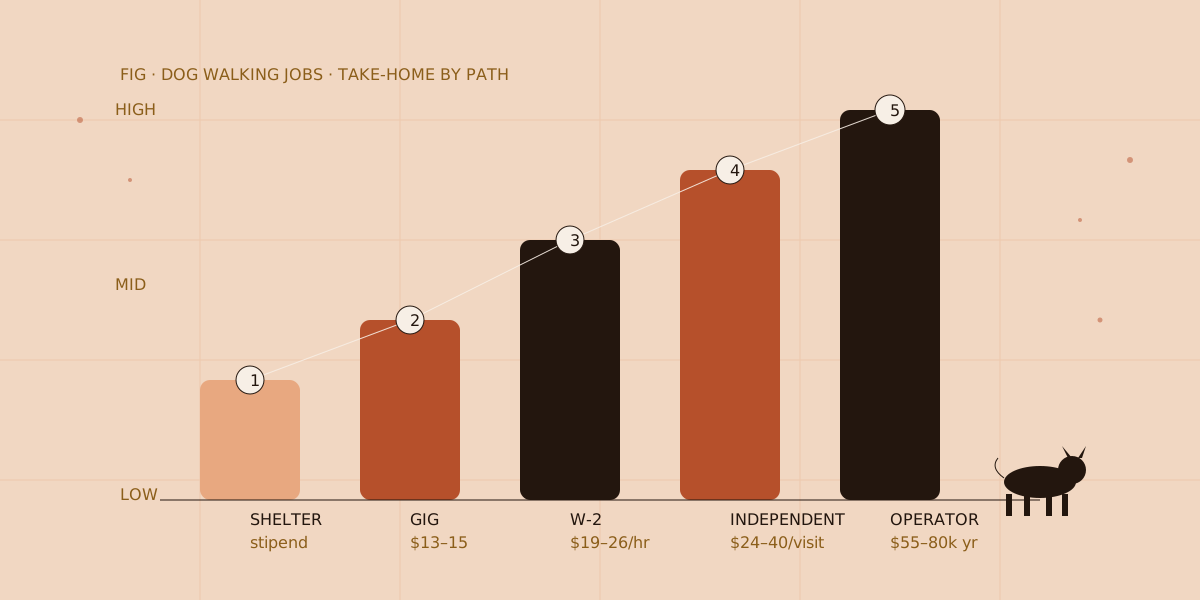
The five structures, ordered by how much of your time the structure consumes for one dollar of take-home, lowest to highest:
- Animal shelter walker (volunteer or stipend). Lowest cash, highest learning per hour. The right entry point if you have never handled an unfamiliar dog and you want to figure out fast whether you actually enjoy it.
- Gig platform walker (Rover, Wag, Care.com). Fast to start, low ceiling, structurally locks you into platform pricing. Right for short-term cash if you have a 12-month plan to leave.
- W-2 employee at an established dog walking business. Steady hours, overtime protection, often paid time off. The most underrated path. The right answer for many people the platforms recruit.
- Independent operator with direct clients. A real small business: your own pricing, your own clients, your own schedule. Slower to build (60 to 90 days of marketing) but the only path with a real income ceiling.
- Operator with hires. Same as four, plus you hire a walker or two. This is the only path that lets you make money when you are sick. Reachable in year two if you build deliberately from path four.
Most career-advice articles list these as one big category. They are not one category. Treating them as one is the single most expensive mistake people make at the start of this career, because the path you choose at sign-up usually sets your ceiling for years.
02 / The frameworkThe five paths, ranked by take-home and ceiling.
Here are the five paths with their honest 2026 numbers. Where I give a take-home figure, it is after the platform fee (if any), after gas and supplies, after self-employment tax (15.3 percent) or payroll deductions (W-2), and rounded to a working operator's rough monthly take-home in a mid-tier metro.
Path 1, Animal shelter walker.
Most US shelters run regular volunteer dog walking programs (the ASPCA, your local SPCA, county-run shelters). A handful pay a small stipend ($10 to $15 per hour). The cash is terrible. The training is excellent: shelter dogs are over-represented in “dogs I have never met before with unknown reactivity,” which is exactly the muscle every paid walker needs. Two months of shelter shifts will tell you, honestly, whether dog walking is a career or a passing fantasy. If you find yourself dreading Saturday at the shelter, the rest of this article will not help you.
Path 2, Gig platform walker.
The Rover/Wag/Care.com path. Sign-up is fast (background check, a quiz, a small fee), the work is real, and your first walk can be inside a week. The math, however, is not what the marketing implies. We will do that math in the next section, because it deserves its own treatment.
Path 3, W-2 employee at a real dog walking business.
This is the path the platforms work hard to make invisible. In every US metro, there are established independent dog walking businesses (often 3 to 15 walkers, often founded by someone who left Rover or Wag years ago) hiring W-2 employees with hourly rates of $19 to $26, overtime, sometimes health stipends, and sometimes a route handed to you so you do not have to find your own clients. Camille runs one in Austin with seven walkers; she pays $22 an hour plus mileage and her senior walkers clear $48,000 a year W-2. Indeed, ZipRecruiter, Care.com, and your local Facebook groups all list these jobs, but they are buried under the platform listings. Look for “dog walker, W-2” specifically, or apply directly to the small operators in your city.
Path 4, Independent with direct clients.
Your own clients, your own pricing, no platform between you and the owner. The hardest path to start (60 to 90 days of consistent outreach before you have a workable book) and the only one with a real ceiling. A solo full-time independent in 2026 grosses $35,000 to $65,000 a year depending on the metro, and takes home $24,000 to $44,000 after self-employment tax and expenses. The biggest predictor of success here is not how good you are with dogs (most people are fine with dogs). It is whether you do the boring marketing work in months one through three before you have anyone telling you it's working.
Path 5, Operator with hires.
The next step from path four, usually 18 to 24 months in. Hire your first walker (W-2, not 1099, see below) once your overflow is consistently more than a day per week. A two-walker operation in a mid-tier metro grosses $90,000 to $130,000 and takes home in the $55,000 to $80,000 range for the owner. Not life-changing money on its own, but it is the foundation of every multi-walker business that exists today, and it is the only structure that survives you being sick.
Pick your path before you sign up for anything. The path you pick is more important than the platform you pick within it. A gig walker who picks Rover instead of Wag earns marginally more. A walker who picks W-2 employment instead of gig earns 30 to 50 percent more, with overtime and no platform fee. The category beats the choice inside the category every time.
03 / The numbersThe 2026 platform math, run honestly.
This is the table the platforms never put on the sign-up page. Same 30-minute walk, three different structures, after-everything take-home. I am using a Tuesday morning in Denver as the worked example because Denver is roughly average for 2026 US pricing.
The independent walker takes home $20.13 against the Rover walker's $13.64 on the same physical walk. That is $6.49 per visit. At 18 visits a week, 48 weeks a year, that is $5,600 of additional take-home a year from the same labor, just because of the contract structure. The W-2 example looks lower per walk but typically comes with overtime, paid time off, and no client-acquisition workload, which is why it is the right answer for a lot of people who don't want to run a business.
The numbers shift in either direction by city: NYC, SF, and LA bump the independent take-home meaningfully higher; the rural South compresses everything down. The shape of the comparison holds in every US metro I have run it for.
The platform is not your boss and it is not your business. It is a marketing channel with a 20 percent service fee, and the fee should be priced into your decision to use it at all.Camille J., Austin operator, 7 walkers
04 / The legal pieceThe W-2 versus 1099 classification trap.
This section is for two audiences: anyone considering a job at a small dog walking business, and any walker thinking they might hire someone in the next two years. The IRS rule is the same for both sides, and most small operators get it wrong.
The default in this industry is to call your walkers “1099 independent contractors.” The IRS, in nearly every case, disagrees. A dog walker working a fixed schedule, in your branded shirt, following your client checklist, on routes you assigned, is structurally a W-2 employee under the IRS's common-law test, no matter what the contract says. The state-level tests in California (ABC test), Massachusetts, and New Jersey are even tighter.
Why this matters for you as a walker: if a small business is calling you a 1099 but treating you like a W-2 (set schedule, set price, set route, no ability to send a substitute), you are absorbing the employer's share of payroll tax (7.65 percent) and you are not covered by workers' comp if a dog pulls you into traffic. You can ask for the classification to be corrected. If the operator refuses, the IRS SS-8 form exists specifically for this, and the federal Department of Labor backs up walker complaints in most jurisdictions.
Why this matters for you as a future operator: misclassification is the most common legal failure mode in this industry. Pet Sitters International and Time To Pet have both flagged it as the single most expensive mistake small operators make, because a state audit triggers back payroll taxes, penalties, and interest, and a misclassified worker can sue for unpaid overtime going back two years. Hire W-2 from your first walker. The math works at scale; the “1099 saves money” instinct is short-term.
If the job listing says “dog walker, 1099, $20 per walk, set your own schedule but show up at 7am Tuesday in our shirt with our client list,” that is misclassification on the page. It is a real signal that the business does not understand the rules it operates under, and that is a signal about how it will treat other things (your insurance, your tax forms, your bonus structure) too.
05 / The second yearThe question every gig walker should answer by month 9.
The gig platforms recruit on the promise of flexibility. The reality, after eight or nine months, is that flexibility is exactly what gets compressed. Your best clients (the ones who book you every week, who tip well, who you have spent six months training their dog to know you) become locked into the platform's pricing forever, and the platform takes 20 to 31 percent of every booking with them, forever. There is no “loyalty discount” for tenure on the platform. Your $20 walks are still $20 walks in year three.
By month nine, every gig walker should answer one question: am I going to leave for path three (W-2) or path four (independent), and what is the date? Most walkers I've coached through this either set the date and execute (most common outcome: they double their take-home within 18 months of leaving), or they don't set the date and they are still on the platform five years later, earning $13.64 per walk in 2031 dollars.
The cleanest way to migrate is: keep the platform account open, slowly move your repeat-booking clients to direct (most go willingly when you tell them you are losing a third of their booking to a fee), and use the platform only for new-client acquisition. By month 18, the platform is at most 20 percent of your week, mostly a way to fill empty slots, and the rest is direct.
06 / The first weekWhat to actually do in your first week.
Whichever path you pick, here is the seven-day starter. It is short on purpose: the people I know who do well in this industry got going fast and refined as they went, not the other way around.
- Day 1 to 2. Decide your path from section two. Write it down. Pick one, not two. Most of the regret stories I hear come from people who hedged across paths in month one and ended up doing all of them poorly.
- Day 3. If path two (gig), apply to Rover only, not Wag. Pay the setup fee, finish the safety quiz, complete the background check (allow 7 to 14 business days). If path three (W-2), pull the “dog walker W-2” results from Indeed and email three local operators directly.
- Day 4. Take the American Red Cross pet first aid course (one day, $30 to $60). It is the only pet-care certification owners recognise, and it is genuinely useful.
- Day 5. If path four (independent), get general liability and care/custody/control insurance through Pet Sitters Associates LLC ($300 to $600 a year) and register a basic business license at your city or county clerk ($50 to $150).
- Day 6. Spend two hours at your nearest open-intake animal shelter. Even if path five is your eventual goal. The dogs at a shelter teach you, in two hours, what a year on Rover with friendly Brooklyn labradoodles will not.
- Day 7. Write your one-page client agreement. Even for gig work. Knowing what you will and will not do (off-leash? aggressive dogs? key handling? emergencies?) is the difference between a clean year and the year you spend rehashing one bad incident.
07 / TakeawayWhat to take with you.
Dog walking jobs are not one job. They are five jobs with very different math, and the path you pick at sign-up sets your ceiling for a long time. If you take nothing else from this piece, take this: the W-2 path is the most underrated; the gig path is the most overrated; the independent path is the most lucrative if you can stand 90 days of marketing before it pays. Pick deliberately. Run the math before you sign up. And whichever path you choose, write the date in your calendar for the second-year question, that is the decision that compounds.
And, as always, write to me. I read every reply. Tell me what your path looks like, what surprised you, what broke. I am collecting stories for the next piece on hiring your first W-2 walker, and yours might make it in.
DR, Brooklyn, June 2026