Jordan charged $22 per 30‑minute walk for his first year independent because that's what Rover's Brooklyn rates capped at. Rover takes 25% of every booking, plus a service fee from the client, plus card processing. Jordan, going independent, kept all of it. He thought that meant he was making good money. He wasn't.
Rover sets the $22 cap because that's what the marketplace will bear after the platform's brand, app, insurance pool, customer acquisition, and dispute resolution have done the work for the walker. Strip those out and Jordan was independently doing what Rover does, but without any of the infrastructure — and he was anchoring his price to a number designed for a different business model.
This piece is the conversation Jordan wishes someone had walked him through in week one of trading independent. There are five numbers every US dog walker needs to know about their pricing — what they're costing per visit, what the market is paying, what their price list says, what their capacity ceiling is, and what they actually take home after self‑employment tax and state income tax. Most operators know two of them. The ones who know all five run businesses that survive their third year. The ones who don't, mostly don't. If you're earlier in the journey, our how to start a dog walking business US piece covers the 90‑day frame.
01 / The myth“Just match Rover's rate.”
The most damaging pricing advice in this industry is “just charge what Rover charges in your area.” It sounds reasonable. It's also a structural mistake.
The 2026 US national average for a 30‑minute walk is $21.45 per HomeGuide's national pricing data, with a wider range of $15–$45 depending on city. Rover's marketplace pricing tends to sit at the lower end of that range because Rover monetizes through volume and platform fees. An independent operator who matches Rover's $20–$22 cap is making themselves a $20 walker without any of Rover's customer acquisition, brand equity, or dispute infrastructure to support it.
Pricing‑by‑Rover‑matching ignores three structural facts: Rover walkers don't pay self‑employment tax on the full visit fee (Rover takes its cut first, you net the rest); Rover walkers don't pay for their own customer acquisition, brand, or platform; and Rover walkers don't carry general liability insurance, workers' comp, or dispute infrastructure — the platform does. Strip those out and the independent operator at $22 is netting less, per hour of work, than the marketplace walker at $30 gross.
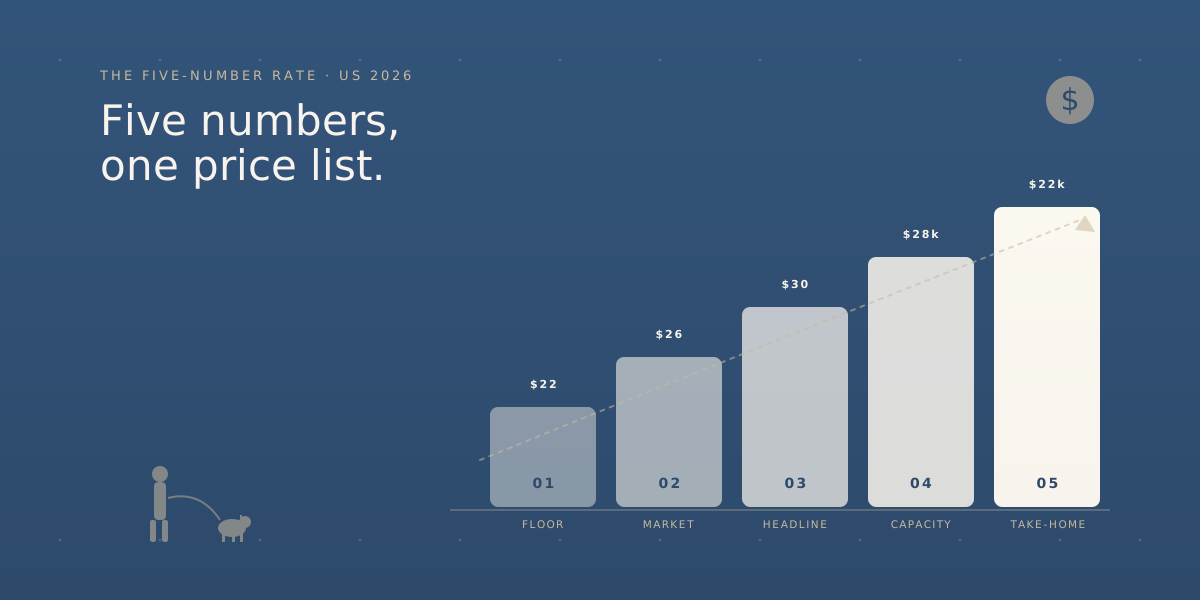
The framework below is what I call the Five‑Number Rate. It maps to the five questions any operator should be able to answer about their own pricing — Am I losing money? Am I obviously out of step? What does my list say? What's my upper bound? What do I actually earn? Get those five right, and the marketplace cap becomes a piece of context instead of a ceiling.
02 / FrameworkThe Five‑Number Rate.
Here it is in one block.
Each number answers a question your business asks of you. Numbers 1 and 2 are research. Number 3 is the decision. Numbers 4 and 5 are the consequences. Most operators set Number 3 by looking at Number 2, skipping Number 1, and are then bewildered three years later when their CPA tells them they actually netted $19,000 on $34,000 of revenue.
The article walks each number in order. Get a pen — by the end you should have written down five figures specific to your business.
03 / Number 1Your floor — cost per visit to break even.
This is the number that ruins the marketing article most pricing guides are trying to write. Your floor is the absolute minimum price you can charge per visit before you are actively making yourself poorer by working.
It has two parts: the expense floor (the cash leaving your pocket per visit) and the opportunity floor (the rate below which you'd be better off taking a barista shift at Blue Bottle).
The expense floor — Jordan's 2026 maths
The cost stack for a solo walker doing roughly 1,200 visits a year, average 3 miles round trip per visit (urban Brooklyn — lower than suburban operators), using a small Honda Fit:
- Vehicle: IRS standard mileage rate 72.5¢/mi × 3 miles = $2.18 per visit (2026 IRS rate, covers fuel, depreciation, maintenance, insurance proportional)
- General liability insurance: $215/year ÷ 1,200 visits = $0.18 per visit
- Workers' comp / additional cover (if any helpers): scales with payroll, ~$0 for true solo
- Equipment depreciation (leashes, harnesses, towels, poo bags, treats): $360/year ÷ 1,200 = $0.30 per visit
- Phone, data, scheduling software: $50/month × 12 / 1,200 = $0.50 per visit
- CPA + bookkeeping software (QuickBooks Self‑Employed): $480/year / 1,200 = $0.40 per visit
- Marketing (Google Business, Nextdoor, occasional flyers): $240/year / 1,200 = $0.20 per visit
- State business filing fees, LLC annual report: $120/year / 1,200 = $0.10 per visit
Total expense floor: ~$3.86 per visit.
Below $3.86 you are paying for the privilege of walking the dog. Almost nobody charges below this, but it's worth knowing because it's the number that moves when gas prices change, and it's what should be moving when you set a price rise.
The opportunity floor
The expense floor isn't your real minimum. Your real minimum is the rate below which you'd take home less per hour than the local cost of living equivalent. The federal minimum wage of $7.25/hour is theoretical for most operators — what matters is the wage you could earn at any other entry‑level local job that wouldn't require carrying your own liability, your own self‑employment tax, and your own customer acquisition.
In 2026, a reasonable national benchmark is $18–22/hour effective take‑home as the rate below which you'd be better off in an hourly role with benefits. NYC operators should use $25; LA $22; rural markets $14–16.
A 30‑minute walk usually costs you 45–50 minutes of working time once travel and admin are included. To clear $20/hr take‑home over 45 minutes you need to net $15 from each visit after expenses, self‑employment tax (15.3%), federal income tax, and state income tax. Working backwards through those rates for a sole‑prop with ~$30k of net business income:
- SE tax: 15.3% of net business income
- Federal income tax: ~12% effective at this bracket
- State income tax: 0% (TX, FL, WA, NV) to ~6.5% (NY) to 9.3% (CA)
- Combined effective tax rate: 27% to 36% of net business income
To net $15 per 30‑minute visit after a combined 32% tax rate, you need to gross $22 per visit after expenses, which is $26 per visit before expenses. So the practical floor is ~$26 per 30‑minute visit in 2026 NYC, ~$22 in most metros, ~$18 in rural and small‑town markets.
Below those numbers you are operating at structurally below‑market hourly take‑home — not as a temporary launch concession. Our dog walking insurance US piece covers the related question of what cover you need at each tier of operation; pricing and insurance are the two operational decisions year‑one operators most often skimp on.
If you take only one number from this article: in 2026 the practical floor for a US 30‑minute solo dog walk is $26 in NYC, $22 in most metros, $18 in rural. Below those numbers you'd be better off — in cash terms, before any of the joy — taking a shift somewhere else.
04 / Number 2The market rate — 2026 US table.
Now you know your floor, the market rate becomes interesting again. Here's the 2026 picture for a 30‑minute walk in the US — refreshed against HomeGuide's national pricing data, Rover's 2026 marketplace rates, and Time To Pet's Dog Walking Rate Calculator pulls.
| Market | 30‑min walk range | 2026 average | Hourly equivalent |
|---|---|---|---|
| New York City | $28–$45 | $32 | $42–$60 |
| San Francisco / LA | $26–$38 | $30 | $36–$50 |
| Seattle / Boston / DC | $24–$34 | $28 | $32–$45 |
| Chicago / Denver / Austin | $22–$30 | $26 | $28–$40 |
| Tampa / Phoenix / Atlanta | $18–$26 | $22 | $24–$34 |
| Midwest mid‑size cities | $16–$24 | $20 | $22–$32 |
| Rural / small town | $12–$20 | $16 | $16–$26 |
A few observations from running the 2026 numbers across the operators we work with:
- The NYC premium has stretched faster than national. Three years ago NYC was 1.5× national average. In 2026 it's closer to 1.7×. The cost of living gap with the rest of the country has accelerated, and so has the rate gap.
- The South has caught up. Tampa, Phoenix, and Atlanta are no longer markedly cheaper than mid‑tier coastal markets. Florida in particular has compressed against California's lower‑cost suburbs.
- Rover sets the floor. In most markets, Rover's marketplace cap effectively acts as a ceiling on what casual walkers will pay. Independent operators who price above Rover differentiate on service (consistency, the same walker every time, real‑time photo updates, written reports) rather than on price.
- The $15 walk is increasingly unviable. In 2024 about 13% of US walks were priced below $15; the 2026 equivalent is closer to 6%. Insurance, gas, and the SE tax burden have done the work that should have been done by operators reading their own books.
The right way to use this table: find your row, note the range not the average, and ignore the people on the bottom end of the range. They are the operators we discussed in Number 1 — the ones who didn't do the maths.
05 / Number 3Your headline price — the three‑tier structure.
Most operators set one rate. The operators who do well set three to five, in a clear tier structure that does most of the pricing work for them.
Solo walk (premium)
30 minutes, one client's dog or two from the same household. The walker's full attention. Higher recall reliability because of fewer variables. Suits reactive dogs, anxious dogs, dogs that don't get along with others. Charge the top of your regional range.
Target price 2026: Solo walks should be priced at the top of your regional range, plus $3–5. NYC $35–42. SF/LA $32–38. Seattle/Boston/DC $28–32. Chicago/Denver/Austin $26–30. South $22–26. Rural $18–22.
Group walk (volume)
30 minutes, three to four dogs from different households. The economic engine of a dog walking business — your gross‑margin dollar is much higher per minute. The risk profile is also higher (recall variance, dog‑fight risk) which is why your group walks should never include unvetted or unreliable dogs.
Target price 2026 (per dog): Charge each owner the standard regional rate so a 4‑dog group walking 30 minutes generates 4× the per‑visit income on the same time block. NYC $25–30 per dog. SF/LA $22–28. Seattle/Boston $20–25. Chicago/Denver $18–22. South $16–20. Rural $12–18.
Pop‑in visit (filler)
20–30 minutes at the client's home — feed, fresh water, toilet break, maybe a short yard break. No walk. The midday slot most pet parents pay for. Stacks neatly between morning and afternoon walks. Fills the diary gaps that a walks‑only operator leaves on the table.
Target price 2026: Pop‑ins are priced at about 70–80% of a solo walk. NYC $22–28. SF/LA $20–26. Seattle/Boston/DC $18–24. Chicago/Denver $16–22. South $14–18. Rural $12–16.
Two optional add‑on tiers, depending on your business
Overnight pet sitting — $75–$125 in cities, $50–$85 elsewhere. Regulatory landscape varies by state and county; California, Texas, and New York operators in particular should check local licensing. We covered the insurance frame in our dog walking insurance US article.
Training‑paired walks — $40–$65, where the walk includes structured training (leash work, recall, socialization). Requires Errors & Omissions (E&O) insurance because you're now selling advice the client relies on.
One price is a price list. Three prices is a business. The difference is whether the client has a way to spend more with you.— PackMonty Field Notes, editorial position
A tiered structure does three useful things at once. It anchors clients toward the middle tier (the group walk) which is also your best margin. It gives premium clients somewhere to land without negotiating you down. And it stops you giving away pop‑ins for free.
06 / Number 4Your capacity ceiling — visits × rate × weeks.
A solo walker's realistic full‑diary capacity in 2026 is 20 to 25 visits per week — slightly lower than the UK equivalent because US operators typically drive longer routes between clients. That's not a theoretical ceiling — it's what we see operationally across the operators we work with once you account for cancellations, weather, sick days, holidays, and the fact that meet‑and‑greets, admin, and Thanksgiving all eat into available time.
The capacity ceiling matters because it sets the absolute maximum a solo operator can gross in a year. The maths is straightforward:
- 22 visits/week × $24/visit × 48 weeks (4 weeks off) = $25,344 gross
- 22 visits/week × $28/visit × 48 weeks = $29,568 gross
- 22 visits/week × $32/visit × 48 weeks = $33,792 gross
That $8,448 gap between $24 and $32 is what a 33% pricing decision looks like across a year. Same dogs, same diary, same hours, same gas. Different number written on the price list.
For two‑walker operations (you plus one W‑2 employee), capacity roughly doubles but income doesn't — you pay the second walker, plus workers' comp, plus your share of FICA, plus state‑mandated benefits, plus your share of any health insurance contribution. Net effect: a two‑walker operation typically clears 1.6× a solo's revenue at 2.2× the working hours.
This is also why PSI's 2024 State of the Industry Survey reports an average gross revenue of $100,537 for member businesses — that number includes operators with employees, multiple services (overnight sitting, daycare), and several years of compounding. The solo walker at full capacity in 2026 should expect gross revenue in the $25,000–$35,000 range, not $100,000.
Tom in Austin (year three). Runs solo at 22 visits/week, $26 per visit, 48 weeks. Grosses $27,456. Has hit his solo ceiling. Two options: raise rates (Number 5 economics) or hire (more revenue, less per hour, plus the 1099/W‑2 question we covered in the insurance article). Most operators hire prematurely; the maths almost always favours one more price rise first.
Before you hire your first walker, check whether a $3/visit price rise across your existing book would clear the same money — and probably more, after workers' comp and your share of FICA. Hiring solves a workload problem, not a pricing one.
07 / Number 5Your take‑home — revenue minus expenses, after tax.
This is the number that matters and the number almost nobody calculates accurately for the US — because the US has more tax layers than most operators track.
Here's the full sequence for Tom in Austin in 2026, working through his numbers from above. We'll do it twice: once at $26 a visit, once at $30.
Tom at $26 per visit
- Gross revenue: 22 × $26 × 48 = $27,456
- Vehicle (IRS mileage 72.5¢ × ~3,200 business miles): $2,320
- Insurance (general liability): $215
- Equipment: $360
- Phone/data/software: $600
- CPA + bookkeeping software: $480
- Marketing: $240
- State filing fees, LLC annual: $120
- Misc (professional body, training): $200
- Total expenses: $4,535
- Net business income (Schedule C profit): $22,921
- Less self‑employment tax (15.3% of 92.35% of net business income): $3,239
- Less federal income tax (after ½ SE tax deduction, standard deduction $15,000 for single filer 2026 estimate): ~$820
- Less Texas state income tax: $0
- Take‑home: ~$18,862
Tom at $30 per visit
- Gross revenue: 22 × $30 × 48 = $31,680
- Same expenses ($4,535)
- Net business income: $27,145
- SE tax: $3,836
- Federal income tax: ~$1,260
- Texas state income tax: $0
- Take‑home: ~$22,049
The $4/visit decision is worth ~$3,200 of take‑home over the year — in Texas.
In New York (state income tax ~6.5% effective at this bracket) the same $4 raise would net Tom about $2,950 more — same operator, $250 less keep, because of state tax. In California (state tax ~9.3% effective) it would be about $2,800.
Multiply $3,200 across a five‑year career and it's a year of college, a down payment on a car, or — for an operator with kids — daycare for half a year. Same dogs. Same diary. Same number of hours. A different conversation in week one.
The pattern most US operators miss: as a solo walker, almost every additional dollar on your headline price drops almost entirely through to take‑home, because your costs are essentially fixed by the diary you're running. Your costs scale with miles driven, not with the price you charge for the visit you'd be doing anyway. The only thing that compresses the gain is your marginal tax rate — which is exactly the same reason a solo‑walker LLC with an S‑corp election starts to make sense at around $50,000 of net income.
08 / The raiseHow to raise prices without losing clients.
The single hardest conversation in the dog walking business isn't a difficult dog or a client complaint. It's the email you send in mid‑November telling your existing clients that prices are going up January 1.
Operators avoid this conversation for years. Most of the $20‑per‑walk legacy book in the US exists because someone in 2019 charged $20, and the same client has been paying $20 ever since while the operator's gas, insurance, SE tax burden, and inflation all rose. By the time you realise you're losing $80/week on inflation alone, you've absorbed five years of compression.
The mechanic that works:
- Give six weeks' notice. Letter or email in mid‑November for a January 1 rise. The clients who would push back are the clients who'll push back regardless of notice; the rest appreciate the warning.
- Frame the rise on cost, not value. “Gas, insurance, and workers' comp have all risen; my rates are moving from $24 to $26 from January 1” is much easier to accept than “I've decided I'm worth more.” The first is a transparent business fact; the second is a negotiation invitation.
- Keep it small and annual. A $2 rise every January feels like inflation. A $6 rise every three years feels like a price hike. Same total amount, completely different emotional load.
- Be willing to lose 5–10% of your book. The clients who leave over a $2 rise are almost always the clients who were going to leave anyway, just over something else. The maths on losing 10% of clients while raising prices 8% is positive — you net more on fewer clients with more room in the diary for premium replacements.
Sara's worked example (Brooklyn, 6 walkers, end of year two).
- Existing book: 30 active clients × 8 visits/month average × $28 = $6,720/month
- January raise: $28 → $32, six weeks' notice, cost‑framed
- Lost 3 clients (10%) in the month after the rise
- New book: 27 clients × 8 visits × $32 = $6,912/month
- Net revenue change: +$192/month from fewer clients
- Net workload change: 24 fewer visits/month (10% less work)
- Effective hourly increase: ~14%
She also picked up 2 of those 3 lost slots within five weeks from her waiting list, at the new rate. Net effect by end of February: more revenue, more headroom, fewer awkward clients.
The $2 rise is the most leveraged business decision a US dog walker can make. Most operators don't make it because the conversation feels harder than walking the dog. It isn't.
09 / Anti‑patternsThe four pricing mistakes.
The Rover‑match. Setting your independent price by anchoring to Rover's local cap. Rover's pricing is a marketplace rate that includes platform monetization. Independent operators who match it are absorbing all of the work Rover's brand, platform, and customer acquisition would otherwise do, without any of the revenue offset. Differentiate on service (consistency, same walker every visit, photo updates, written reports) and charge $4–8 above Rover's local cap.
The fill‑the‑diary discount. “I'll launch at $18 to fill the diary, then raise to $25 once I'm at capacity.” This never works the way operators imagine. Raising existing clients from $18 to $25 is five times harder than starting them at $25. You'll end up running an $18 diary for eighteen months while you save up the courage to do the conversation you should have avoided. Start at the right price.
The flat hourly. Charging “$30 an hour” when 90% of your visits are 30 minutes. This confuses clients (do they pay $30 for the 30‑min walk or $15?) and creates a structural deal where clients expect 30‑min walks at the discounted rate. Use per‑visit pricing for walks. Per‑hour pricing belongs to pet‑sitting visits and overnight boarding.
The no‑raise. Going three years without a price change because the conversation feels difficult. The $20 walk you set in 2023 is a $17 walk in real terms in 2026 after CPI. You are quietly making yourself poorer every twelve months you don't raise. The $2/year raise is much easier than the $6/three‑years raise.
10 / ConclusionOne thing for tomorrow.
The Five‑Number Rate is one piece of paper. Floor. Market. Headline. Capacity. Take‑home. Pen and paper, twenty minutes.
If you're a solo walker setting your first price list, the order is: work out your $22 floor (Number 1), check your regional range (Number 2), pick a headline price above the regional average not at it (Number 3), check the maths against your weekly capacity (Number 4), and project the take‑home through SE tax and state income tax (Number 5). Tomorrow morning you can have a price list that takes you home to $22,000 instead of $16,000.
If you're three years in and haven't raised prices, the conversation that's worth more than any other 30 minutes you'll spend on your business this year is writing the email that begins “I'm writing to let you know that effective January 1, 2027, my standard visit rate will be moving from...” The hardest sentence in your trading year is also the highest‑leverage one.
Jordan raised his rates from $22 to $28 in his twentieth month after running the maths in this piece for the first time. He lost two clients. He's never gone back to $22. His take‑home for year three was $19,400 — almost exactly what he'd been grossing in year one minus the platform fees, but without Rover's brand to absorb the customer acquisition.
That's the version this framework is designed to make obvious.
— Devon Russo, Brooklyn, on a humid Tuesday afternoon