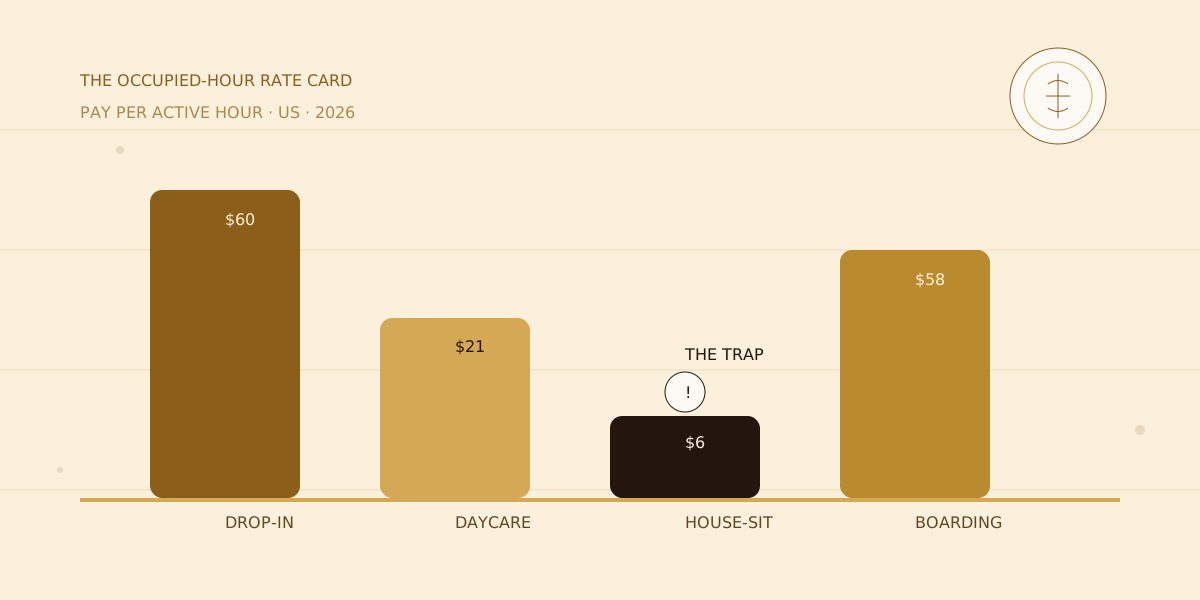
Nobody tells you that the most profitable‑looking service on your price list is usually the one quietly losing you money. A drop‑in visit at $30 for half an hour reads like a worse deal than a $90 overnight. Run the math on what each one pays per hour you are actually working, and the ranking flips. The overnight is the trap.
Search “dog sitting rates” and you get a wall of numbers. Rover says one thing for your city, Care.com lists an hourly figure, a forum thread swears the going rate is something else, and a rate calculator spits out a national average to the penny. All of it answers the question a pet owner is asking: what does dog sitting cost? None of it answers the question you are asking: what should I charge, and what do I keep?
I ran a small independent operation in Brooklyn for six years and added overnights in year three. For the first two years I priced sitting the way everyone tells you to, by checking the local market and landing somewhere in the middle. It took me far too long to notice that two of my four services were subsidising the other two. This is the framework I wish I had used from the start.
01 / The wrong questionWhat should I charge is the wrong question.
“What should I charge for dog sitting” assumes dog sitting is one thing with one rate. It is not. The phrase covers at least four different products that share almost nothing operationally: a fifteen‑minute drop‑in, a full day of daycare, a night spent in a client's home, and a night boarding dogs in yours. They have different costs, different risks, and wildly different returns on your time.
The number that matters is not the price on the listing. It is the price divided by the hours that price ties up. Call that your rate per occupied hour. Once you measure every service that way, the market starts to look very different, and the services that felt like your bread and butter sometimes turn out to be the ones bleeding you.
Hold that middle number in your head. A $75 overnight that ties up twelve hours and your whole night pays about $6.25 per occupied hour. A $30 drop‑in that ties up thirty minutes pays $60. The drop‑in is ten times better per hour, and almost nobody prices as if that were true.
02 / The four ratesThe four rates you actually sell.
Before you price anything, separate your services into the four real products. Here are the current 2026 US reference ranges, pulled from marketplace data and rate calculators. Treat them as the middle of the market, not your target.
- Drop‑in visit. A short visit to feed, let out, and check on a dog. National range $20 to $38 for thirty minutes, averaging around $28. Higher in dense cities, where $30 to $45 is normal.
- Daycare. The dog spends the working day with you. Range $40 to $55 a day, often run with several dogs at once.
- House‑sitting. You stay overnight in the client's home. Range $45 to $80 a night, and this is the one that looks lucrative and rarely is.
- Boarding. The dog stays overnight in your home. Standard care runs $40 to $65 a night per dog, with luxury and large‑city rates climbing past $100.
Notice what the calculators never tell you: these four numbers are not on the same scale. Forty‑five dollars for a drop‑in would be a premium price. Forty‑five dollars for an overnight, where you give up your bed and your evening, can be a loss. Same dollar figure, opposite economics. That gap is the whole game.
03 / The frameworkThe Occupied‑Hour Rate Card.
The Occupied‑Hour Rate Card is a single sheet that scores each of your four services on three things: the hours it occupies, how many dogs you can serve at once, and whether it locks you out of all other work. Once you fill it in, the right prices become obvious, and so do the mistakes.
For each service, write down four columns. Active hours: the time you are genuinely working, hands on the dog. Occupied hours: the total time the service ties up, including the night you spend on call. Concurrency: how many dogs you can take at the same time. Exclusivity: yes if the service blocks you from taking any other client, no if it does not.
Here is the card filled in for Marisol, who runs a six‑sitter operation in Austin. The numbers are hers; the structure is what I want you to copy.
Read down the card and two things jump out. Daycare and boarding both scale, because the concurrency column is greater than one. Marisol can mind four daycare dogs in the same nine hours and board three dogs in the same night. House‑sitting does not scale and is exclusive, so its true cost is everything else she cannot do that night. That is why she prices it highest of all.
An exclusive overnight should always cost more per night than a boarding night, never less. House‑sitting locks one sitter to one home; boarding lets that same sitter mind several dogs at once.
Most sitters price these two backwards, charging less for the house‑sit because “I'm just sleeping there.” You are not just sleeping there. You are turning away every other client who wanted that night.
04 / Your floorSetting your occupied‑hour floor.
The card tells you which services pay well. Your floor tells you the line below which none of them is worth doing. The floor is the cost of one occupied hour, and it is higher than new sitters expect because most of the cost is invisible.
Add up four buckets. Vehicle: in 2026 the IRS lets you value business driving at 72.5 cents a mile, which is a fair proxy for what each mile actually costs you in gas, wear, and insurance. Fixed costs: liability insurance, your scheduling and invoicing software, bonding if you carry it, supplies, phone. Your wage: the hourly number you would accept to do this for someone else. Tax reserve: the slice of every dollar you must hand back, which we get to next.
Trevor, a solo sitter in Columbus, ran his floor and found it sat at $24 an active hour before he made a dime of profit. That single number reframed his whole list. His $26 drop‑ins were barely clearing the floor once driving was counted, so he raised them to $32 and dropped the two clients who lived twenty minutes past everyone else. His boarding, at three dogs a night, was clearing the floor several times over, so he left it alone and marketed it harder.
If you do not know your cost per hour, you are not setting prices. You are accepting them.— Trevor M., solo sitter, Columbus
05 / The modifiersLayering the modifiers.
Your four base rates are the spine. The modifiers are where a tidy operation pulls meaningfully ahead of a sloppy one, because they capture the extra work you are already doing for free. Five of them earn their place.
- Additional dog. A second dog from the same home roughly doubles feeding, cleaning, and supervision. Charge $13 to $15 per extra dog on visits and walks, and $35 to $50 a night on overnights and boarding.
- Holiday premium. Your highest‑demand, lowest‑supply nights. A flat $8 to $15, or 15 to 20 percent, on a published list of holiday dates. Decide the dates in January, not the night before Thanksgiving.
- Puppy and senior care. Puppies need more frequent visits; seniors often need medication and slower handling. A $5 to $15 surcharge, or a longer booked visit, both work.
- Meet and greet. Not a fee, a filter. A free fifteen‑minute meeting before the first booking screens out the dogs and owners who will cost you more than they pay. The best money you never charge.
- Last‑minute and off‑area. A booking inside 24 hours, or a client well outside your normal cluster, is a real cost in routing and risk. A modest surcharge keeps both honest, or gives you a clean reason to say no.
Keep the list short and the prices visible. The single most common pricing mistake I see is a sitter who quietly does the extra dog, the holiday, and the medication for the base rate because raising it in the moment feels awkward. Put the modifiers on the page once, and the awkward conversation happens zero times.
06 / Take-homeWhat you actually keep.
Here is the part the rate calculators skip entirely. The price a client pays is not the money you keep. As a sole proprietor you owe 15.3 percent self‑employment tax on your net profit, covering Social Security and Medicare, and that is before any income tax. The good news is that half of it is deductible against income tax. The hard news is that it still comes off the top of everything.
Run a real month. Say Dana, who boards dogs in Denver, books $5,000 of work. Her gas, insurance, software, and supplies take roughly $1,100. That leaves $3,900 of net profit. The self‑employment tax on that is about $600. So her actual take‑home, before income tax, is closer to $3,300, around 66 percent of the headline number. If she had priced her overnights as if $5,000 were what she kept, she would have been short every single month.
The fix is a habit, not a spreadsheet. Set aside 25 to 30 percent of every payment the day it lands, in a separate account you do not touch. Treat your real take‑home as roughly two‑thirds of revenue. Then price each service so that two‑thirds still clears the wage you set in your floor. If it does not, the rate is too low, no matter what the local market is doing.
07 / Anti-patternsWhat not to do.
Four habits sink more sitting businesses than slow demand ever will. Each one feels reasonable in the moment.
- Do not anchor to Rover. A marketplace rate is a ceiling set by a platform taking its cut, not a floor for an independent who owns the client. Price for your direct relationship, which is worth more, not for the app you are trying to leave.
- Do not price per task. Charging a dollar here for medication and a dollar there for litter invites confusion and undercounts your time. Price by the duration of the visit and fold the small tasks in. Time is the honest unit.
- Do not underprice the overnight. This is the expensive one. If your house‑sit costs less per night than your boarding, you are paying clients to take your nights. Flip it today.
- Do not skip the holiday premium. The sitters who absorb December demand at the normal rate are the ones who quietly resent the work and stop answering the phone by year three. Charge for the sacrifice.
08 / Start hereTake this with you.
If you do one thing this week, fill in the Occupied‑Hour Rate Card for your own four services. Most sitters find at least one rate that is upside down, and it is almost always the overnight. Fix that one number and you will likely earn more next month without taking a single extra booking.
Then write your floor on the same sheet, and check that every service clears it after the tax reserve comes out. The market rate is useful background. Your floor is the law.
And tell me how it goes. I read every reply, and I am collecting real rate cards from operators across the country for a follow‑up. Yours might make it in.
— DR, at the kitchen table, Brooklyn