Nobody asks this question casually. When someone types how much do dog walkers make into Google at 11pm, they are either deciding whether to quit a job, or they are already walking dogs and quietly worried the numbers do not work. The answers they find are useless in a specific and frustrating way: ZipRecruiter says $35,770 a year, a Medium post says $120,000, and a Reddit thread says both of those people are lying. All three are reporting real numbers. They are just standing on different rungs of the same ladder and shouting the height down to each other.
This piece fixes that. First, the actual 2026 data, with sources, and an explanation of why the published figures disagree by a factor of three. Then the Take-Home Ladder: five rungs that take a walk from its sticker price down to the money that lands in your account. Then a real week, run through it. The point is not to be discouraging. The point is that you cannot price a business, hire a walker, or decide whether to go full-time using a number that is measuring something else.
01 / The confusionWhy “how much do dog walkers make” has three different answers.
The question hides three unrelated jobs that happen to share a name, and almost every article on the subject blends them into one average.
The employed walker is on someone's payroll, walks a route her employer built, and gets a W-2 in January. Her employer covers half her payroll taxes, her mileage, and her insurance. This is the person Indeed and ZipRecruiter are actually measuring, because their data comes from job postings.
The platform contractor takes bookings through Rover or Wag. Her listed price is not her income: Rover deducts a 20 percent service fee in most states, 25 percent in California and on RoverGO, while Wag takes somewhere between 25 and 40 percent depending on tier. She covers her own gas, insurance, and the full 15.3 percent self-employment tax.
The owner has a book of clients, possibly some walkers, and quotes gross bookings when asked what she makes. This is where the six-figure headlines come from. They are almost always revenue, and revenue has to pay for payroll, fuel, insurance, and software before any of it is income.
Put those three side by side and the apparent contradiction dissolves. A $60,000 book of business, a $42,000 take-home, and a $17.20 hourly wage can all describe the same operation viewed from three positions. The trouble starts when a walker compares her gross bookings against a friend's salary and concludes she is doing brilliantly, or compares her post-tax take-home against a Reddit headline and concludes she is failing.
02 / The benchmarkWhat the published numbers actually say in 2026.
Here is the honest national picture, with the caveats attached, because you need a reference point before you can tell whether your own numbers are good.
On wages, the aggregators cluster tighter than their reputation suggests. ZipRecruiter puts the US dog walker average at $35,770 a year, or $17.20 an hour, as of July 2026, with the 25th to 75th percentile running $30,000 to $41,000 and the top decile at $46,500. Indeed reports $19.57 an hour from about 6,100 reported salaries, with a low of $13.01 and a high of $29.46. Glassdoor sits highest at roughly $21 an hour. The Bureau of Labor Statistics reports a median of $33,860 for Animal Care and Service Workers, its May 2024 figure, and that number needs a warning label: there is no dedicated dog walker classification, so kennel attendants and shelter staff are folded into the same group, which pulls it down.
On prices, most US walkers charge $20 to $30 for a 30-minute solo walk in 2026. Major metros run $30 to $45, mid-tier cities $20 to $30, and rural markets $15 to $25. The industry underneath those prices is small and stable rather than booming: IBISWorld puts US dog walking services at about $1.3 billion across both 2025 and 2026, spread across roughly 35,000 businesses. The wider pet industry is the growth story, at $158 billion in 2025 and a projected $165 billion in 2026 according to the American Pet Products Association.
Notice what none of those sources tell you. Not one of them converts a per-walk price into an actual hourly rate, and not one subtracts the cost of getting to the walk. That is the entire gap between what a walker charges and what a walker earns, and it is where the rest of this article lives.
03 / The frameworkThe Take-Home Ladder: five rungs from sticker price to bank balance.
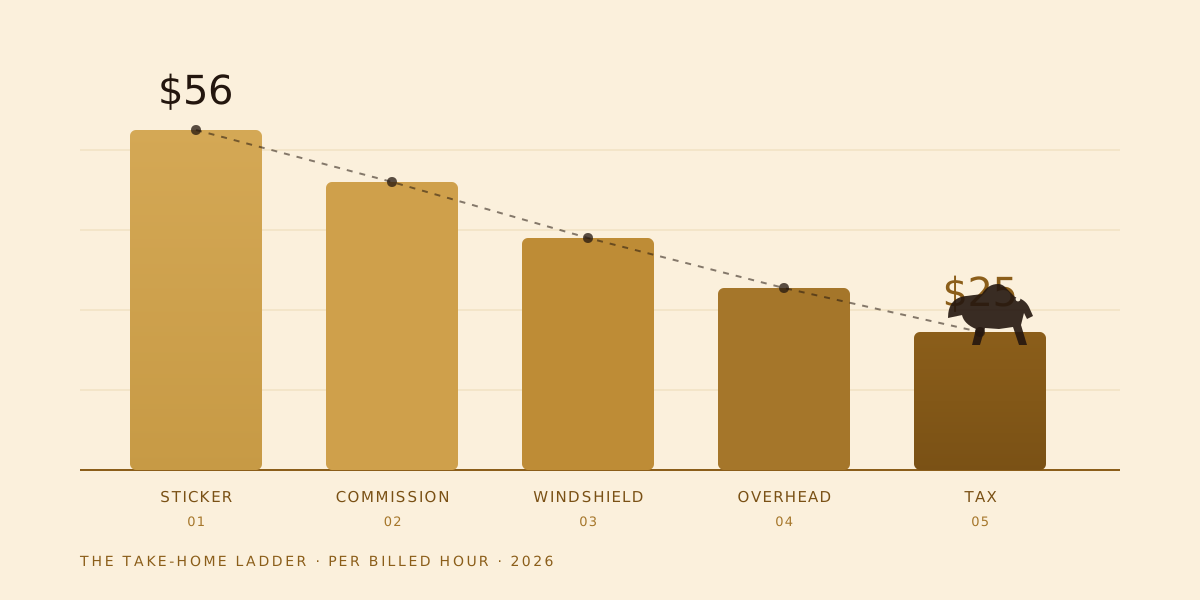
Every walk starts at a sticker price and ends at a smaller number. The Take-Home Ladder names the five places money leaves, in the order it leaves, so you can find the rung where yours is going. Run it on one real week, not a hypothetical full calendar. The whole thing takes about forty-five minutes the first time.
Rung two: commission is the visible cut.
This is the rung most walkers already know about, which is why it gets disproportionate attention. If you take bookings through Rover, a $30 listed walk pays you $24. The client pays more than $30, because Rover charges owners an 11 percent booking fee on top, capped at $50. That gap matters for a reason people miss: it means the market in your area already tolerates a price above your listing, so a direct client can pay you the full $33 and still pay less than they would through the app. Commission is the easiest rung to climb back up, and the only one you can fix in a week.
Rung three: windshield time is the invisible one.
Here is where the real damage happens, and it is not a dollar deduction at all. It is a division. A $28 walk that takes 30 minutes feels like $56 an hour, and that feeling is the single most expensive mistake in this trade. You did not work 30 minutes. You drove 12 minutes to get there, you will drive to the next one, and at some point today you will spend 45 minutes on invoices, keys, and a text from a client whose dog is off her food.
Count everything between leaving your door and getting back to it, then divide. Nine walks does not mean four and a half hours. It means closer to seven. Any figure you quote that skips this step is fiction, and it is the fiction that convinces walkers to keep a client 25 minutes across town at the same rate as the one four doors down.
Rung four: the costs that feel optional and are not.
Mileage first, because it dwarfs the rest. The IRS set the 2026 business mileage rate at 72.5 cents a mile, up from 70 cents in 2025. That rate exists because driving genuinely costs roughly that much once fuel, tires, servicing, and depreciation are counted. A walker covering 180 miles a week is spending about $130 a week on the car, whether or not she ever writes it down. Then liability insurance, which averages around $42 a month for dog walkers in 2026, scheduling software, phone, poop bags, and the accountant.
Rung five: the 15.3 percent nobody withheld for you.
Self-employment tax is 15.3 percent applied to 92.35 percent of net earnings, so about 14.1 percent of what survives rung four. An employed walker never sees this, because her employer pays half the equivalent and payroll withholds the rest. A self-employed walker who has not set money aside meets it in April. This is the largest single reason a $19 hourly wage and a $19 hourly rate are not the same offer.
Your per-walk price is a price. Your per-hour take-home is a wage. Comparing your price against someone else's wage will make you feel rich, and comparing your wage against someone else's price will make you feel like a failure. Neither comparison is real.
04 / In practiceNathan's week in Denver, all five rungs.
Nathan walks solo in Denver. He charges $28 for a 30-minute solo walk, fits nine walks into a weekday, and works five days: 45 walks a week. Twelve of those still come through Rover from his early days; the other 33 are direct. He drives about 180 miles a week and spends roughly 45 minutes a day on admin. Here is the climb down.
Rung one, sticker. Forty-five walks at $28 is $1,260. This is the number Nathan says out loud when someone asks how he is doing.
Rung two, commission. Twelve Rover walks at 20 percent gives up $67.20. He is down to $1,192.80.
Rung three, windshield. Walking time is 22.5 hours. Driving is nine hours. Admin is 3.75. Total on-clock: 35.25 hours, which puts him at $33.84 an hour before a single cost comes out. Worth pausing on that. He believes he charges $56 an hour, and before he has bought a tank of gas he is already at sixty percent of it.
Rung four, overhead. Mileage at 72.5 cents on 180 miles is $130.50. Insurance at $500 a year is $10.42 a week. Software is $7.50, phone and supplies about $15. Total $163.42, leaving $1,029.38.
Rung five, tax. Roughly 14.1 percent of that is $145.45. Nathan's actual take-home for a 45-walk week is $883.93, which across 48 working weeks is about $42,400 a year, and works out at $25.08 an hour for every hour he was on the clock.
I told people I made fifty-six an hour for three years. I made twenty-five. Both numbers came off the same invoice.– Nathan K., Denver, seven years walking
Now put Nathan next to the published figures. His $42,400 sits just under Glassdoor's $43,640 and comfortably above ZipRecruiter's $35,770. The aggregators were not wrong. They were measuring rung five while Nathan was quoting rung one, and the six-figure Reddit posts are quoting rung one on a much bigger book. Everyone was honest. Nobody was talking about the same thing.
The practical value of the ladder is that it tells you which rung to work on. Nathan's biggest leak is not commission, it is windshield time: nine unpaid hours a week. Tightening his route into two geographic clusters would buy back more than moving his rate by two dollars. If pricing is the lever you want instead, the Five-Number Rate builds a rate card from costs rather than from local guesswork.
05 / Anti-patternsFour ways dog walkers get the earnings math wrong.
- Quoting the per-walk rate as an hourly rate. The $28 half-hour walk is not $56 an hour and never was. It is the price of a service that occupies about 47 minutes of your working day once you have driven to it. Every hiring decision, every rate rise, and every should-I-go-full-time calculation built on the doubled number is built on sand.
- Treating the platform's listed price as revenue. If 20 to 40 percent goes to Rover or Wag before you see it, your revenue is what arrives, not what was advertised. Walkers who track listed prices in their own books overstate their income all year and then find the discrepancy at tax time.
- Filing mileage as a deduction instead of a cost. The 72.5 cents is not a tax perk. It is an estimate of what the driving actually costs you in fuel, tires, and the resale value of a car doing 9,000 walking miles a year. Deducting it reduces your tax bill; it does not refund the money.
- Comparing gross bookings to somebody's salary. A $60,000 book and a $60,000 salary are separated by self-employment tax, insurance, fuel, unpaid sick days, and no employer pension contribution. The honest comparison to a salary is rung five, not rung one, and using rung one is how operators talk themselves out of raising prices they badly need to raise.
06 / TakeawaysTake this with you.
Do one thing this week. Take last week, a real one with a cancellation and a slow Thursday in it, and run the five rungs. Most walkers discover the gap sits at rung three, not where they expected, and that the fix is a map rather than a price list. If the number at the bottom is lower than you hoped, that is information you can act on, which is more than the average on page one of Google has ever given anyone.
So: how much do dog walkers make? In 2026, an employed walker earns $17 to $21 an hour, a busy solo operator takes home somewhere in the low forties, and the six-figure stories are revenue with the costs left out. The useful question was never what dog walkers make. It is which rung your own number is standing on, and whether you knew that when you set your rate.
– DR, still counting the driving, Brooklyn