
Almost anyone can call themselves a dog trainer tomorrow morning. No state in the US requires a license, no exam stands between you and your first paying client, and nobody will check your credentials before you put up a website. That sounds like freedom, and for the wrong people it is. For the trainers who go on to earn real money, the absence of a gate is the first thing they choose to ignore.
Search “how to become a dog trainer” and the results split into two unhelpful camps. One is the certification academy that wants $5,600 and tells you the path is its program. The other is the forum thread that shrugs and says you do not need anything at all, just go for it. Both are missing the structure that actually gets someone from loving dogs to running a business that pays.
I am not a trainer. I ran a small walking and sitting operation in Brooklyn for six years, and in year four I hired one. Watching Renata go from an apprentice logging shelter hours to the most profitable line on my service menu taught me what the academies leave out and what the forums get wrong. This is the path I watched work, named so you can follow it.
01 / The missing gateThe gate that isn't there.
Start with the fact everyone glosses over: in the US, dog training is unregulated. There is no licensing board, no mandatory qualification, and no legal definition of who gets to use the title. The certifications that exist, from the Certification Council for Professional Dog Trainers downward, are entirely voluntary.
This cuts both ways. It means you can begin earning while you learn, which is rare and valuable for career‑changers coming from another job. It also means the market is full of people who skipped the learning, trained a few dogs with outdated dominance methods, and damaged both the dogs and the reputation of the trade. The science of canine behaviour moved to positive reinforcement and LIMA, short for Least Intrusive, Minimally Aversive, years ago. Plenty of self‑declared trainers did not move with it. Professional bodies like the CCPDT and the Association of Professional Dog Trainers exist precisely to mark the line between the two.
So the gate is not legal. It is reputational, and you build it yourself. The trainers clients seek out, recommend, and pay a premium for are the ones who chose the standards nobody forced on them. That choice is the whole subject of this article.
02 / The frameworkThe 300‑Hour Path.
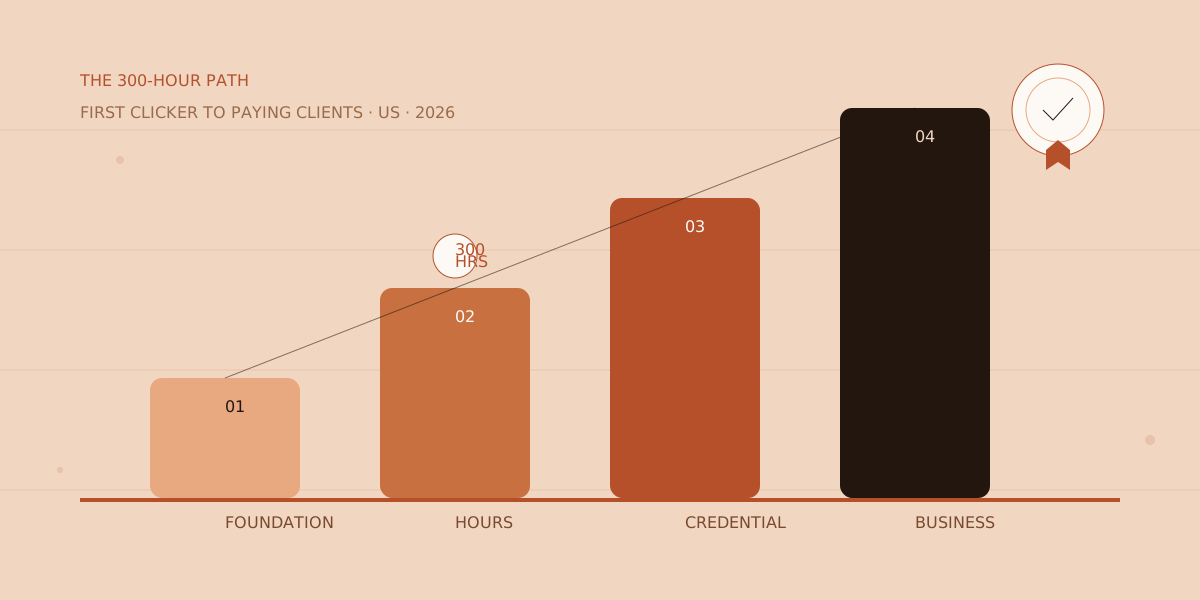
The 300‑Hour Path is the route from no experience to a credentialed, paying trainer, built around the single number that governs the whole journey. The CPDT‑KA, the credential most respected clients have heard of, requires 300 hours of documented dog‑training experience within the previous three years before you are even allowed to take the exam. Everything else arranges itself around clearing that bar.
The path has four stages, and they run in order. Skip one and you feel it later.
- Foundation. Learn the science before you charge a cent. Learning theory, canine body language, and humane method.
- Hours. Log the 300, hands on real dogs, supervised. This is the stage nobody warns you about and the one that takes longest.
- Credential. Convert those hours into a certification a client recognises. CPDT‑KA, KPA‑CTP, or Fear Free.
- Business. Turn the skill into income with a niche, real pricing, and a plan for where training sits in your week.
Notice that paying for a course is not stage one, and that certification is stage three, not the finish line. The order matters because each stage earns the next. Here is what each one actually involves.
03 / FoundationStage one: build the foundation.
Before you handle a stranger's reactive German shepherd, you need to understand how dogs learn. That is not a platitude. The difference between a trainer who fixes a behaviour and one who makes it worse is almost always a gap in the fundamentals: canine psychology and how dogs actually learn, operant and classical conditioning, reinforcement schedules, threshold and trigger stacking, and how to read the early body‑language signals that tell you a dog is over its limit. Basic obedience is the easy part; the science underneath it is what you are really buying.
You can start this stage for almost nothing. The foundational texts and a few good online courses cost less than a tank of gas, and they will tell you quickly whether the work suits you. When you are ready to go deeper, a structured program gives you a curriculum and, often, supervised practice. The price range is wide, so choose by what it includes, not by the headline number.
- Short certificates. The Fear Free Pet Sitter course is about $99 for members, $199 otherwise. Good for a fast, humane grounding.
- Self‑paced diplomas. Penn Foster's dog obedience program is roughly $749 and takes about eight months. The ISCDT online course is around $399.
- Full professional programs. The Karen Pryor Academy Dog Trainer Professional program runs to about $5,600 and includes hands‑on workshops. Animal Behavior College pairs online study with a supervised externship.
Renata started with a $39 book and two free webinars. She did not enrol in a paid program until she was sure, three months in, that she wanted the career. That sequence, cheap before expensive, is the right one. The most common foundation mistake is paying $5,600 for a school before you have spent a single afternoon finding out whether you actually like training other people's dogs.
Method is not a style choice. The credible certifications and the current science all sit on positive reinforcement and LIMA. A program that teaches dominance, “balanced” shock, or alpha theory is selling you a foundation you will later have to tear out.
Pick your education by its method first and its price second.
04 / The hoursStage two: log the 300 hours.
This is the stage the academies underplay, because it is the one they cannot sell you. Knowledge gets you ready; hours make you a trainer. The CPDT‑KA requires 300 documented hours of dog‑training experience within three years, and at least 225 of those must be hands‑on instructional time, with no more than 75 coming from online work. Real dogs, real handlers, real mistakes you learn from.
You do not pay for these hours. You earn them, three main ways.
- Shelter and rescue work. The fastest, cheapest way to accumulate hours and the broadest exposure to behaviour. Shelters are short‑staffed and will welcome a volunteer who shows up reliably. The CCPDT counts shelter training time toward the requirement.
- Apprenticeship. Assisting an established trainer is the highest‑quality route. You watch how a professional reads a room, handles a difficult owner, and structures a session. Many trainers will trade your help at group classes for mentorship.
- Assisting group classes. Running the floor at a training school or pet store class builds instructional hours quickly and teaches you the part of the job that is really about coaching people, not dogs.
Keep a log from day one. Date, hours, dog, what you worked on, who supervised. When you apply for the exam you will need a signed attestation, and a clean record built over time beats a panicked reconstruction the week before the deadline. Renata hit her 300 in about fourteen months, working evenings and weekends around the walks she was still doing for me.
The certificate is not the job. The three hundred hours are the job. The paper just proves you did them.— Renata, on the day her CPDT‑KA arrived
05 / The credentialStage three: earn a credential.
Once the hours are logged, you convert them into something a client recognises. Certification is still optional, but it is the cheapest marketing you will ever buy: it answers the unspoken question every nervous owner has, which is “does this person actually know what they are doing?” Three credentials carry real weight, and they prove different things.
- CPDT‑KA. The Certified Professional Dog Trainer, Knowledge Assessed. A 200‑question exam, a $400 application fee, the 300‑hour requirement, and a signed attestation. It proves you have both the experience and the theory. Recertify every three years with 36 continuing‑education units. An optional practice test runs $105.
- KPA‑CTP. Awarded for completing the Karen Pryor Academy program. Where CPDT‑KA tests knowledge, this proves hands‑on skill under assessment. Strong signal, higher cost, no separate hours requirement because the program supplies them.
- Fear Free. A shorter, accessible certification focused on reducing fear, anxiety, and stress. Popular with walkers and sitters adding training, and increasingly recognised by clients who care about gentle handling.
For most people building a general training business, CPDT‑KA is the one worth aiming at, because the public and other professionals know it. If your route was a full academy program, the KPA‑CTP it confers may be enough on its own. What you should not do is collect credentials for their own sake. One respected certification, backed by real hours, beats three obscure ones.
06 / The numbersWhat it actually pays.
Here is the part the inspirational career pages skip. The headline averages are modest, and the spread underneath them is enormous, because dog training is two different jobs wearing the same title: an hourly employee and a business owner.
As an employed trainer at a chain like Petco or a training facility, you are paid by the hour. Indeed's 2026 data puts the national average at $19.55 an hour, with most postings between roughly $12 and $22. The Bureau of Labor Statistics pegs the annual average at about $45,780. That is the floor of the trade, and most employed trainers stay between $30,000 and $50,000 regardless of how good they get.
Self‑employment is where the ceiling lifts. The economics are simple once you see them. Charge $60 a session, run five sessions a day, five days a week, fifty weeks a year, and that is $75,000 before you add a single group class. Specialisation pushes it further: behaviour‑modification and aggression cases command $150 to $300 a session because the client is desperate, and a two‑to‑four‑week board‑and‑train program runs $1,500 to $4,000 per dog. Three board‑and‑train dogs a month is a second income on its own.
The trainers clearing six figures are rarely the most gifted with dogs. They are the ones who price by the package instead of the hour, hold a clear specialism, and have a steady way to be found. The gap between a $40,000 trainer and a $120,000 one is mostly a business gap, not a skill gap. Which is the whole point of stage four.
07 / The businessStage four: build the business.
A credential and a full logbook make you a competent trainer. They do not make you a business. The last stage is the one most trainers neglect, and it is where the income actually lives. Three decisions do most of the work.
Choose a niche. “I train dogs” competes with everyone. “I rehabilitate leash‑reactive dogs in north Denver” competes with almost no one and lets you charge accordingly. Puppies, reactivity, service‑dog tasks, scentwork, board‑and‑train: pick the one that fits your temperament and your market, and become the obvious answer for it.
Price by the package, not the hour. Hourly pricing caps your income at the number of hours you can stand up. A six‑week puppy package, a two‑week board‑and‑train, or a reactivity program sold as an outcome lets the client buy a result and lets you earn for the whole transformation, not the clock. It also screens for the clients who are serious.
Decide where training sits. If you already run walks, daycare, or boarding, training is the highest‑margin thing you can bolt on, and your existing clients are a warm audience who already trust you with their dog. Renata started by offering thirty‑minute “manners” add‑ons to our boarding clients and grew it into a board‑and‑train line that out‑earned every walk on the schedule. For an existing operation, training is not a new business. It is a margin upgrade to the one you have.
This is also the stage where good software stops being optional. Scheduling, client records, vaccination tracking, and invoicing for packages are exactly the things that fall apart when you try to run them from a notebook, which is the quiet reason we built PackMonty for operators adding services like this one.
08 / Anti-patternsWhat not to do.
Four mistakes show up again and again in trainers who stall. Each one feels sensible at the time.
- Paying for the expensive school first. A $5,600 program before you have logged a free shelter hour is a bet on a career you have not tried. Do the cheap foundation, log a few weeks of hours, then decide.
- Charging before you are ready. The unregulated market lets you take money on day one. Resist it. A handful of botched early clients and the reviews that follow will cost you more than the income was worth.
- Chasing certificates over clients. Three obscure credentials impress no one and train no dogs. One recognised certification plus a full calendar beats a wall of paper.
- Selling hours instead of outcomes. Hourly rates trap you below your worth and attract bargain hunters. Sell the result, in packages, and price for the value of the change, not the length of the lesson.
09 / Start hereTake this with you.
If you do one thing this week, do not enrol in anything. Find a local shelter or an established trainer and arrange to log your first ten hours. The foundation reading can happen in the evenings; the hours are the bottleneck, so start the clock on the 300 today. Everything else, the program, the exam, the pricing, gets easier once that meter is running.
Then keep the log clean from the first hour. The version of you applying for the CPDT‑KA in two years will be grateful for the version of you who wrote down the date.
And if you already run an operation and you are reading this to hire rather than to retrain, the same path tells you what to look for: logged hours, a science‑based method, and one recognised credential. Renata had all three. She was worth every dollar.
— DR, watching a puppy class through the window, Brooklyn