Seven fifty-two on a Tuesday, Zilker Park, and Nadia has four dogs on a coupler and a fifth on a short leash when a squirrel commits to crossing the path. She has about one second. Not one second to pick a technique or remember a class. One second, one word, and whatever those dogs already know.
Nadia is one of nine walkers at an operation Dara Whitlock runs in Austin. She is good at this. The dogs were fine. But the thing that saved that moment was not the agility class two of them attend on Saturdays, and it was not the scent work titles the beagle mix has hanging in his owner's hallway. It was a behavior so unglamorous that no advanced dog training guide on the internet bothers to list it: the dogs looked at her before she asked them to.
That gap, between what advanced training is sold as and what actually holds when you have five leashes in one hand, is the whole subject of this piece. Search the term and you get weave poles, tunnel discrimination, scent imprinting, chin rests, competition routines, a hundred behaviors sorted by how impressive they look on video. Very little of it survives contact with a real walk. Not because the techniques are wrong. Because they were built for a different room.
01 / Why it breaksWhy advanced dog training falls apart on a group walk.
Read the top ten results for advanced dog training and you will notice they all agree on the definition without ever stating it. Advanced means the behavior is harder. Basic is sit, down, stay. Advanced is agility, scent detection, distance work, trick chains, cooperative care. The axis is difficulty of the trick.
Now hold that definition against your Tuesday. You have four to six dogs, not one. Your hands are not free, they are holding leashes, a phone, and a bag you would rather not describe. You did not raise this dog, you see it three times a week for forty-five minutes, and someone else undoes your work for the other hundred and twenty hours. You are on a clock, and the clock belongs to a client who bought a walk, not a training session. And the environment is not a controlled space you introduce distractions into. The environment is the distraction. That is the product. Nobody pays you to walk their dog in a quiet room.
Which brings us to the thing that is genuinely broken, and it is broken in the best advice on the internet, not the worst. Every serious trainer teaches the three Ds: duration, distance, distraction. Build duration first, then add distance, then add distraction. Distraction last, always last, because it is the hardest variable and you earn it.
That sequence is correct. It is also structurally unavailable to you. Distraction is not the last variable you add to a walk. It is the first condition you are handed. You start where the owner's training program hopes to finish.
The owner trains toward distraction. You start there. You are working the last rung of a ladder nobody built for you.– Dara W., nine walkers, Austin
02 / The testThe load test: what actually makes a cue advanced.
Here is the reframe the rest of this piece rests on. Advanced is not a harder behavior. Advanced is an ordinary behavior that survives load.
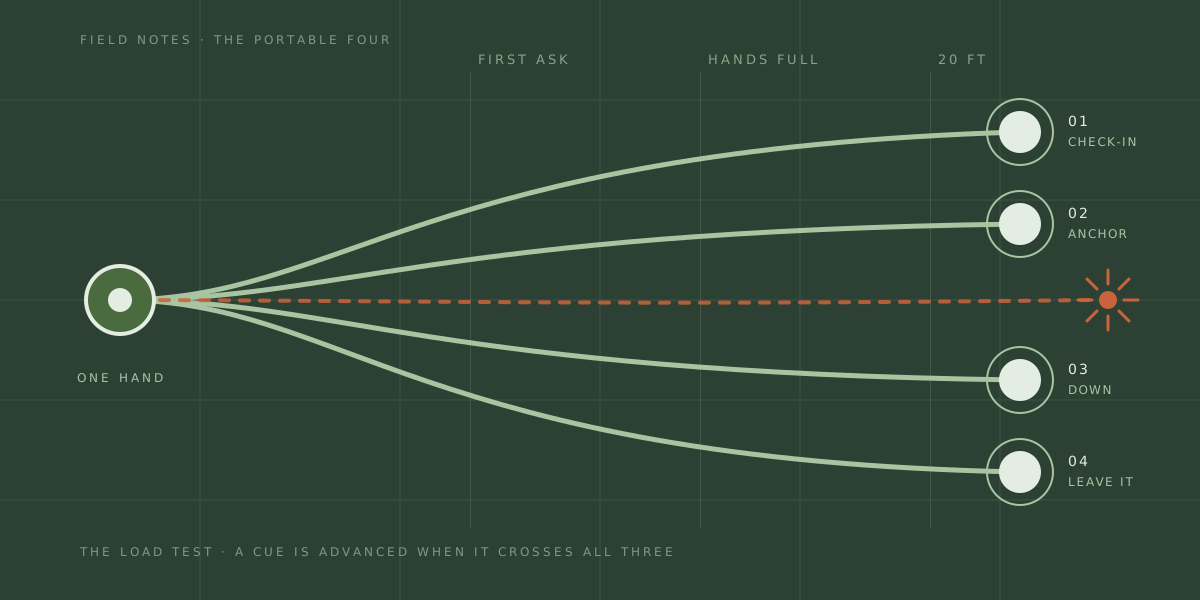
Load is the sum of everything competing with you at the moment you ask. Not in theory. At 7:52. Take any cue a dog supposedly knows and put three questions to it:
- Does it work on the first ask? Not the third. If you find yourself saying a dog's name three times, the dog has not learned the cue. The dog has learned that the cue is name, name, NAME, and you taught that, patiently, over months.
- Does it work with your hands full? If the behavior needs a treat produced from a pocket, a clicker found, or a second hand, you do not have it. You have a thing you can do at home.
- Does it work with another dog inside twenty feet? Not a theoretical dog. A real one, on a leash, pulling toward yours.
Three yeses and the cue is advanced, whatever it happens to be. Two yeses and it is a work in progress, and you now know precisely which condition is failing, which is more diagnostic information than most training plans ever give you. One yes is a party trick. Charming. Useless on a Tuesday.
If that standard sounds like something a walker made up to feel better about not teaching weave poles, consider who else uses it. The AKC's advanced tier above Canine Good Citizen is Community Canine, and its ten test items are performed entirely on leash, in real community settings rather than a ring. Walking past distraction dogs without pulling. Leaving food on the ground on cue. A distance stay on a twenty-foot line while the handler turns their back. Recall with distractions present. Holding a sit-stay three feet from other dogs while the humans make conversation.
Look at that list again. There is not a single novel behavior on it. Every item is something a dog learned in week three of a puppy class. The AKC calls it advanced because of the conditions, not the content. Their definition of advanced is closer to yours than to anything on page one of Google.
A cue you have to ask for twice is not a cue. It is a suggestion the dog is choosing to consider.
This is the most useful thing in this article and it costs nothing to apply. Stop counting behaviors. Start counting first asks. A dog with four cues at first-ask reliability is better trained, by every measure that matters to you, than a dog with fourteen that need repeating.
03 / The frameworkThe Portable Four.
Four cues survive load well enough to earn their place in your hand. Everything else is optional, and I mean that literally: if a dog has these four and nothing else, your walks are safe, calm and good. If a dog has forty behaviors and not these four, you are managing, not handling.
1. The check-in
The dog offers you eye contact without being asked. Not a cue at all, technically, which is exactly why it is first. Everything else in this list requires the dog to already be listening, and the check-in is the behavior that produces listening. A dog who looks at you every twenty or thirty seconds has told you, before the squirrel, that you have an account open.
It is also the only one on this list that works while you are doing something else, which is most of the time. This is what saved Nadia. Not a recall. The four dogs on that coupler had already checked in eleven seconds before the squirrel appeared, so when she said one word, she was interrupting attention that was already partly hers.
2. The anchor
One word, and the dog parks itself at your side or behind your leg and stays there. Not a heel, which is a moving position and much harder. A destination. Somewhere to be when something is coming.
The anchor is your reset. Cyclist on a shared path, loose dog ahead, a kid running at the pack with both arms out: you do not need a plan for each of those, you need one behavior that puts every dog in a known location while you deal with it. On a group walk this is also what the other four dogs are doing while you work with the fifth, which is why it is worth more than its share of your time.
3. The distance down
The dog drops, at range, on a hand signal, without coming to you first.
This is your brake, and it is the one cue on the list worth calling genuinely hard. It matters because the default emergency behavior, recall, asks the dog to travel, and travel is exactly what you do not want when there is a road, a bike, or another dog between you. A down stops the dog where it stands. The hand signal matters as much as the behavior: at forty feet across a park, in wind, your voice is a rumor. Your arm is not.
4. Leave it, under load
The workhorse. Chicken bone on the sidewalk, another dog's tennis ball, something dead in the grass, a toddler's dropped cracker. You will use this more than the other three combined.
The load qualifier is doing real work in that heading. Almost every dog has a leave-it that functions when the dog is calm, the item is boring, and you are close enough to intervene. That version is worthless. The version that counts fires when the dog is already lit up, already at the end of the leash, and already committed. Different behavior entirely, and it is the one on this list most commonly mistaken for trained.
Notice what is not here. No recall, because you should not be relying on one with a client dog off leash, for reasons we will get to. No tricks, though they are excellent for other things and we have written a whole playbook on which ones earn their place. No agility, no scent work, no cooperative care, all of which are genuinely valuable and none of which are available to you at 7:52 with your hands full.
04 / The buildHow to build the Portable Four when the dog isn't yours.
You get forty-five minutes, three times a week, with someone else's dog, on someone else's money. That constraint is not a footnote, it is the design brief.
Invert the ladder
You cannot lower distraction, so lower everything else. Hold distraction at full, which is to say hold it at wherever you happen to be standing, and drop duration and distance to something almost insultingly easy. One second of eye contact in a busy park. A three-foot anchor. A down from six feet, not forty.
This feels like going backwards and it is not. One second of attention in the environment the dog has to work in is worth more than thirty seconds in an empty hallway, because the hallway version does not transfer and the park version is already there. You are building at the top of the ladder with the rungs beneath it missing. That is fine. You were never going to get the lower rungs.
Fold reps into stops you already make
Do not run training sessions on a walk you were paid to deliver. Count the stops in a normal forty-five minute walk instead: the front door, the elevator, the curb, the crossing, the gate, the water break, the second crossing, the pause while someone else's dog passes, the door again. Eight or nine, most days, and you make every one of them whether you train or not.
Each stop is one rep. Nine reps a walk, three walks a week, is twenty-seven reps a week that cost you zero additional minutes and zero client money. That is more repetitions than most owners manage, and all of them happen under load.
Get the owner's handshake first
You have that dog for roughly three hours a week. The owner has it for the other hundred and twenty. If you are using “wait” and they are using “stay” for the same behavior, you are not training the dog, you are teaching it that words are approximate.
The fix takes one message. Ask which words they use for the four, ask what their trainer, if they have one, wants reinforced, and then use their words even when yours are better. Consistency beats correctness here, and it is not close. If you want the longer version of this argument, the same logic drives how walkers should use a training app: match the owner, always.
Dara ran exactly this on Theo, a two-year-old cattle dog mix who arrived with a leave-it his owner swore by and who ate a chicken wing off a curb on day four. Six weeks, one cue, twenty-seven reps a week, all of them at stops the walk was making anyway. At the week-six load test Theo passed two of three: first ask, yes; hands full, yes; another dog at twenty feet, no. So they did not move on. They spent two more weeks at three feet with a decoy dog and then he passed. Eight weeks for one cue on one dog, which sounds slow until you notice it is the first leave-it in that dog's life that has ever been tested.
05 / Anti-patternsWhere advanced dog training goes wrong on a group walk.
Four failures, roughly in order of how much they cost.
Betting a client dog on a recall
A recall that works on a Sunday afternoon with one dog is not the recall you have at 7:52 with four others pulling. Everyone knows this and people unclip anyway, because the dog has been good for months and the field looks empty.
The behavior argument is the weaker one. The money settles it. General liability policies carry a care, custody and control exclusion, which means the client's dog, the thing you are actually being trusted with, is the one thing the policy does not cover. Pet-care policies commonly go further and apply a separate deductible, often around 500 dollars per occurrence, specifically when a client dog is voluntarily released from its leash outside a fenced yard. Read that clause slowly. Your insurer has priced this exact decision and written it down. The upside is a nicer walk. The downside is a dead dog and a claim your policy was built to refuse.
Training on someone else's clock without telling them
If you are running drills, the walk shrinks. The client bought forty-five minutes of walk. Either fold the reps into stops you were making anyway, which is free and honest, or sell the training as its own thing at its own price. What you cannot do is quietly convert a walk into a lesson and let the owner find out from a tracker.
The “he knows it at home” trap
The owner says the dog knows down. The dog knows down in the kitchen, with a treat visible, with nothing else happening, from four feet, on the third ask. You are being handed a completely different behavior with the same name on it.
Do not argue about this. Run the load test on the first walk, write down which of the three conditions failed, and send the owner that line rather than an opinion. “Down works first-ask at home, needs three asks at the curb” is a fact, and facts do not start arguments about whether someone's dog is well trained.
Adding a fifth cue before the first four hold
This is the most seductive one, because adding a behavior feels like progress and proofing one feels like standing still. It is the same instinct that produces a dog with fourteen tricks and no brakes. Four cues, load-tested, in that order. If your instinct is to teach a fifth, teach the fourth again in a harder place instead.
06 / Start hereStart with the check-in.
Pick one dog tomorrow. Not the worst one, and not your favorite. Just one. Run the load test on whatever cue the owner is proudest of and write down which of the three conditions it fails, and then do nothing about it for a week except mark every time that dog looks at you without being asked.
That is it. That is the whole first move. Advanced dog training on a group walk is not a curriculum you buy or a class you send the dog to, it is a standard you apply to things the dog already half-knows, and the standard is the same every time: first ask, hands full, another dog at twenty feet. Most dogs fail it on cues their owners believe are finished. That failure is not bad news. It is the first honest measurement anybody has taken of that dog, and you are the only person in its life standing in the conditions where the measurement means anything.
Nadia still tells that squirrel story wrong, by the way. She says she got lucky. She got eleven seconds of prior eye contact from four dogs on a coupler, on a Tuesday, in a park, because she had spent six weeks marking glances at stops she was making anyway. Nobody gets lucky like that twice.
– DR, on a bench in Prospect Park, waiting out a rain shower