Thanksgiving week is the quietest week of the year in a dog walking business, and the first time it happens to you it feels like a billing error. The phone goes silent. A schedule that has been full since March develops holes you could drive a van through. Fifty-two walks gone out of a hundred and forty, and every cancellation says a version of the same sentence: we are away until Sunday.
Those clients did not vanish. They got on planes. And a decent number of them left a house with a cat in it, which means somebody is letting themselves in twice a day, feeding it, scooping the box, and getting paid holiday rates to do it.
That somebody could be you. Most articles about adding cat sitting services will tell you so, and they will give you the market-size argument: roughly 53 million US households owned a cat in 2025, about 39 percent of all households, and cat ownership grew about 5 percent year over year, driven by Gen Z and millennial buyers. All true, and not the reason to do it.
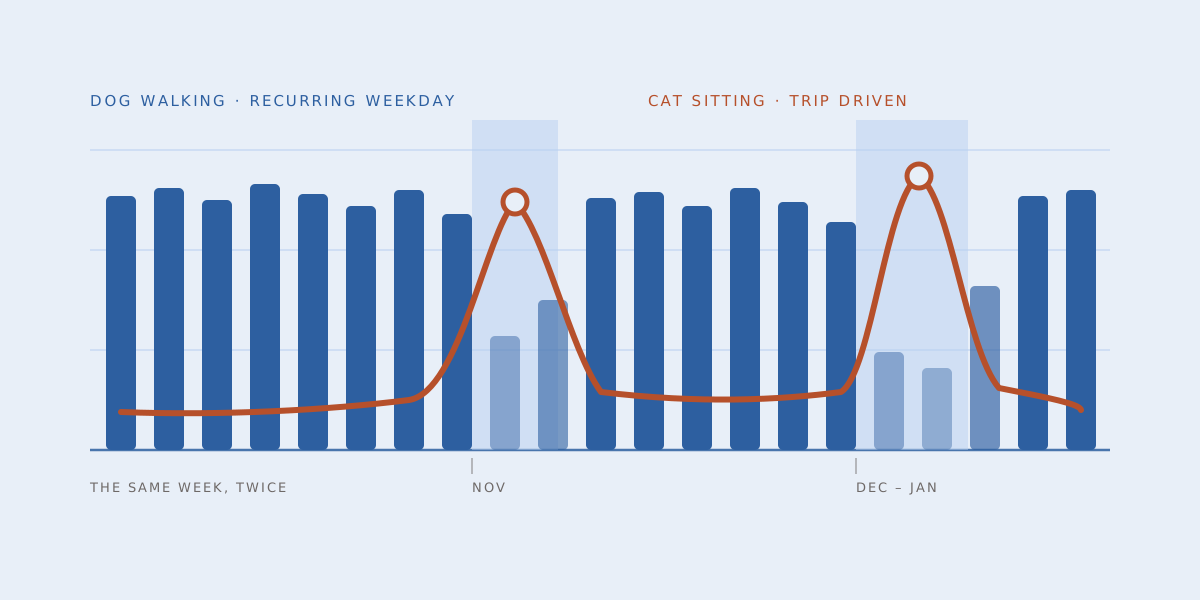
The reason to do it is that cat sitting has the inverse demand curve of dog walking, and almost nothing else you could add does.
01 / The shapeCat demand is the mirror image of dog demand.
Dog walking is a weekday subscription. The client goes to an office, the dog cannot hold it for nine hours, and you solve a problem that recurs every Tuesday. It is beautiful business: predictable, recurring, high retention. It also has one structural weakness, which is that it depends on the client being at work.
When the client is not at work, the walk does not happen. The dog is home with them, or it went to the in-laws, or it is boarding somewhere. Holiday weeks, school breaks, the first week of July. The exact weeks a normal business books its best revenue are the weeks a dog walking business books its worst.
Cat sitting is the opposite instrument. Nobody buys a cat visit because they are at work. They buy it because they are gone. Demand is trip-driven, which means it spikes on the holidays, the long weekends and the summer vacations, and sits relatively quiet in the middle of an ordinary February.
Put those two curves on the same axis and they cross. Your worst dog week is a decent cat week. Your worst four dog weeks of the year are the four biggest cat weeks in the calendar. That is a genuinely unusual property in a second service line, and it is worth more to a walking business than the raw size of the cat market.
Cat sitting is not a bigger version of what you do. It is the counterweight to it.Field Notes · Operations
Which also explains why so many operators bolt it on badly. They treat it as one more line on the price list, sell it to their existing dog clients, and discover in November that they have built a second business with a completely different shape and none of the systems it needs.
02 / The frameworkThe Counterweight Check.
Four things run backwards when you move from dogs to cats. Check all four before you list a price. Each one is cheap to fix in September and expensive to discover on Thanksgiving morning.
One: the calendar
The counterweight only works if you staff for it. Cat bookings arrive in clusters, and the cluster lands on the days your team most wants off. Pet sitters book up four to six weeks ahead for the winter holidays, and often further. If you open a cat book in October and start taking Thanksgiving reservations, you are selling a shift nobody has agreed to work yet.
Decide two things in advance. Who covers the holidays, and what they get paid for it. A holiday surcharge that goes entirely to the business and not at all to the sitter standing in a stranger's kitchen on Christmas morning is a retention problem dressed up as a pricing decision.
Two: the route
This is the one that quietly kills the margin, and it is pure geometry.
A group walk shares an hour across four dogs. One walker, one block of time, four invoices. That is the entire economic engine of dog walking, and it does not exist in cat sitting. Every cat visit is one household, one door, one invoice. There is no such thing as a group cat visit.
So the unit of efficiency stops being the walk and becomes the drive. A 30-minute cat visit in a dense neighborhood, with a lockbox on the gas pipe and street parking, realistically eats 45 minutes of a sitter's day. In spread-out suburbs with a garage code, a storm door and a four-mile hop to the next client, it is past an hour. Eight to ten visits is a full, honest day.
Run that number for your own territory before you quote anything. If your dog clients are clustered in three walkable neighborhoods and your first cat inquiries come from thirty minutes out in every direction, the cat book is not the same business geography and it will not carry the same rate.
Three: the failure
A dog going wrong is loud. It pulls, it lunges, it slips a collar, it eats something on the sidewalk and you know within ninety seconds. Dog risk announces itself, which is why dog walkers get good at handling and recall.
Cat risk does the opposite. Cats are evolved to conceal illness, and the conditions that kill them move fast and quietly. A male cat with a urinary obstruction can go from slightly withdrawn to a genuine emergency inside 48 hours, and the visible signs are subtle: repeated trips to the box producing nothing, crying while trying to urinate, excessive grooming of the genital area, a tense painful belly, hiding.
Which reframes what you are selling. The feeding is not the product. Anyone can put food in a bowl. What a professional cat visit actually delivers is a trained human looking at an animal every day and noticing when something is different. Pet Sitters International has been blunt about this for years: cats need daily visits, and you should not let a client talk you down to every other day because their cat is “independent.”
Four: the key
In dog walking, a key failure costs you one walk. Annoying, recoverable, the dog crosses its legs and the client sighs. In cat sitting, a key failure means nobody enters that house at all, possibly for days, with no backup and an owner in a different time zone.
Access therefore stops being an admin detail and becomes part of the service. The pattern that scales is a client-owned lockbox secured somewhere discreet on the property: a side gate, a rear rail, a gas pipe, not the front door handle where it advertises an empty house. The key stays at the address. Any sitter you assign can cover the visit without a handover. Put two keys in the box so a bent key does not end the booking, and insist on a physical key even where there is a keypad, because batteries die and power fails.
03 / The unitPrice a block of time, not a list of cat tasks.
The single most common mistake in cat pricing is itemizing. A base visit, then a dollar for medication, two for the litter box, two more for plants, one for the mail. It feels fair and it creates arguments, because every client believes their add-ons are the ones that should have been included.
Time To Pet has argued the better position for years and it holds up: sell duration. Fifteen minutes, thirty minutes, sixty minutes. Everything you do inside that window is included. If a cat needs more done, it needs a longer visit, and a longer visit has a published price. You are not charging for litter. You are charging for half an hour of a trained person's day, which is the thing that actually costs you money.
Here is where published US rates sat in 2026.
| What you sell | Published US range | What moves it |
|---|---|---|
| Drop-in visit, 15 min | $18 – $25 | Density of your route |
| Drop-in visit, 30 min | $20 – $35 | The standard unit |
| Drop-in visit, 60 min | $30 – $50 | Multi-cat, shy cats, medication |
| Two visits per day | $40 – $70 | Kittens, seniors, insulin |
| Overnight in-home | $50 – $95 | Sitter sleeps at the property |
| Each additional cat | +$5 – $15 | Per visit, not double |
| Medication | +$5 – $20 | Injections and sub-q fluids |
| Holiday surcharge | +$5 – $20 | Or 15% to 30% of the visit |
Two notes on that table before you copy a number out of it.
The first is that marketplace rates and independent rates are not the same rates. Platforms publish their cut: Rover and Mad Paws take 20 percent from the sitter, Pawshake 19 percent, and Rover charges owners a separate 11 percent booking fee at checkout. A $30 listing on a 20 percent platform is a $24 job. If you are pricing against what you see on a marketplace, you are pricing against a number that has already been reduced.
The second is the holiday surcharge, and you should launch with it rather than add it later. Fifty-eight percent of PSI member businesses already charge one, and for nearly half of those it sits between five and ten dollars a visit. Introducing a surcharge to clients who booked without one is a conversation. Publishing it on day one is a policy.
If a cat visit and a dog walk take the same half hour of the same person's day, they should not be priced twenty percent apart because one of them involves a leash.
Price the hour. Let the animal be a detail of how the hour gets spent.
04 / WorkedOne operator, two demand curves.
Tasha Okoro runs six walkers in Raleigh. Her core book is 140 midday walks a week at $26, which is $3,640 in a normal week, and it has been steady enough for three years that she stopped watching it.
Thanksgiving week 2025, 52 of those 140 walks cancelled. Thirty-seven percent of the week, gone, worth $1,352. Her fixed costs did not move. Her walkers still wanted hours. She had known it was coming and had still somehow budgeted as though it were not.
For 2026 she added cat sitting in September, which gave her ten weeks to run the Counterweight Check and take bookings. By the first week of November she had nine cat households confirmed for the Thanksgiving period, all of them twice-daily, all four days.
The number that matters is not the $2,592. It is that the work landed in the hours the walk schedule had just vacated, covered by walkers who would otherwise have been sent home, on a route she had already checked for drive time. Nine households is a small book. It was enough to turn the worst week of her year into an ordinary one.
The part she got wrong is worth having too. She priced medication as an add-on for the first month, then hit a diabetic cat needing insulin twice daily and a sitter who was not comfortable giving injections. She moved medication into a 45-minute visit tier and assigned it to two named sitters. Both fixes took an afternoon. Both would have been free in September.
05 / The visitWhat a cat visit is actually for.
If detection is the product, the intake form and the visit routine are where you build it.
Cat intake needs six things a dog intake usually skips. Where the cat hides, because a sitter who cannot find the cat has not finished the visit. How the cat reacts to strangers, and how it reacts to the owner being gone. Any bite or scratch history, toward people and toward other animals, and ask directly rather than waiting to be told. The litter box baseline: how many boxes, where, and what normal looks like. The medication schedule with the actual route of administration written down. And the vet's details with written authorization to seek treatment, because the owner may be over the Atlantic when you need a yes.
On the box count, give clients the standard while you are there: one litter box per cat, plus one, placed somewhere the cat feels safe rather than next to a washing machine that starts a spin cycle mid-visit. It makes your visits cleaner and it makes the cat more likely to use the box, which is what makes the box readable.
Then standardize how a visit ends. Four observations, every time, logged before the sitter gets back in the car.
- Did the cat eat? Not “was food put down.” Was yesterday's bowl empty.
- Did the cat drink? Water level, and whether the bowl or fountain is still upright and working.
- What was in the box? Urine clumps and stool, counted roughly. A box with nothing in it after 24 hours is the single most important thing a cat sitter can notice.
- Did you physically see the cat? Eyes on the animal. Under the bed with a flashlight if that is what it takes.
That last one gets skipped more than any other, and it is the one the whole service rests on. A shy cat that hid for the first three visits and hid for the fourth looks identical in the notes to a cat that hid because it was in pain. Getting on the floor and looking is thirty seconds. It is also the difference between a report and an observation.
Two more things worth building in. Cats need roughly 30 minutes of moderate activity a day, so play is part of the job rather than a bonus, and a wand toy in the bag costs eight dollars. And leave the litter area cleaner than you found it, sweeping tracked litter off the floor and out from under the mat. Clients notice that one specifically, and it generates more referrals than any marketing you will buy.
06 / Anti-patternsFour ways operators get this wrong.
“Cats are easier, so we'll charge less.” The visit takes the same half hour and carries more diagnostic responsibility, not less. A dog walk has the owner home that evening to catch anything you missed. A cat visit is often the only human contact that animal has for a week. Pricing cat work below dog work trains clients to treat it as the budget option and trains your sitters to rush it.
“Every other day is fine for a confident cat.” This is the client's request, not your policy, and the gap between them is exactly where the bad outcome lives. Put daily visits in the contract as a term. If a client will not accept daily visits, decline the booking. You are not being rigid; you are declining to be the person who found the cat on day three.
“Our dog walking insurance covers it.” Check the declarations page rather than assuming. Pet-specific programs list covered services explicitly, and cat work raises two exposures at once: care, custody and control, because standard general liability excludes animals in your care as property, and lost key liability, which pays to re-key a home and commonly caps around $2,000. You will be inside empty houses far more often than you were as a walker.
“We'll hold the keys at the office.” It works until you have forty clients, a sitter calls out, and the coverage depends on somebody driving across town to a key cabinet at 6am. Client-owned lockboxes at the property remove the handover entirely and make every visit coverable by whoever is nearest. Retrofit them onto forty existing clients and it is a project. Start with them and it is a line in the onboarding email.
07 / Take this with youThe short version.
Adding cat sitting services is not a marketing decision about a bigger animal market. It is a scheduling decision about the four weeks a year your core business stops working.
- Check your own troughs first. Pull twelve months of walk volume and mark the worst four weeks. If they are the holiday weeks, the counterweight argument is true for you specifically, not just in general.
- Price by duration, never by task. Fifteen, thirty, sixty. Litter, medication, plants and mail all live inside the time you sold.
- Launch with the holiday surcharge. Adding one later is a negotiation with every existing client. Publishing it on day one is just a price.
- Test the drive time before you quote. Cat visits never share an hour. Eight to ten a day at real density, and you should prove that number in your own territory.
- Make detection the standard, not the extra. Ate, drank, box, eyes on the cat. Four observations, every visit, logged before the car door shuts.
If you only do one thing this week, do the first one. Open last year's schedule, find the week you lost the most walks, and count how many of those cancellations came from a client who owns a cat as well as a dog. In most books it is somewhere between a third and a half, and they were all paying somebody.
Figures in this article are drawn from the American Pet Products Association 2026 State of the Industry report, published 2026 US cat sitting rate guidance from Petful, Petworks and The Pet Sitter, Pet Sitters International guidance on cat-sitting visits and holiday surcharges, Time To Pet guidance on duration-based service pricing and key management, and published platform commission rates from Rover, Mad Paws and Pawshake as of September 2026. Rates vary by market and change over time. Tasha Okoro is a composite example and the arithmetic in her section is illustrative. Nothing here is veterinary, legal or insurance advice, and no article replaces reading your own policy schedule or calling your own vet.