Pet Sitters International surveys its US members every year, and the 2026 numbers describe a healthier industry than most operators feel like they are working in. Average gross revenue per business hit $112,423 in 2025, up from $100,537 two years earlier. The average member served 113 households and completed 4,200 visits.
Divide the second number by the third. That business collected $26.77 per completed visit.
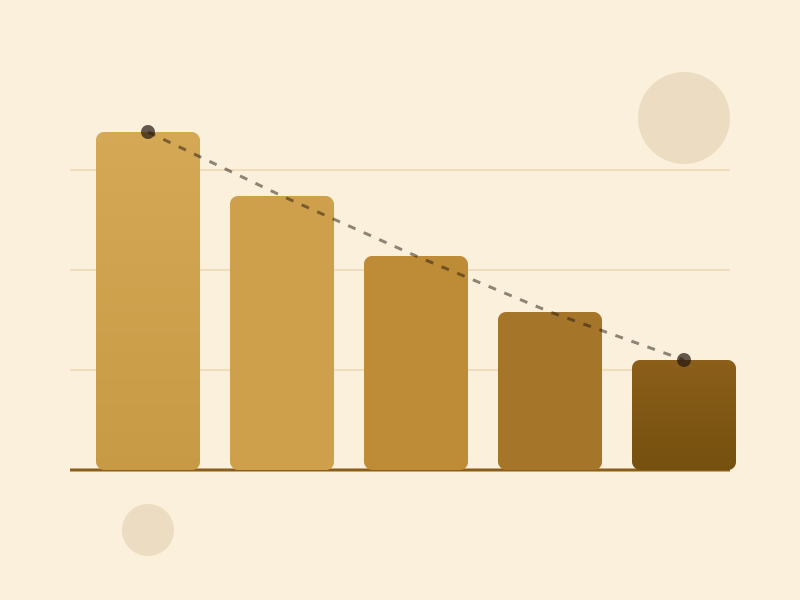
Now open any rate guide. A 30-minute drop-in lists at $25 to $35. Time To Pet, pulling from the software its customers actually bill through, puts the national average nearer $34. So a professional pet sitting business, running four thousand visits a year, with insurance and software and a real client list, is realizing something like seven to eight dollars a visit less than the number it publishes on its own website.
That gap is not a rounding error and it is not incompetence. It is the structure of the business showing through. And every article about pet sitting rates that stops at the averages leaves you holding the wrong number.
01 / The gapThe listed rate and the collected rate are different animals.
Four things sit between what you publish and what lands in the account, and none of them are visible on a rate page.
Multi-visit and recurring discounts. A weekly rate of $310 across five days of twice-daily visits is not ten visits at $31. Almost every operator running recurring clients has a package price, and package prices are discounts wearing a nicer name.
The mix. A 15-minute potty break and a 60-minute visit both count as one visit in your total. If a quarter of your volume is short visits, your average collapses toward the short-visit price even though your headline rate never moved.
Cancellations absorbed. Most operators have a cancellation policy and most operators waive it for good clients. Every waiver is a completed slot with no revenue against it.
The unbilled minute. This is the big one, and it is the reason rate guides written for pet owners are useless to someone running the business. A 30-minute visit is not thirty minutes of your day. It is the drive there, the visit, the notes, the photos, the lock-up and the drive to the next one.
Run the arithmetic on a single visit. Thirty minutes on site, twelve minutes of driving, three minutes writing the report and uploading photos. That is 45 minutes of clocked time for one billable unit. At $34, the hourly equivalent is $45.33 before a cent of overhead comes out. Push the drive to twenty minutes, which is normal in a spread-out suburb, and the same visit is 53 minutes of your life for $38.49 an hour.
Density is therefore not a nice-to-have. It is the single largest variable in whether a pet sitting business pays anybody properly, and it is invisible in every published rate table in the industry.
You are not paid for the visit. You are paid for the visit plus the drive, and only one of those appears on the invoice.Field Notes · Pricing
02 / The numbersWhat a visit actually pays in 2026.
Here is the honest picture, with the caveat that these are national figures and the national figure is a fiction that no individual market obeys.
| Service | Typical range | Working average |
|---|---|---|
| Drop-in visit, 30 min | $20 to $35 | $25 to $34 |
| Drop-in visit, 60 min | $30 to $45 | $38 to $44 |
| Dog sitting visit, 30 min | $25 to $45 | $32 |
| Overnight in client home | $75 to $150 | $97 |
| Full day care, 8 to 10 hrs | $100 to $175 | $140 |
| Five-day week, drop-ins | $250 to $375 | $310 |
| Additional pet, per visit | $5 to $10 | $5 to $8 |
| Holiday surcharge | +25% to +50% | +30% |
Two things worth understanding about that table before you use it.
First, sources disagree by design. HomeGuide and Thumbtack track what consumers report paying, which skews low because it includes casual and platform sitters. Time To Pet pulls from businesses billing through professional software, which skews high because those are established operations. Pet Sitters International surveys its own members, who are, by definition, people who joined a professional association. None of them are wrong. They are measuring different populations, and the population that matters is the one in your zip code.
Second, the geographic spread is larger than the service spread. A 30-minute drop-in in San Francisco or Boston runs 40 to 60 percent above the national median. Chicago, Denver, Austin and Miami sit 20 to 30 percent above. Rural and small-town markets run 10 to 15 percent below. That means a Seattle sitter charging the national average is losing roughly a third of their revenue, and a rural Ohio sitter charging the national average is pricing themselves out of their own town.
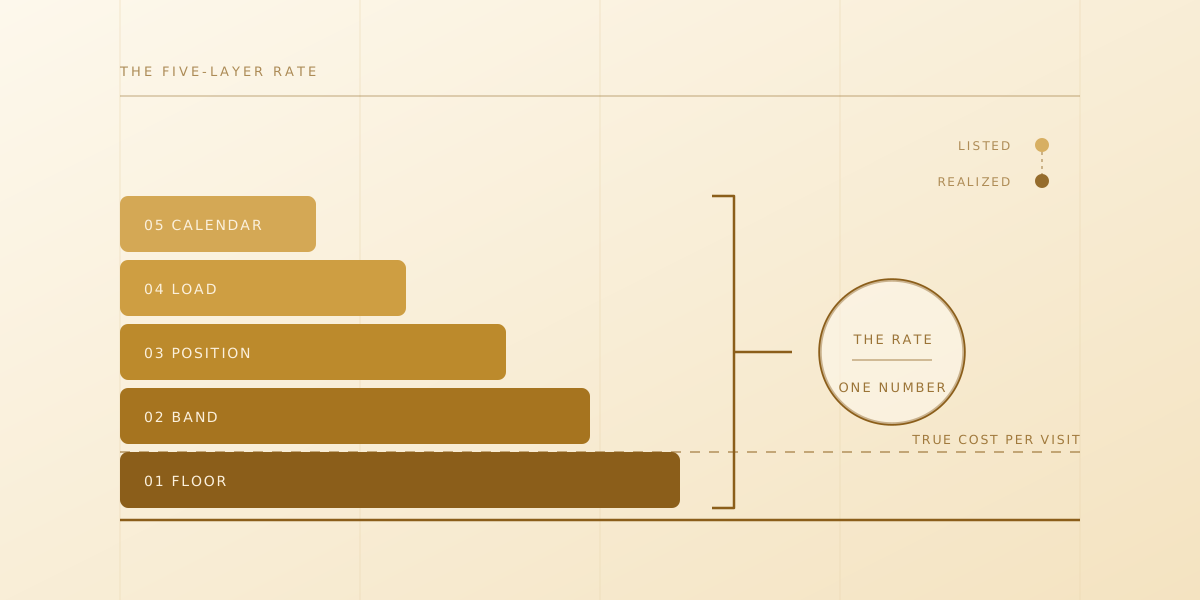
03 / The frameworkThe Five-Layer Rate.
The mistake almost every operator makes at the start is beginning with someone else's price. You look at three local listings, pick a number slightly below the middle one, and go. It feels like research. It is actually inheriting a stranger's cost structure, their vehicle, their insurance policy and their tolerance for being underpaid.
Build from your own numbers instead, in five layers, from the ground up.
Layer one: the floor
Add every fixed cost the business carries in a year. General liability insurance runs $300 to $800. Bonding for theft and property damage runs $150 to $400. Scheduling software, a business license, accounting, a share of the phone bill. For most solo operators that lands somewhere near $1,900 to $2,400.
Then add the vehicle, which is usually the largest single line and the one people forget. At roughly seventy cents a business mile, nine thousand miles is $6,300. That number alone is bigger than everything else combined.
Divide the total by the visits you genuinely complete in a year, counting only the weeks you actually work. A solo sitter doing five visits a day, five days a week, across 46 working weeks completes 1,150 visits. Against $8,200 of annual cost, the floor is $7.13 per visit.
That is the number below which a visit costs you money to perform, before you have paid yourself anything at all. Most operators have never calculated it, and almost all of them guess low.
Layer two: the band
Open five live listings in your own zip code for the same service and duration. Not the national average, not what a guide says your metro tier should be. Five real prices from five real businesses currently taking bookings. Write them down. That range is your band, and it is the only market data that describes the actual choices your clients have.
Do this once a year on a fixed date. Local rates drift upward, and an operator who set a price in 2024 and never checked is almost certainly underpriced by now.
Layer three: position
Where you sit inside the band should rest on evidence a client can verify, not on how confident you feel. Four things move you up: years in operation, count of genuine reviews, pet first aid and CPR certification, and carrying real insurance with a written service agreement.
A new sitter with no reviews starts at the low end of the band and stays there for about a year. Ten or more verified reviews plus basic certification is worth 10 to 15 percent. Fifty or more reviews and a professional pet first aid credential is worth 15 to 25 percent. A five-year operator with a hundred reviews, multiple certifications and medical-needs experience can hold the top of the band and should.
The move operators get wrong is waiting too long. Position is not a reward for endurance, it is a reflection of the risk you remove from the client, and the risk drops fast in the first eighteen months.
Layer four: load
Load is everything that changes per booking. Additional pets at $5 to $8 each. Complex medication, meaning insulin or multi-dose regimens rather than a pill in a treat, at $5 to $10. Outside the service radius. Booked inside 48 hours. Key pickup and return.
The principle is that the base rate buys a standard visit for one pet, and anything that adds time, skill or risk gets its own line. The first pet absorbs the fixed overhead of the trip. Each additional pet is mostly incremental care time, which is why a flat per-pet fee works better than a percentage.
One caution, and it runs against the way most rate guides handle this: do not line-item the routine. Time To Pet's guidance here is right. Giving oral medication, changing a litter box, bringing in the mail and watering a plant all belong inside the visit duration. If they push the visit long, sell a longer visit. A menu of dollar-fifty surcharges reads as nickel-and-diming and costs more in goodwill than it collects.
Layer five: calendar
Holidays are when demand exceeds the supply of sitters by the widest margin in the year, and pricing should say so. A 25 to 50 percent surcharge is standard. Thanksgiving, Christmas, New Year's Eve and the Fourth of July commonly justify 50 to 100 percent.
Two rules make holiday pricing hold. Publish the dates and percentages before the season, so nobody is surprised, and apply them to everybody without exception. Then set a minimum booking length during peak weeks, usually two or three nights, because holiday capacity is the scarcest thing you own and single visits during it crowd out multi-day bookings worth four times as much.
The floor-derived base, the load menu and the calendar dates belong together, visible, before anybody books. A surcharge a client agreed to in advance is a policy. The same surcharge discovered on an invoice is an argument, and you will lose it even when you are right.
This is also the cheapest sales asset a pet sitting business owns. Operators who publish full rates get fewer inquiries and close a far higher share of them, because the people who call have already accepted the price.
04 / WorkedTwo operators, same framework, different answers.
Dana Whitfield is solo, three years in, working out of Asheville. Her floor is $7.13. Her local band for a 30-minute drop-in runs $26 to $38. She has 41 reviews and a Pet Tech first aid certificate, which puts her comfortably in the upper middle: $33. Load menu of $6 per extra pet, $8 for insulin, $15 inside 48 hours. Calendar surcharge of 30 percent on eight published dates.
At 1,150 visits a year that is $37,950 gross, $29,750 after costs, and roughly $22,300 in her pocket after setting aside 25 percent for self-employment and income tax. Which is a working wage in Asheville and not much more, and Dana knows it, because she did this arithmetic instead of guessing.
Here is the part the rate guides never get to. Dana cannot fix that with her rate. Pushing to $40 a visit, which is above her band, would take her to $28,000 in pocket at the cost of her competitiveness. The number that actually moves is density. Her average drive between visits is nineteen minutes. Tightening her territory to three adjacent neighborhoods cuts it to nine, which buys her three more visits a day inside the same working window. At $33, eight visits a day across the same 46 weeks is $60,720 gross and roughly $37,000 in pocket. Same rate. Same hours. Sixty-five percent more income.
Tomás Beltran runs nine sitters out of Sacramento, about 2,900 visits a quarter. His floor is different in kind, not just in size, because his largest cost is payroll rather than mileage. He pays sitters $19 an hour with a visit-based bonus, which works out to roughly $16.50 of direct labor per 30-minute visit once travel time is paid.
That single number changes the whole calculation. Tomás cannot charge $33 and survive, because $33 minus $16.50 of labor minus $4 of allocated overhead leaves $12.50 of gross margin per visit, and that has to cover admin salary, marketing, software at scale, insurance for nine people and his own income. His band supports $38 to $52 in the Sacramento metro. He sits at $44, and the gap between his rate and Dana's is almost entirely the cost of not being the person doing the visit.
05 / Pay-throughWhat changes the moment you hire.
Every pet sitting rate guide on the first page of Google is written for a solo sitter. The moment you employ somebody, the arithmetic inverts, and nobody warns you.
The number that matters is the pay-through ratio: the share of the client's payment that leaves as sitter compensation. Most healthy operations land between 45 and 55 percent. Below 40 percent you will struggle to keep good sitters. Above 60 percent the business cannot fund its own overhead and you are running a job with extra paperwork.
Three things push the ratio in directions people do not expect.
Paid travel time is not optional and it is expensive. If you pay hourly and you pay for drive time, every minute of inefficient routing comes out of margin rather than out of the sitter's day. A business with 19-minute average drives and paid travel is spending roughly a third of its labor budget on driving. The same business at 9 minutes is spending a sixth. Density is a margin lever twice over once you have staff.
The holiday surcharge has to be shared. If a client pays 50 percent more on Thanksgiving and the sitter working Thanksgiving gets standard pay, you will not have sitters next Thanksgiving. Pass a meaningful share of the surcharge through, publish that policy internally, and holiday coverage stops being an annual crisis.
Employer costs are real and get forgotten. Payroll taxes, workers compensation, and the administrative time to run a team all sit between the client's payment and the sitter's paycheck. Budget them into the floor at the start rather than discovering them in the first quarter.
Operators who grow from solo often keep their solo rate and simply hire underneath it. It works for about six months, because the founder is still doing half the visits and absorbing the shortfall with their own unpaid time.
Reset the rate at the point you hire, not at the point it starts hurting. A rate that supported one person doing everything cannot support two people doing the same work, and the arithmetic does not care how long you have been charging it.
06 / StickingThe increase that does not cost you clients.
Setting a rate is the easy half. Moving an existing client from an old rate to a new one is where most operators freeze, and the freezing is expensive: a business that has not raised prices in three years has quietly given away most of a decade of inflation.
The mechanics that work are unglamorous and consistent across every operator who does this well.
- Pick a fixed annual date and never move it. Predictable increases are accepted. Surprise increases are negotiated. Announce in the same month every year and clients stop reacting to it at all.
- Give 30 to 60 days of written notice. Email, not a mention at handover. Written notice also means the new rate is documented if anyone queries an invoice later.
- Keep it modest. Five to eight percent annually is absorbed. Twenty percent, after four years of not raising, is a shock, and the shock is what loses clients rather than the amount.
- Do not announce in December or in tax season. The same increase lands differently in October than it does the week before Christmas.
- Attach something visible. More detailed visit reports, extra photos, a wider booking window. It does not have to be expensive. It has to be noticeable.
- Give long-standing clients one booking at the old rate. A small courtesy that costs almost nothing and converts the conversation from a price change into a relationship.
Every operator who has done this reports the same thing afterward: they worried about a mass exodus and it did not come. The clients who leave over a well-communicated 6 percent increase are, with reliable consistency, the clients who were already the most work for the least money.
07 / Anti-patternsSix ways operators price themselves poor.
Racing to the bottom to win the first ten clients. Underpricing does not attract loyal clients, it attracts price-sensitive ones, and price-sensitive clients leave for the next cheap sitter. Worse, a low rate signals inexperience rather than value, and it is far harder to raise a rate on a client who chose you for being cheap.
Pricing hourly. Hourly rates punish you for getting faster and invite arguments about minutes. Price per visit and per night. A sitter who finishes a 30-minute visit in 24 minutes because they know the dog should not earn less for it.
Building a service menu with fourteen items. Cat visit, dog visit, morning walk, evening walk, weekend visit, holiday visit, medication visit. Most of these take the same time and should be the same price. Three durations plus an add-on menu covers almost every business, and it makes scheduling, invoicing and payroll dramatically simpler.
Line-iteming insurance and fuel. These are legitimate costs and they belong inside the base rate. A client wants one clear number. A quote broken into six small fees reads as untrustworthy even when every fee is honest.
Forgetting the platform cut. If some of your volume comes through a marketplace taking 20 percent, that is not a marketing cost, it is a rate cut. A $35 booking is a $28 booking. Either price differently on-platform or treat platform work as acquisition rather than as revenue.
Setting the rate once and treating it as settled. Costs move every year. Insurance renews higher, fuel moves, the local band drifts. A rate is a decision you make annually on a scheduled date, not a thing you decide at the start and inherit forever.
08 / Take this with youThe short version.
Pet sitting rates look like a market question and they are mostly an arithmetic question. The market tells you the band you can operate in. Your own costs, your own density and your own staffing tell you where inside that band you have to sit to make the business work, and those three things vary enormously between two operators on opposite sides of the same city.
- Calculate your floor. Fixed costs plus mileage, divided by real annual visits. Most operators have never done this and almost all guess low.
- Find your band from five live local listings. Not a national average. Five real prices, refreshed on a fixed date every year.
- Position on evidence, and stop waiting. Reviews, certification, insurance and a written agreement all justify moving up the band, and the first move should come inside twelve months.
- Publish load and calendar before the season. A surcharge agreed in advance is a policy. Discovered on an invoice, it is an argument.
- Fix density before you touch the rate. Cutting average drive time from nineteen minutes to nine is worth more than any price increase you could survive charging.
If you only do one thing this week, do the floor. It takes about forty minutes with a bank statement and a mileage estimate, and it produces a single number that changes how every subsequent pricing decision feels. Most operators finish that calculation slightly angry. That is the correct reaction, and it is a much better place to price from than a competitor's website.
Figures in this article are drawn from Pet Sitters International salary and State of the Industry survey data, Time To Pet national rate calculator averages, a Calday market study of 237 independent pet sitting businesses across 42 states, and HomeGuide consumer cost tracking. Rate ranges are national and will not match any individual market. Vehicle cost is calculated at approximately seventy cents per business mile; confirm the current IRS standard mileage rate before using it in your own figures. This article is not tax, legal or insurance advice.