
Buying pet sitting insurance takes about ten minutes, which is roughly ten minutes less than reading it. That asymmetry is the whole problem. Every provider in this market leads with the same headline: a million dollars per occurrence, two million aggregate, proof of insurance in your inbox before you finish your coffee. Six providers, six identical headlines, six wildly different answers to the only question that ever gets asked in anger, which is what happens when a dog you are looking after ends up on a surgical table.
This piece is not another list of coverage types. If you want the list, the companion piece on what dog walking insurance actually covers lays out the five-cover stack and which tier you need at which size. This one assumes you already have a policy, or three quotes open in tabs, and you want to know which one is real. It comes down to five numbers, and only one of them is on the marketing page.
01 / The gapThe $2,500 limit and the $24,608 claim.
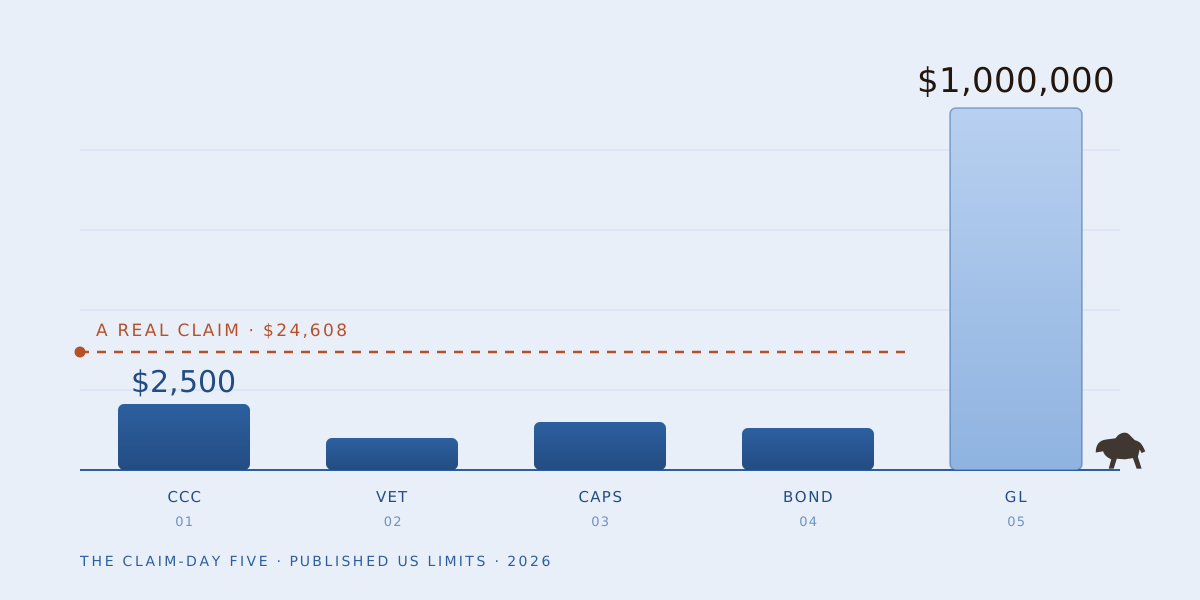
Start with the arithmetic that made me rewrite my own policy. Pet Care Insurance publishes its limits openly, which is more than most competitors do, and its standard pet sitting policy carries general liability of $1,000,000 per occurrence against animal bailee cover of $2,500 per incident and $5,000 per year. Veterinary reimbursement, the part that pays regardless of fault, sits at $1,000 per incident with a $250 deductible.
Now put a real claim next to it. Pet Sitters International publishes payouts from claims handled through its group policy. A dog hit by a car requiring multiple surgeries and physical therapy: $24,608. A cat given too much insulin: $13,433. A dog killed by another dog while in a sitter's care: $22,378. A sitter who left a toilet running and damaged the contents of a client's home: $29,832. Death claims involving clear negligence have reached $50,000.
Both of those facts sit inside policies that say “covered.” The word is doing very little work.
The gap is not fraud and it is not a trick. Entry-level policies are priced for entry-level exposure, and $29.43 a month buys what $29.43 a month buys. The failure is that nothing in the buying flow tells you the sublimit is the operative number. You are shown a million dollars, you feel insured, and the $2,500 line sits four screens deep in a coverage table you scrolled past on your phone in a parking lot.
02 / The exclusionCare, custody and control is where every claim lands.
Here is the mechanism, and it is worth understanding rather than memorizing, because it explains why the sublimits exist at all.
Almost every general liability policy written for a small business contains a care, custody and control exclusion. It removes cover for damage to property that is in your possession at the time. The logic is sound from the insurer's side: a general liability policy is designed to pay for harm you cause to the outside world, not for the things you were entrusted with and mishandled. A house painter's general liability pays when a ladder falls on a passerby, not when the painter ruins the antique dresser he was supposed to move.
Insurers classify a client's pet as property. So the exclusion applies. Your standard general liability policy will pay handsomely if a dog you are walking bites a stranger, and will pay nothing at all if that same dog is hurt.
That is not a marginal edge case for a pet sitter. It is the job. The overwhelming majority of pet sitting claims involve the animal itself: a dislocated hip during play, a swallowed ball, a slipped collar, a fight at a dog park, a medication error at a drop-in visit. Every one of those falls squarely inside the exclusion that a standard policy carries.
Which is why specialist pet policies buy the cover back, under names that vary just enough to be confusing: animal bailee, pet protection, or plainly care, custody and control. Same thing. It is an endorsement bolted onto general liability, and because it is an add-on it comes with its own, much smaller, limit.
The general liability number is the size of your policy. The care, custody and control number is the size of your protection. On most entry-level pet sitting policies those two figures differ by a factor of four hundred.
Association group policies price this differently. The Pet Sitters International policy written through Business Insurers of the Carolinas mandates care, custody and control cover and then offers a ladder of limits from $10,000 up to $200,000 per occurrence. The agency's own reported observation is worth quoting plainly: the most common mistake it sees is sitters in their second or third year, arriving after a claim, who had chosen the $10,000 option without understanding what it was, and discovering that $10,000 no longer covers what it once did.
03 / The frameworkThe Claim-Day Five.
Five numbers, checked in this order, tell you what your policy does on the worst day of your year. The order matters, because it runs from the number most likely to fail to the number least likely to. Most people read it exactly backwards.
One: the care, custody and control limit, both halves.
Find the per-incident figure and the annual aggregate, because sitters read the first and get caught by the second. A $2,500 per-incident limit against a $5,000 annual limit means precisely two bad days before the cover is gone for the rest of the policy year. Carry at least $25,000 per incident. If you take multi-dog households, senior pets on medication, or any off-leash work, carry more.
Two: veterinary reimbursement and its deductible.
This is a separate, smaller pot and it does a different job. Care, custody and control pays when you are found liable. Veterinary reimbursement pays regardless of fault, which is what you need at 9pm on a Sunday when a dog has swallowed something and nobody is assigning blame yet. Typical limits run $1,000 per incident with a $250 deductible. An emergency exploratory surgery in 2026 starts north of $3,000. Know that the gap exists before you are standing at the counter.
Three: the caps that quietly void everything above.
This is the number almost nobody checks and the one that turns a covered claim into an uncovered one. Published policy caps include a maximum of five pets at any one time and a maximum of 30 consecutive days for a single engagement. There is often a service-mix condition too, such as house sitting with no pet present being limited to 25 percent of annual revenue. Dogs with a dangerous-dog designation or a bite history are excluded outright.
None of those caps announce themselves. You breach them by growing. The six-dog Thanksgiving booking and the five-week client trip are the two most common ways a fully paid-up policy stops applying, and both of them look like good news when they land in your inbox.
Four: the bond, and its two conditions.
A bond is not insurance. It is a guarantee that your client gets paid if someone in your business steals from them, after which the bonding company goes after the person responsible. Two conditions decide whether yours is worth anything. First, who counts as an employee, because narrow definitions exclude owners and independent contractors, and if you run on contractors that exclusion covers most of your workforce. Second, whether it requires a criminal conviction before it pays, which in practice means most claims never pay at all. The Pet Sitters International bond covers owners, employees and contractors and carries no conviction clause. Some employee dishonesty products, priced around $4.92 a month for $10,000 per occurrence, skip the credit check and the conviction requirement entirely. Others do neither.
Five: general liability, checked last.
Almost every specialist pet policy sold in the US carries $1,000,000 per occurrence and $2,000,000 aggregate. It is the number on every landing page precisely because it is the number nobody competes on. Confirm it, then move on. The odds that general liability is the constraint on your claim are low, and the four numbers above it are where the money actually stops.
04 / In practiceMarisol reads her own policy in ten minutes.
Marisol Vega runs a six-sitter pet sitting operation in Austin. Drop-in visits, overnights, and a growing boarding-at-the-sitter's-home line that now brings in a third of revenue. She has carried the same policy for four years at $34 a month and has never claimed. Here is what ten minutes with the coverage table turned up.
One, care, custody and control. $2,500 per incident, $5,000 per year. Her largest regular client is a household with three dogs, one of them a nine-year-old shepherd on daily medication. A single bad reaction would exhaust the per-incident limit before the first overnight stay at the emergency clinic was billed.
Two, veterinary reimbursement. $1,000 per incident, $250 deductible, seven-day waiting period from policy start. Adequate for a laceration. Not adequate for anything requiring anesthesia.
Three, caps. Five pets at once. In November she took a booking for six. She had not read the cap and would not have found out about it until she needed to.
Four, bond. None. Four of her six sitters are 1099 contractors, and the bond quote she had bookmarked defined employee in a way that excluded all four.
Five, general liability. $1,000,000 and $2,000,000, exactly as advertised, and entirely beside the point.
I had a million dollars of cover and two and a half thousand of protection. I could not tell you which one I thought I was buying.– Marisol V., Austin, six sitters, nine years
Her fix cost $23 a month. She raised care, custody and control to $25,000, added the higher veterinary reimbursement tier, added an employee dishonesty endorsement that covers contractors, and put a hard cap of five pets into her booking rules so the system refuses the sixth rather than relying on her to remember. The premium went from $34 to $57 a month. Against a $24,000 claim, that is a rounding error, and against six sitters holding keys to forty homes it is arguably the cheapest line in the business.
Note what she did not do. She did not switch providers, and she did not shop around for a cheaper headline. She adjusted four numbers inside a policy she already owned. That is available to almost everyone reading this, at renewal, this year.
05 / The hireWhat changes the day someone else holds the keys.
Solo sitters and sitters with staff are running two different risk businesses under one job title, and the policy that fits the first is quietly wrong for the second.
Three things change on the day you hire. Workers' compensation becomes the coverage that matters most, because liability insurance never pays for injuries to you, your partners, your employees or your contractors. A dog bite to your own hand is not a liability claim and never was. Insureon puts median workers' comp for pet sitting businesses at $102 a month, which is more than most sitters pay for everything else combined, and in California, Pennsylvania and New York it is mandatory from the first employee. Florida requires it at four. Texas leaves it optional and leaves you exposed.
Theft cover stops being a marketing badge and starts being a real exposure, because you now have people you did not personally vet holding physical keys and lock codes for dozens of homes. And the classification question arrives: if your 1099 contractors are scheduled by you, wearing your shirts and following your protocols, a state auditor may well reclassify them, and both your workers' comp exposure and your bond definitions change retroactively when that happens.
There is one operational habit worth adopting alongside all of this. Claims are paid on evidence, and the evidence is your visit records. Time stamps, photos, the note that says the dog was already limping at pickup, the message where the client approved the off-leash park. Sitters who keep that record in a scheduling system get paid. Sitters who keep it in memory and a group chat argue about it for four months.
06 / Anti-patternsFour ways sitters find out at the worst possible moment.
- Buying on the headline number. Six providers offering $1,000,000 per occurrence are not offering the same policy. They are offering the same general liability limit with animal bailee sublimits that range from $2,500 to $200,000, and the price difference between those two is smaller than most sitters assume. Compare sublimits or you are not comparing anything.
- Assuming a platform covers you. Rover does not insure its sitters as an employer would, and the Rover Guarantee is a reimbursement program with its own conditions, exclusions and caps, not a liability policy in your name. Sitters working through platforms need their own cover, and increasingly need it in order to take direct clients at all, since many apartment buildings now ask for a certificate of insurance before they will let a sitter through the door.
- Growing past your caps without telling anyone. Adding boarding at your own home, adding grooming, adding training, adding pet taxi work: each of these can sit outside your existing policy and each of them arrives gradually, as a favor for a good client, months before it appears in your service list. Call your provider when the service changes, not at renewal.
- Treating the cheapest quote as the win. The cheapest specialist policy in this market is roughly $250 a year and the most expensive individual policy is roughly $600. The difference between them is about $30 a month. The difference between their care, custody and control limits can be $22,500. There is no other line in a pet sitting business where that much protection is available for that little money.
07 / TakeawaysTake this with you.
Do one thing this week. Open your policy documents, find the coverage table, and write down five numbers on a sticky note: care, custody and control per incident and per year, veterinary reimbursement and deductible, your pet-count and consecutive-day caps, your bond limit and its conditions, and general liability last. Ten minutes. Then hold that note next to the biggest booking you took this year and see which line you have already outgrown.
Pet sitting insurance is one of the few problems in this trade where the fix is genuinely cheap and genuinely fast. Nobody is going to call and tell you your sublimit is too low. The claim will do it, and it will pick the timing.
– DR, four years at $2,500 and lucky, Brooklyn
PackMonty is not an insurance broker and does not sell insurance. Figures quoted are published rates and limits current in 2026 and vary by state, provider and business. Talk to a licensed agent before buying.