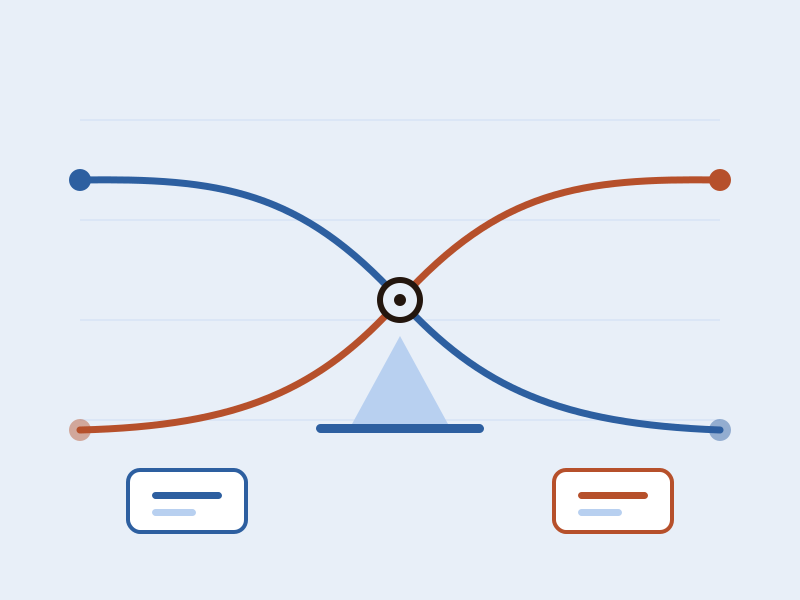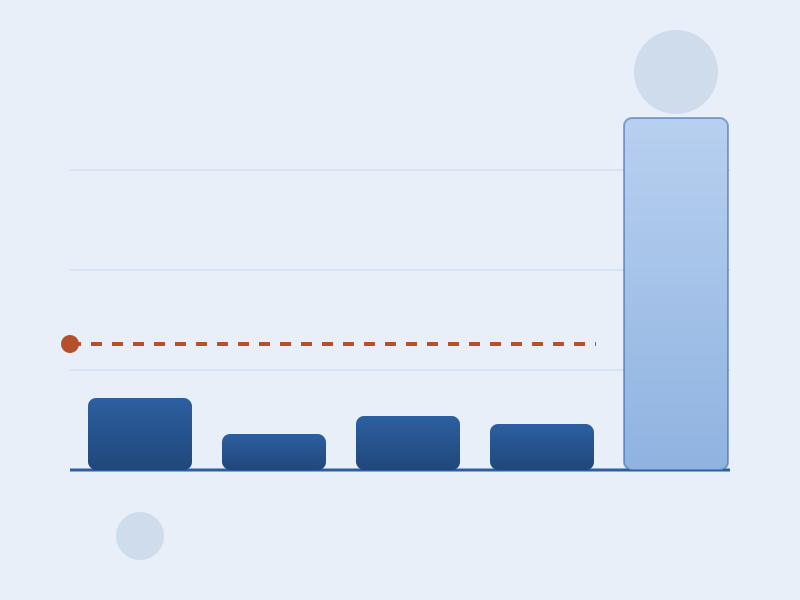
Nobody quits this work because the dogs were hard. They quit because of the driving. Eleven months in, somebody sits in a parked car on a street twenty-two minutes from the last house, eating a gas station sandwich, doing arithmetic they have been avoiding, and discovers that the $26 walks add up to about $14 an hour once the car is counted. That is the moment the career ends, and it has nothing to do with dogs.
Search how to become a dog walker and you will get the same eight steps in a slightly different order every time. Love animals. Get first aid certified. Buy a leash. Sign up for a platform. Get insured. They are all correct and they all stop at exactly the point where the job gets interesting, which is somewhere around walk forty, when you are technically a working dog walker and are quietly wondering why it does not feel like a living.
This piece covers the entry steps quickly, because they are genuinely quick, and then spends its real length on the part that decides whether you are still doing this in year three.
01 / The real barWhat you actually need to start.
The bar is lower than the internet suggests, and the reason it looks high is that most of the pages explaining it are published by people selling certifications.
Legally required in almost every US market: nothing specific to dog walking. No state licenses dog walkers as a profession. No certification is mandatory. If you operate independently you will likely need an ordinary local business license from your city or county, which is the same license a house cleaner or a landscaper needs, and a federal tax ID if you use a business name rather than your own. A handful of cities regulate group walking directly. San Francisco requires a commercial dog walker permit at $285 initially and $114 a year to renew, for anyone handling four or more dogs at once. New York City requires an animal care certificate costing $39 for a 12-hour course.
Required in practice by platforms and clients: you must be 18 or older, pass a criminal background check, own a smartphone with working GPS, and be able to get to clients. If you are in a dense city that means shoes. Anywhere else it means a car, and the car is the single biggest hidden cost in this business.
Worth paying for: pet first aid. The American Red Cross runs a 35-minute online cat and dog course for roughly $25 to $40, covering vital signs, breathing emergencies, wound care and seizure response. Pro Pet Hero runs a deeper version at $45 to $80. Either one is the only credential in this field that reliably earns back its cost, partly because it makes you better at the job and partly because clients read it as evidence you take it seriously.
Not worth paying for, yet: the $200 to $500 online courses marketed as dog walking certifications. There is no licensing standard for the field, which means there is nothing for these credentials to certify against. Clients respond to references, insurance and first aid. They do not know what a certified dog walker is, because nobody does.
The gear list is similarly modest. A good six-foot leash at $15 to $25, a slip lead at around $8, a treat pouch, waste bags, a collapsible water bowl, a basic pet first aid kit, and walking shoes that will absorb ten to fifteen miles a day without destroying your knees. Call it $135 to $200 total. Add roughly $59 to $84 if you enter through Rover, which charges a $49 profile processing fee plus a background check at $10 for the basic version or $35 for the enhanced one that earns a profile badge.
Then there is insurance, which is the one line on this list where the advice is unconditional.
Insure yourself before month three, whatever your volume. General liability plus care, custody and control coverage runs $200 to $400 a year, which is roughly the price of eight walks. One dog bite, one escaped retriever, one lost key on a condo building, and the uninsured version of that number is five thousand dollars.
Platform coverage is not your coverage. The Rover Guarantee reimburses up to $25,000 in vet costs, but it exists to protect pets, owners and the platform. It does not cover work you book directly, and directly booked work is where you are heading.
That is the whole entry checklist. Two weeks and about $200 on a platform, or about $450 independent and properly insured. If a page is telling you it takes six months and a course, the page is selling the course. Our guide to dog walking insurance goes through what each coverage line actually pays out on.
02 / Year one mathWhat the first year actually pays.
Here is where most guides get vague, so let us be specific instead.
The 2026 national average for a 30-minute walk sits around $21.45. Independent walkers in dense cities commonly charge $24 to $34. Suburban markets run $15 to $25 and rural towns $10 to $20. Solo walks command a premium over group walks of roughly $5 to $10, and most walkers add $2 to $5 for a second dog in the same household.
None of those numbers is your wage. They are your price, and the gap between the two is the entire subject of this article.
What actually happens over twelve months, based on the patterns visible across the market and the ones we have seen from operators we work with:
- Month one. Background checks, profile setup, waiting for approval. Rover takes 10 to 20 business days. Direct-hire jobs at local pet care companies often have you working inside seven. Income $0 to $300. Net for the month, after gear and fees, is usually slightly negative.
- Months two and three. First bookings, first reviews. $300 to $700 a month. Insurance and mileage start appearing as real costs.
- Months four to six. Cumulative break-even usually lands around month four. Monthly income $600 to $1,200. This is where most of the quitting happens.
- Months seven to twelve. $1,000 to $2,500 a month for someone working consistently. Part-time first-year totals land at $7,000 to $15,000. A committed full-time first year reaches $20,000 to $35,000.
For context, the Bureau of Labor Statistics puts median annual pay for animal caretakers at $33,470, with the occupation projected to grow 11 percent between 2024 and 2034 and around 81,700 openings a year. That median is what the work pays once you are established. Year one is not that. Year one is construction, and it is worth knowing that going in so you do not read a slow April as failure. We broke the full earnings picture down separately in how much dog walkers really make.
The rate is a number you post. The wage is a number you discover, eleven months later, in a parked car.Field Notes · Operations
03 / The frameworkThe Density Ladder.
Everything that separates a walker who lasts from one who does not comes down to a single variable, and it is not price, marketing, certification or how good you are with dogs. It is density: how many walks you complete per hour you are away from home.
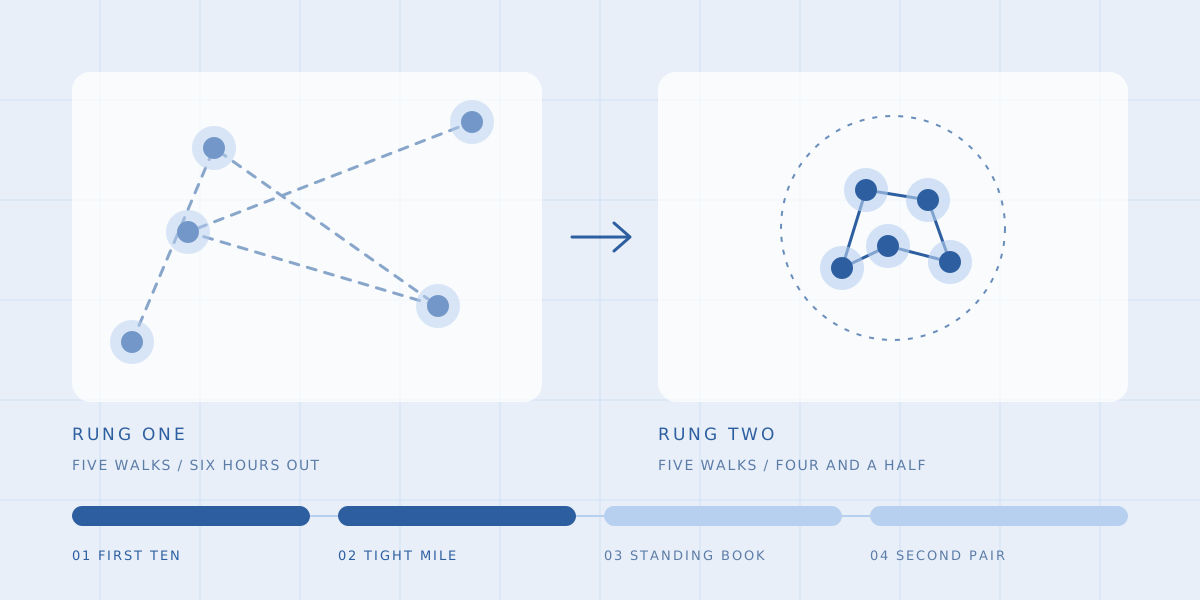
Density is a ladder with four rungs. Each rung has exactly one number attached to it, which means you can look at your own week and say out loud which rung you are on.
Rung one: the first ten
Ten paid walks, through whichever channel you can reach fastest. Do not optimize anything at this rung. Not your rate, not your brand, not your service menu. Ten is the smallest number that tells you whether you can handle a 70-pound dog you have never met, in a stranger's hallway, in weather you would not have gone out in.
Run three channels at once to get there. Apply to direct-hire jobs at local pet care companies, which start fastest. Sign up for a platform, which is free on Rover beyond the fees and typically takes two to six weeks to produce a first booking. And tell everyone you already know, which produces your highest-paying and most loyal early clients. Most successful walkers got their first three to five clients from people who already trusted them.
Rung two: the tight mile
Draw a circle. One mile across in a dense city, three in a suburb. Seventy percent of your walks need to sit inside it, and getting there means refusing work outside it, including work you want.
This is the rung almost nobody writes about and it is the one that changes the arithmetic. Effective earnings per hour typically rise by half or more when a walker tightens the radius, with no change at all to the posted rate. The entire gain is travel time you stopped spending.
Rung three: the standing book
Recurring weekday slots, booked at least four weeks out, covering roughly 60 percent of monthly revenue. Price the standing slot a little below your ad-hoc rate. The discount is not generosity, it is what you pay for predictability, and predictability is what lets you plan a Tuesday.
The trap here is chasing new clients when you should be converting existing ones. A client who has booked you three times is dramatically easier to move onto a Tuesday-and-Thursday standing slot than a stranger is to acquire, and most walkers on rung two are running ads instead of asking.
Rung four: the second pair of hands
The rung has no volume target. It arrives as a week: the first week you turn down work you were physically capable of doing. That is the signal that you have become the constraint, and the only way past a constraint that is you is another person. Whether that is a subcontractor, a part-time walker or a co-owner is a separate decision, and starting a dog walking business properly covers the structure side of it.
Rung two is made entirely of walks you turned down. There is no version of it where you climb by adding. Every walker who is stuck on rung one is stuck there because saying yes felt like growth.
04 / The one numberEffective hourly, and how to find yours.
Density is a concept. Effective hourly is the number that makes it real, and you can work yours out on a Sunday afternoon in about fifteen minutes.
Take one working block, meaning one continuous stretch when you left the house and came back. Add up everything you were paid for that block. Then divide by the door-to-door time, including driving, parking, waiting for a lockbox, sending photos afterward and the fifteen minutes of messaging you did at the kitchen table when you got in.
Effective hourly = total pay for the block ÷ total door-to-door hours.
Almost everybody who does this for the first time is unpleasantly surprised. A walker posting $26 for thirty minutes assumes they are earning $52 an hour. The real figure at rung one is usually somewhere between $14 and $19, because a 30-minute walk consumes 55 to 75 minutes of life once travel and admin are counted.
That is not a reason to raise your rate. Raising the rate is the slow lever and it has a ceiling set by your market. Density is the fast lever and it has no ceiling until you run out of dogs on the street.
05 / Worked exampleMarcus climbs one rung.
Marcus Delgado started walking in Denver in early 2025, part-time, while keeping three shifts a week at a bike shop. By month four he had eleven clients and was proud of that, which was the problem.
His Tuesday looked like this. Four walks at $26 each, so $104 for the day. He left the house at 8:40am and got home at 2:50pm. That is 6 hours and 10 minutes door to door, which is an effective hourly of $16.86. Two of the four clients were his best-paying and most enthusiastic: one in Wash Park, one out toward Green Valley Ranch. They were also 22 minutes apart, and between them they were eating most of his day.
He dropped them both. It felt like sabotage. He replaced them over six weeks with three clients in Baker, all within eleven blocks of each other, found through one Facebook post in a neighborhood group and one conversation at a dog park.
The new Tuesday: five walks at $26, so $130. Out at 9:10am, home at 1:40pm. Four and a half hours door to door. Effective hourly of $28.89.
Same rate. Same city. Same dogs, roughly. Seventy-one percent more per hour, and he finished ninety minutes earlier. He did not raise a price or run an ad. He drew a circle and enforced it.
Marcus is on rung three now, eighteen months in, with six standing weekday slots and a waiting list he did not ask for. The waiting list is what rung two produces: when all your clients live near each other, they talk to each other.
06 / What goes wrongFour traps that keep walkers on rung one.
These are the four failure patterns that show up again and again, and three of the four feel like good decisions at the time.
Trap one: pricing to win. New walkers routinely price 30 to 50 percent below their market to get bookings faster. It works, and what it buys is a client base of people who chose you on price and will leave on price. Worse, it sets an anchor you cannot move later without losing everyone at once. Price at market from walk one and win on reliability instead, which is a real competitive advantage and a permanent one. Dog walker pricing covers how to set the number.
Trap two: the far walk. The 25-minute drive for a $26 walk. It always looks like income and it is always a loss, because the hour it consumes was the hour you needed to acquire a client three blocks from home. This is the single most expensive habit in the business and it is invisible until you compute effective hourly.
Trap three: certification as a substitute for walks. Spending eight weeks and $400 on a credential before doing ten real walks. The credential does not tell you whether you can handle a reactive dog on a narrow sidewalk, and that is the only question that matters at this stage. Pet first aid is worth it. Everything else can wait until you know you are staying.
Trap four: running uninsured past month two. Understandable and indefensible. $200 to $400 a year feels like an expense that buys nothing right up until the afternoon it becomes the only thing standing between you and a vet bill you cannot pay. The correlation between walkers who skip this and walkers who leave the industry involuntarily is not subtle.
One more that is less a trap than a habit worth building early: photograph every dog at the start of every walk. It sounds excessive for about four months, and then one day a client raises a limp that was there when you arrived, and you have a timestamped photo.
07 / Take this with youThe first thirty days, in order.
If you want a sequence rather than a philosophy, this is the one that works.
- Days 1 to 3. Tell fifteen people you know that you are doing this. Apply to every direct-hire pet care job within your radius. Start a platform application in parallel. Do not wait to see which works.
- Days 4 to 10. Buy the minimum kit, roughly $150. Book the Red Cross pet first aid course. Take profile photos with a dog in them. Write your bio around what the dog gets, not what you love.
- Days 11 to 20. Draw your circle on an actual map and write the boundary streets down. Post once, briefly, in two local neighborhood groups inside it. Introduce yourself to two veterinary offices and a groomer within it.
- Days 21 to 30. Take your first bookings. Over-deliver on the first three because those reviews carry the next six months. Start a one-page log of every walk with times in and out.
That log is the whole trick. Thirty days of times in and out is what lets you compute effective hourly at the end of month one instead of month eleven, and month one is early enough that the answer is still cheap to act on.
You can be a working dog walker in two weeks. Whether you are still one in year three is decided by a circle on a map and how ruthlessly you defend it.
Rates, fees and pay figures quoted are published US figures current in August 2026 and vary widely by state, city and market. Licensing and permit requirements are set locally. Check your own city and county rules before operating, and confirm coverage terms directly with an insurer before relying on any policy described here.