Search pet business insurance and you get eleven pages of carriers. Every one of them is organized the same way, as a list of coverages: general liability, animal bailee, workers compensation, commercial auto. Pick the ones that apply to you, add to cart, download the certificate.
The list is accurate. The framing is wrong, and it is wrong in a way that costs operators real money.
Because the coverages that apply to you are not a fixed set. They are a function of what your business is doing this month, and a pet care business changes shape faster than almost any other small business in America. You start doing drop-in visits. Someone asks if you board. You say yes to one dog over Thanksgiving. A friend helps out on weekends. You buy a van because the back of a Civic stopped working two years ago.
None of those decisions feel like insurance decisions. All four of them are.
The policy you bought did not change. It is still sitting in the same email folder, still renewing automatically, still producing a certificate with a seven-figure number on it. What changed is the distance between the business described in that document and the business you got out of bed for this morning. Nobody sends you a letter about it. You find out on the day you call the claims line, which is the single worst day to be learning anything.
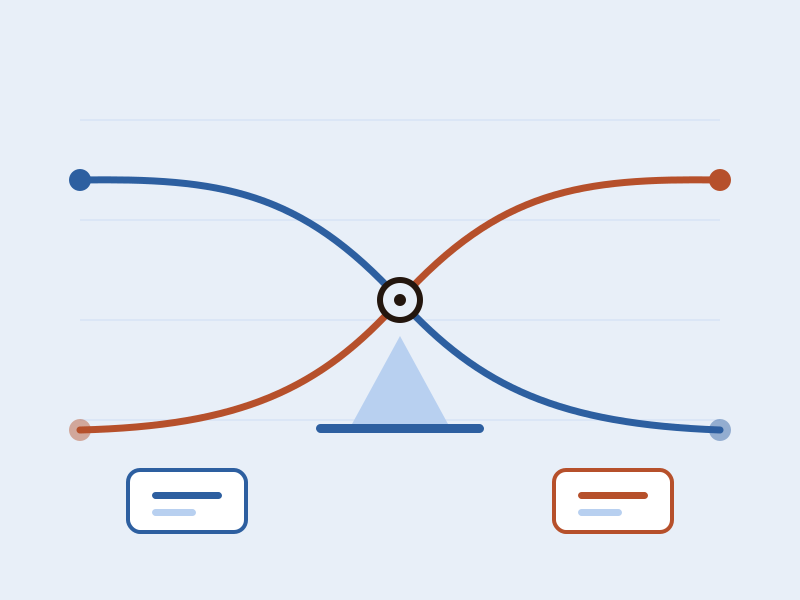
01 / The snapshotA policy is a photograph, and the business keeps moving.
Underwriting is a description exercise. When you bought your coverage you answered questions: what services do you provide, where do you provide them, how many people work for you, do you use a vehicle. Your premium was calculated from those answers, and the policy was issued against them.
That means the document is not a general promise to protect a pet care business. It is a specific promise to protect the business you described on the day you filled in the form. Insurers are explicit about this when you read closely. MoneyGeek's 2026 analysis of pet care carriers notes that Hiscox covers only the services listed in your policy, and warns that if you later add boarding or transport you should not assume the policy follows you. That is not a Hiscox quirk. It is how every policy in the category works.
Here is why it bites pet care specifically rather than, say, a bookkeeper. A bookkeeping business that doubles in size is still a bookkeeping business. A pet care business that doubles in size has usually also changed what it does, where it does it, and who does it, because growth in this industry almost always arrives as a new service line or a new pair of hands rather than as more of the same thing.
So the drift is structural. It is not carelessness, and the operators it catches are usually the ones doing well.
The policy did not lapse. The business moved, and the paperwork stayed exactly where you left it.Field Notes · Operations
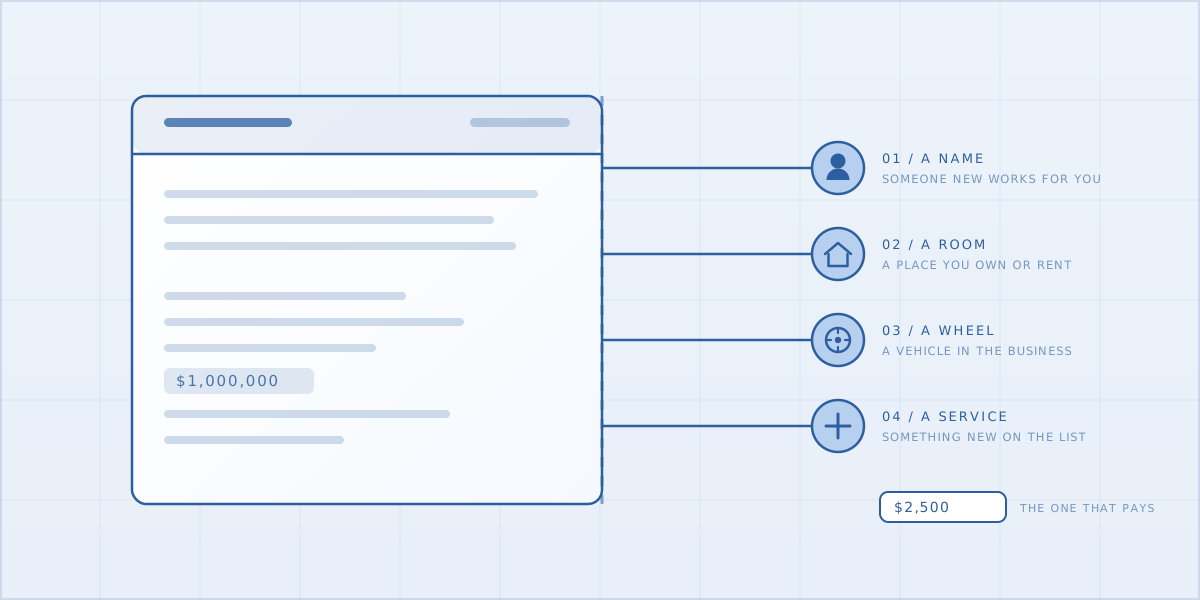
02 / The frameworkThe Four Triggers.
There are dozens of things that can change in a pet care business, but only four of them reliably break the description in the policy. Learn these four and you can stop thinking about insurance the rest of the year.
Trigger one: a name
The moment a second person does work for the business, two separate things happen and most operators only notice one of them.
The first is workers compensation, which is the one people know about. It becomes a legal requirement in 49 states once you have employees, with Texas the notable exception for most private employers. Most states require it from the first employee. A handful set the bar higher: two in Virginia, three in Arkansas, Georgia, Missouri, New Mexico and North Carolina, four in South Carolina and for non-construction employers in Florida, five in Alabama and Tennessee. Check your own state rather than a national summary, because the classification of the worker matters as much as the count.
The second thing is quieter and catches more people. On most pet-specific programs, coverage attaches to named individuals, not to the business generally. The Pet Sitters Associates program is typical: spouses, partners, employees and independent contractors each have to be added to the certificate at around $95 a year, and additional insureds such as an apartment complex or a county park are $15 each. A helper who is not on the certificate is, for practical purposes, an uninsured person doing your work in a client's home.
Note the direction of the risk there. It is not that you get caught. It is that the claim arrives and the person who caused it was never on the policy.
Trigger two: a room
The industry line most operators internalize is that pet sitting insurance covers you in the client's home. True, and it is where most programs stop. The moment an animal spends time at a location you control, you have crossed into a different exposure, and your own house counts.
Association programs handle this with a daycare and boarding endorsement, commonly around $160 a year, and it is required for any private location you own or rent, including your residence, even for one animal at a time. What people miss is that these endorsements come with operating conditions attached. The typical set caps you at ten animals in care at once and five staying overnight, requires that every animal can be separated in an emergency by crate or gate, requires current vaccinations, and requires a temperament check before the booking.
Read that as a checklist rather than as small print, because it is the difference between an endorsement you bought and an endorsement that pays. A boarding claim on a night you had six dogs staying is a conversation you do not want to have.
Your homeowner's policy does not quietly fill this gap either. Homeowner's policies exclude business use, and running paid daycare in your living room is business use in every reading of the phrase.
Trigger three: a wheel
Personal auto policies typically exclude business use. Travelers says so directly on its pet care page, and it is standard language across the market. Once a vehicle is regularly carrying client animals, staff or equipment, the personal policy is the wrong instrument for the job.
What replaces it depends on who owns the vehicle. A business-owned or leased vehicle needs commercial auto, which is the most expensive line in the whole category at roughly $143 a month. A personal vehicle used for business is usually handled through a hired and non-owned auto endorsement bolted onto your general liability, which costs a fraction of that.
The exposure that actually matters here is worth naming plainly, because operators consistently picture the wrong accident. The risk is not the dog getting hurt in the back. It is the four-car pile-up on the interstate, where the claim is a bodily injury claim against a personal policy that excluded the trip you were making.
Trigger four: a service
This is the trigger that fires most often and gets logged the least, because saying yes to a new service feels like sales rather than administration.
Pet-specific programs are unusually blunt about it. A basic Pet Sitters Associates membership at $220 a year covers pet sitting, dog walking, pooper scooper work and pet taxi within a 200-mile radius. That is the list. Grooming is a separate $100. Obedience training is $155. Daycare and boarding is $160. House sitting without pets present is $100. Show dog handling is $175. Each is a distinct product because each is a distinct risk, and the basic membership does not stretch to cover them out of goodwill.
Mainstream carriers do the same thing less visibly, through the business classification on your declarations page. You were written as a pet sitter. You now groom on Saturdays. The classification says otherwise, and the classification is what the underwriter priced.
03 / The sublimitThe number that actually pays for the dog.
Before the review, one thing worth fixing, because it distorts how operators think about all four triggers.
Every certificate in this industry leads with a large number. One million per occurrence, two million aggregate. It looks like a wall, and operators quote it to clients with some pride.
That number is the general liability limit, and general liability covers injury to people and damage to other people's property. It is the right number for the claim where a dog you are walking bites a passerby, which is not a hypothetical: the Insurance Information Institute puts the average dog bite liability claim paid in 2025 at $65,450, up from $33,230 in 2016, with insurers paying out $1.86 billion across the year. A million dollars of general liability is a sensible wall against that.
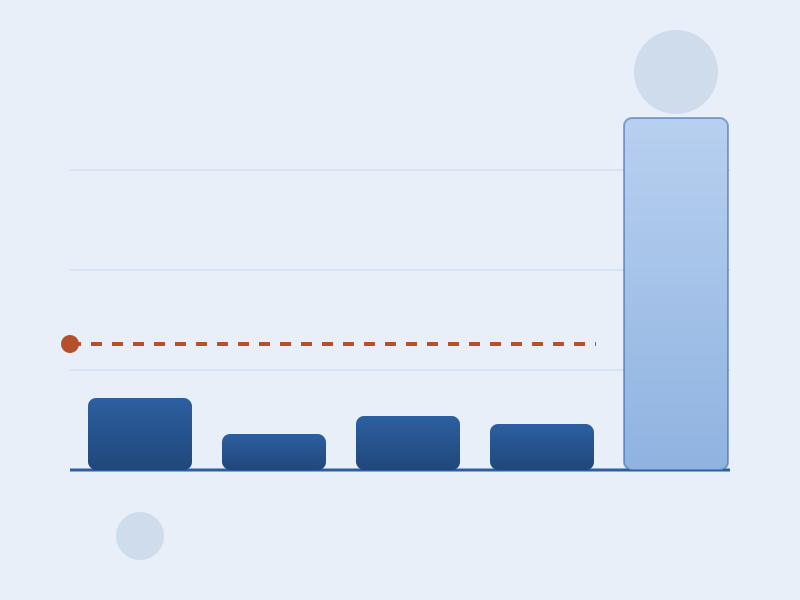
It is not the number that pays for the dog. Standard general liability contains a care, custody and control exclusion which removes coverage for property you are looking after, and in the language of the policy an animal is property. The coverage that responds when the animal itself is hurt is animal bailee, sometimes sold as pet protection, and it carries its own limit that is smaller by three orders of magnitude.
| What the limit is for | Typical included figure | Reads on the certificate as |
|---|---|---|
| Injury to a person, per occurrence | $1,000,000 | General liability |
| Injury to a person, annual | $2,000,000 | Aggregate |
| Third-party claims from an animal | $100,000 / $200,000 | Animal liability |
| Pet hurt, lost or killed in your care | $2,500 to $15,000 | Animal bailee |
| Vet bills regardless of fault | $1,000 to $2,500 | Vet reimbursement |
| Re-keying a client's home | $2,000 | Lost key liability |
| Fire damage to premises you rent | $100,000 | Damage to rented premises |
Sit with the fourth row for a second. A per-incident animal bailee limit of $2,500 is common on entry-level policies, and emergency surgery on a mid-size dog after a road accident does not stay under $2,500. Association programs run higher, at $15,000 per occurrence and $30,000 a year, but the vet reimbursement that pays regardless of fault is still $1,000 per incident on a basic membership, with an upgrade to $2,500 available for another $55.
The gap between the headline and the sublimit is the single most misunderstood thing in pet business insurance. Two operators can hold identical million-dollar certificates and have a thirteen-thousand-dollar difference in what happens when a dog is hit by a car.
The number you quote to clients and the number that saves you are not the same number. Write both on the same sticky note and put it inside the policy folder.
If you only upgrade one limit this year, upgrade the animal bailee sublimit. It is usually the cheapest line on the schedule and the one most likely to be tested.
04 / WorkedFour years, four triggers, one policy.
Marisa Okonkwo started in Tucson in 2022 doing drop-in visits and midday walks, on her own, out of a Corolla. She bought a pet-specific policy for $246 a year and it was, at the time, exactly right.
By the summer of 2026 she has five people, a leased 1,400 square foot unit doing daycare four days a week, boarding on weekends, a van, and a grooming table she added in March because a client kept asking. Revenue is up around five times. The policy renewed four times without a single question being asked, because renewal notices ask you to confirm your details and almost nobody rereads their details.
Every one of the four triggers fired, and here is the order they fired in, which is the order they usually fire in.
- A name, October 2023. Her first helper, a friend's daughter, two afternoons a week, paid in cash. Not on the certificate, not on payroll, not on anybody's radar. Uninsured for fourteen months.
- A room, February 2024. One boarding dog over a long weekend, in her spare bedroom, as a favor to a regular. No endorsement. That single yes moved her from a program that covered client homes to one that no longer described her.
- A wheel, August 2025. The van. Registered to the business, insured on a personal auto policy for eleven months, carrying up to six client dogs at a time across a city with a lot of highway.
- A service, March 2026. Grooming, which on her program is a separate $100 endorsement carrying its own professional liability, and which her declarations page has never mentioned.
Nothing bad happened to Marisa. That is the point of using her as the example rather than a horror story. For four years she ran a good business, looked after animals well, paid her premium on time, and was progressively less insured every year, and there was no moment at which anybody would have told her.
When she finally ran the review it took twenty-two minutes and produced four calls. Her premium went from $246 to roughly $2,100 a year, which sounds brutal until you set it against a business turning over five times what it did in 2022 with a leased unit and a five-person payroll. The old number was not a bargain. It was a description of a business that no longer existed.
05 / The reviewTwenty minutes, once a year, and on every trigger.
The review is deliberately short, because a two-hour annual insurance audit is a thing operators plan and never do. Three steps.
Step one: describe the business from memory. Before you open anything, write down what the business did last month. Every service you sold. Every person who worked, including the weekend helper and the contractor who covers your vacation. Every location where a client animal spent time, your own home included. Every vehicle. Do it from memory first, because if you start from the policy you will read your business into the document instead of comparing them.
Step two: read the declarations page, not the marketing page. The declarations page is the front sheet of the actual policy, and it is where the description lives. Find four things on it: the named insured plus any scheduled individuals, the business description or classification code, the scheduled locations, and the list of covered operations. Then find the sublimits, which usually sit on a separate schedule and are the numbers that pay for animals, keys and client property.
Step three: mark the mismatches and get answers in writing. Put your list next to the schedules and mark every line that appears in one and not the other. Each mismatch is either an endorsement to add or a confirmation to obtain. Get the confirmation by email. A service representative telling you on the phone that you are “probably fine” is not a coverage grant, and it will not be there in eighteen months when it matters.
Run this on a fixed annual date, and run it immediately whenever a trigger fires. The annual pass catches drift. The trigger-day pass catches the thing that would actually have hurt you.
A certificate of insurance is a one-page summary produced for landlords and clients. It shows limits, not exclusions, not conditions, not the schedule of covered operations.
Every operator who has been surprised by their coverage had a perfectly valid certificate in a drawer. The certificate was never the thing that was going to tell them.
06 / CostsWhat pet business insurance charges in 2026.
Two markets exist here and they price very differently, which is worth knowing before you shop.
Pet-specific programs are cheap, fast and narrow. Pet Care Insurance starts at $17.92 a month, or $194 a year. Pet Sitters Associates is $220 for a basic membership. Both are built for solo and very small operations, both issue certificates instantly, and both handle growth by selling you named add-ons rather than by rewriting the policy.
Commercial carriers cost more and stretch further. MoneyGeek's 2026 analysis puts the recommended bundle of general liability, animal bailee and professional liability at $116 a month, or $1,392 a year. The Hartford reports its pet care customers averaging $1,687 a year for a business owner's policy, and $1,193 for grooming businesses specifically.
| Coverage | Average monthly | Trigger that requires it |
|---|---|---|
| Animal bailee | $9 | Any animal in your care |
| Tools and equipment | $27 | A service (crates, clippers, dryers) |
| Commercial property | $30 | A room |
| Professional liability | $31 | A service (advice, training, scheduled care) |
| Workers compensation | $73 | A name |
| General liability | $76 | Baseline |
| Commercial auto | $143 | A wheel |
Read that table by the third column rather than the second. The premium is not really driven by how much money you make. It is driven by how many of the four triggers you have fired, which is why two businesses with the same revenue can be quoted $400 apart and both quotes be correct.
It is also why the cheapest policy is only cheap while the business stays still. A $194 program that does not cover your boarding weekend is not cheaper than a $1,392 bundle that does. It is a different product.
One more figure worth carrying, because it explains why workers compensation gets priced the way it does. The Bureau of Labor Statistics found that in 2022, 11 of every 100 full-time veterinary services employees suffered a nonfatal injury or illness, roughly four times the all-industry average. Animal work is physically hazardous in a way the premium reflects and most owners underestimate until the first bite that needs stitches.
07 / Anti-patternsFive assumptions that get expensive.
“The platform covers me.” Marketplace protection programs are real, but they are the platform's policy, they apply only to bookings made through the platform, and they usually sit behind conditions about how the booking was arranged. Any client who moved off-platform, any repeat booking taken by text, any of your own marketing, none of it is covered. Carriers know this well enough to sell products aimed specifically at platform workers, which tells you what the platform's own coverage leaves out.
“My contractor carries their own.” Sometimes true, and it does not remove you from the claim. A client who is harmed sues the business they hired, which is you. If the contractor genuinely carries their own policy, get a copy, check that it covers the work you are sending them, and get yourself named as an additional insured. Otherwise you are relying on a document you have never read.
“I'll sort it at renewal.” Renewal is a date chosen by the insurer for administrative convenience. It has no relationship to when your risk changed. The gap between a trigger firing and the next renewal averages six months, which is a long time to be running a service the policy does not mention.
“A bond covers theft, so I'm protected.” Bonds and employee dishonesty coverage are different instruments, and the differences favor the insurer. Bonds commonly require a criminal conviction before paying, run a credit check on you at application, and frequently require you to reimburse the bonding company afterward. Employee dishonesty coverage is insurance and behaves like insurance. If a client contract asks for a bond, buy the bond, but do not treat it as protection you own.
“It says covered, so it's covered.” The word covered in a brochure is doing a lot of work. Coverage lives in three places at once: the grant, the exclusions, and the conditions. An animal bailee endorsement you satisfied at purchase can still fail if you breached an operating condition, such as the ten-animal cap or the requirement that animals be separable in an emergency. There is also usually a deductible that applies specifically to off-leash work, commonly $500 when a pet is voluntarily released outside a fenced yard.
08 / Take this with youThe short version.
Pet business insurance looks like a shopping problem and is mostly a maintenance problem. Choosing a policy takes an afternoon and you will probably do fine. Keeping the policy pointed at the business you actually run is the part nobody schedules, and it is where the money is.
- Learn the four triggers. A name, a room, a wheel, a service. Those four cover almost every way a pet care business outgrows its own paperwork.
- Treat a trigger as same-day work. Not renewal work. The average gap between the two is about six months of running a service your policy has never heard of.
- Read the sublimit, not the headline. The million-dollar figure protects people. The two-and-a-half-thousand-dollar figure protects the dog, and only one of those appears on the certificate.
- Get every answer in writing. A phone call is not a coverage grant. An email from the carrier costs nothing and survives staff turnover on both sides.
- Run the review annually on a fixed date. Twenty minutes, three steps, same week every year. Put it next to whatever else you already do annually so it inherits a habit rather than needing a new one.
If you do one thing this week, do step one on its own. Write down what the business did last month, on paper, without opening the policy. Most operators get about eleven lines in before they hit something the document has never been told about, and that recognition is worth more than any amount of reading about coverage types.
Figures in this article are drawn from published 2026 coverage schedules and pricing from Pet Care Insurance and Pet Sitters Associates, The Hartford's published pet business insurance averages, MoneyGeek's 2026 pet care business insurance analysis, Travelers' pet care services guidance, Insurance Information Institute dog bite liability data for 2025, and US Bureau of Labor Statistics occupational injury data for 2022. Coverage terms, limits and state requirements vary by carrier and by state and change over time. Marisa Okonkwo is a composite example. This article is not legal, tax or insurance advice, and no article can substitute for reading your own declarations page.