Tamika Reyes hired nine attendants in fourteen months to keep a floor of six. She ran a 40-dog daycare outside Columbus, her ad said “competitive pay, fun environment,” and every Monday somebody she had trained was texting that they could not make it in. The dogs were fine. The schedule was not. She was the one who kept filling the gap.
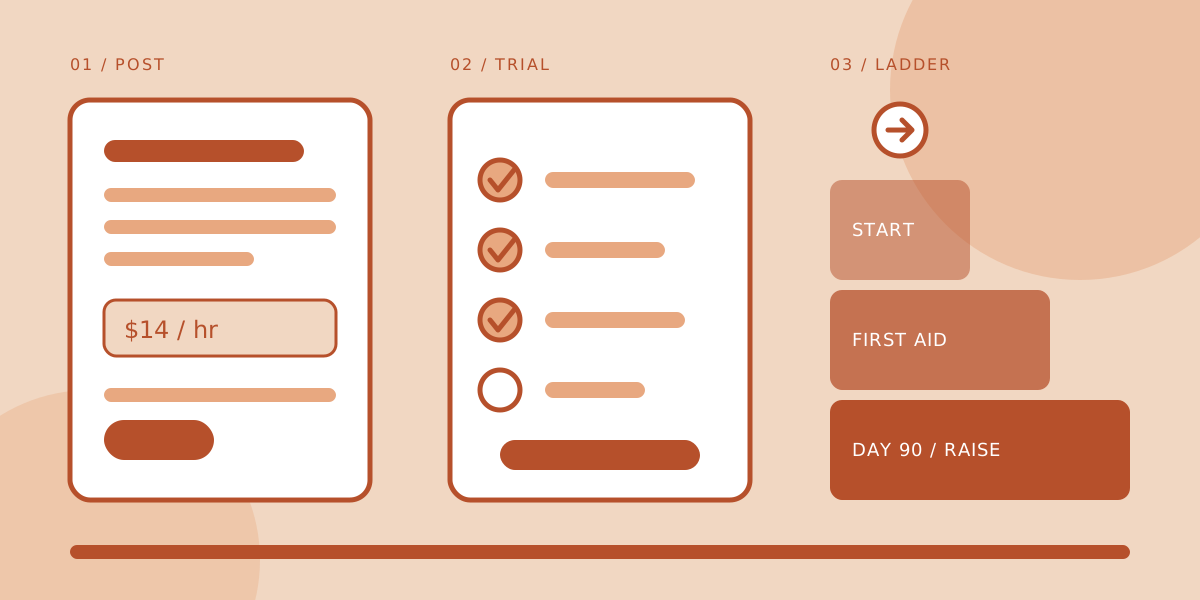
Dog daycare hiring looks like a volume problem, so most owners answer it with more postings. Tamika’s was a retention problem wearing a hiring costume. She was losing people in their first three months, and she was losing them to jobs she had never described honestly. This piece uses a three-part method, Post, Trial and Ladder, to fix the sequence: say the real job, test it with a paid shift, then show the next rung. If you also board, our guide to the kennel technician role covers the overnight side of the same team.
01 / The problemWhy daycare staff leave in the first three months.
Start with pay, because everyone does. PayScale’s 2026 figure is $14.74 an hour on a small sample, with the bottom 10% at $9.45 and the top 10% at $17.97. That is a wide band for a job that asks someone to stand for hours, lift a large dog and clean up after twenty of them. Pay matters, but the band tells you something else: candidates cannot tell which end of it you sit on, because most ads do not say.
I read five daycare employment pages that rank for this search. Only one, Dallas Dog Palace, printed an hourly figure: $12 to $13 with no experience and $14 to $15 with it. Canine Crews in Chicago said “competitive wages” and nothing more, though it was candid about the other things, such as lifting 50 pounds, working at least three shifts a week and cleaning pet waste. Dogtopia’s page named a raise after 90 days but no rate. Camp Canine’s page, last modified in 2022, listed duties and no pay or shifts at all. The ranking pages are thin, which is your opening: a complete ad stands out.
Then there is the cost of leaving. Mary Steinebrunner, who owns two pet care facilities, told a Pet Industry Leaderboard webinar that turnover cost her more than $500,000 in 2025, and that her monthly turnover fell from 10.4% to 4.3% once she changed how she hired and onboarded. That is one owner’s account, not a benchmark, and it is the only turnover number I could find for this industry. Treat it as a direction, and run your own figures. Tamika does that further down.
02 / The methodPost, Trial, Ladder: three stages, in that order.
Each stage removes a different reason for someone to quit. The ad removes surprise. The trial removes bad fits. The ladder removes the sense that the job goes nowhere.
The order matters because owners tend to start at the end. They add a perk, then a bonus, then a pizza party, and keep hiring from the same vague ad. If the first week contradicts the ad, no perk repairs it.
03 / PostWrite the ad as if the candidate will compare it to the job.
They will. Most daycare quits happen because the reality was a surprise: the early shift, the lifting, the dog that does not like anyone. An honest ad loses a few applicants and keeps the ones who would have left in week three. Put these in the ad itself:
- The pay. A range with the experience that moves someone up it, as Dallas does. If the number embarrasses you, that is useful information about the number.
- The shifts. Hours, weekends, holidays and the minimum number of shifts a week. Canine Crews says three, which filters out the casual applicant politely.
- The physical part. Standing, lifting and cleaning, in plain words. Say “lift 50 pounds”, not “able to perform physical tasks”.
- The first raise. Dogtopia names one at 90 days. Name yours, with the rate if you can.
- How to apply. One route that works. Two of the five pages I read sent candidates to an email address, one to a job board and one to a form that showed an error message.
If a candidate could not tell from your ad what they will earn, when they will work and what will make them tired, you have written a brochure, not an ad.
Put the ad on your own site as well as the job boards. CareerPlug, a hiring software vendor, claims candidates from a company careers page are four times more likely to be hired than those from job boards. That is a vendor claim, so discount it, but the logic holds: someone who read your page has seen the whole job. If you are building the rest of the business around this, our guide to starting a dog care business covers the legal and insurance basics.
04 / TrialPay people to show you the work before you promise them any.
Interviews measure how well someone interviews. A dog daycare floor measures something else: whether a person reads body language, stays calm when two dogs square up and keeps counting heads. You can only see that on the floor, so put them on it, for pay, before an offer.
Steinebrunner replaced a pile of about 100 resumes with a Saturday hiring event. Roughly 50 candidates confirmed, 25 to 30 attended and 5 to 8 were hired. It is a tidy funnel, and one operator’s, but the shape is worth copying: a fixed time, dogs in the room, several candidates at once and a decision by the end of the day. You see how people behave when they are not being watched for the answer.
Keep the trial short, paid and structured. Four to six hours, a named shadow, and a score sheet with five lines you fill in afterwards:
- Reads dogs. Did they notice stress, stiffness or a dog pushing a corner?
- Keeps the count. Could they say how many dogs were in the room at any moment?
- Takes correction. When you changed how they held a lead, did they change?
- Does the dull work. Water bowls, waste, mopping, without being asked twice.
- Talks to the shadow. Questions are a good sign. Silence is not.
Keep ratios honest while you do this. A WebMD Q&A reports that the Pet Care Services Association recommends one staff member per 15 dogs, one per 10 for very active groups and one per 20 for calm ones, and notes that Colorado requires 1:15. Wagbar, citing the International Boarding and Pet Services Association, gives 1:10 to 1:15 in active play and at least two staff on duty. A trial candidate is a pair of hands, not a staff member, so do not count them in your ratio. Our post on building a pet boarding service has the same capacity logic for overnight beds.
05 / LadderShow the next rung before they ask for it.
A first-week hire who sees no next step starts looking at the next ad. The ladder does not have to be grand. It has to be written, and it has to survive contact with your margins. The 2026 benchmarking report PocketSuite cites puts labour at about 52% of revenue for facilities earning $150,000 to $500,000 and closer to 48% for $500,000 to $1 million. Whatever you promise has to fit inside that.
A workable ladder has three parts, and none needs a big budget:
- A 90-day review with a number attached. Dogtopia ties a raise to 90 days and a performance review. Choose a step you can afford, such as $1 an hour, and put it in the offer letter.
- A paid skill. Pet first aid and CPR, as Our Best Friend Doggie Daycare in Gig Harbor lists, or medication handling. The skill earns a pay bump, and the bump is what makes it a rung.
- A named next role. Playroom lead, front desk, trainer assistant. Name it, and say what changes in pay and duties.
Add a check-in. Steinebrunner has a trainer talk to each new hire after their fourth shift. It is cheap and early enough to catch the person who is about to disappear. Cross-train as you go: when two people can run the front desk and the floor, one sick call stops being a crisis, and fewer crises means fewer resignations.
06 / Worked exampleWhat Tamika’s turnover was costing her.
Here is Tamika’s year, worked through. This is an illustration, not a benchmark. The inputs are her own assumptions and the turnover rates reported above: eight attendants, 10.4% monthly turnover before and 4.3% after.
At 10.4% a month, eight attendants lose about 0.83 people a month, or roughly 10 a year: 10 × $1,430 = $14,300. At 4.3%, the figure is about 0.34 a month, or 4 a year: $5,900. The difference is about $8,400 a year, before counting the dogs that got a worse day because the person walking them was new. A $1-an-hour raise for all eight at 30 hours a week costs about $12,500 a year, so the raise alone does not pay for itself on these numbers. The trial and the honest ad are what make the saving real. That is the argument for doing the stages in order.
If the arithmetic on your own floor shows a bigger gap, a staffing and scheduling tool such as PackMonty can keep shifts, ratios and certification dates in one place. The numbers come first, though. Write down what your last departure actually cost.
07 / What not to doFour mistakes that keep the revolving door turning.
- Writing “competitive pay” and nothing else. It tells candidates you will not say, and they assume the worst.
- Hiring from a single interview. You will pick the best talker, and the floor will show you the rest in week two.
- Counting trainees in your ratio. One distracted new hire among twenty dogs is how incidents happen, and how insurers get involved.
- Promising a raise you do not diarise. A 90-day review that nobody holds is worse than none, because it turns a perk into a broken promise.
08 / Take this with youOne thing to do this week.
Open your current ad and check it against the five lines under Post. If any are missing, rewrite it before you post again. Then work out what your last departure cost, using Tamika’s four lines. If the total is over $1,000, the Saturday trial is already paid for.
Tamika’s ad now has a number in it. She still gets the odd Monday text, but they come with a name she already knows how to cover.
– DR, Portland, with a clipboard and a lint roller