Marisol Vega counted her beds twice before she believed the number. Four. She had been telling clients she boarded “a few dogs at a time” and quoting $45 a night, because that was what the place down the road posted. Then she filled all four beds for the Fourth of July week and took home less than she had in an ordinary week in March. The beds were full. The business was not.
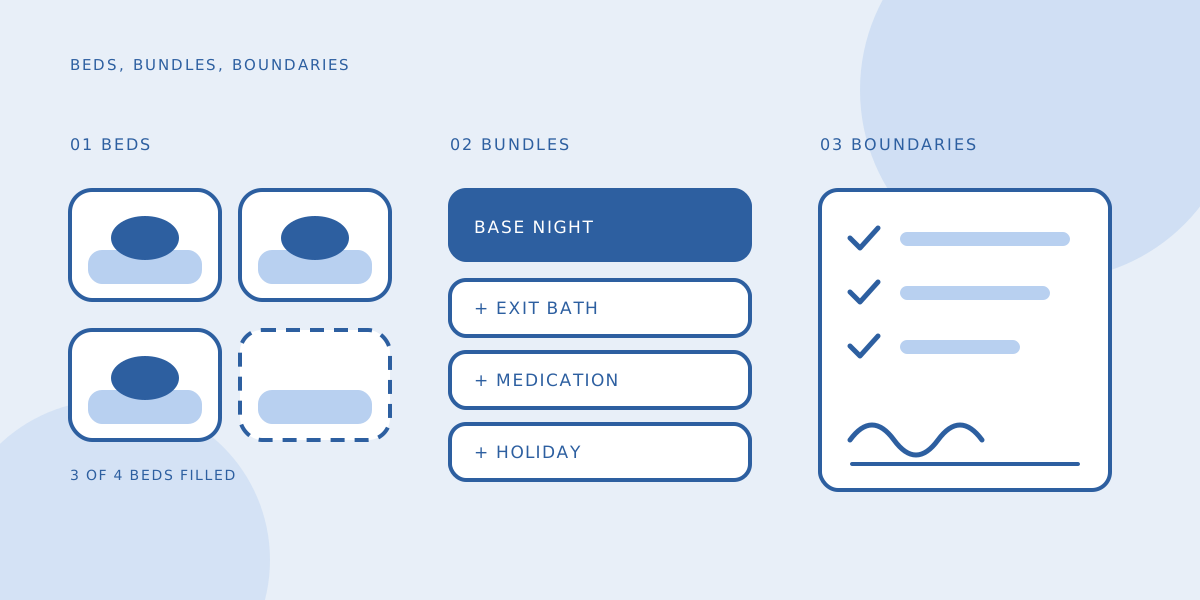
A pet boarding service is easy to describe: you keep other people’s animals overnight while they are away. It is harder to run well, because one night of boarding is really three products sold as one. There is a bed, a bundle of care, and a set of promises about what happens when something goes wrong. Most guides stop at the first and hand you a price. This one uses a three-part method, Beds, Bundles and Boundaries, to decide what you offer and what you charge. If you want the plain definition first, start with what dog boarding actually covers.
Demand is not the question. The American Pet Products Association put U.S. pet industry spending at $158 billion in 2025, and 71 million U.S. households, 53% of the total, now own a dog. The question is how much of that you keep.
01 / The marketWhat a night costs, and why the number misleads.
Those are the headline numbers, and they are useful only as a starting point. By service type, Dogster lists regular kennels at $35 to $85 a night, in-home boarding at $40 to $90, and dog hotels with spas and pools at $75 to $150. By place, the spread is wider still. Wag! reports metro medians from $79 in San Francisco and about $69 in New York down to about $45 in Houston. Goose’s state averages run from $70.50 in Washington, D.C. to $32.70 in Mississippi.
Read the fine print before you borrow any of them. Goose builds its average from posted facility rates for small dogs and leaves out in-home providers. Wag! reports what its own marketplace customers pay. Neither is a quote for your town. Prices are also moving: Goose found 42.1% of facilities raised their rate compared with 2025, by an average of $7.02. A competitor’s posted price is a data point, not a plan.
02 / The methodBeds, bundles, boundaries: three decisions, in that order.
Revenue from boarding is beds times nights times occupancy times price. You cannot add a fifth bed on a Friday. So once the beds are fixed, the only levers left are how full they run and how much each bed-night earns. The method follows that logic.
Why this order? Because price is the last thing to decide, not the first. Operators who start from the price end up like Marisol, copying a number and then discovering what it has to cover. Start from capacity and the rest follows from arithmetic.
03 / BedsCount beds by what you can supervise, not what fits.
Three limits cap your beds, and the lowest one wins.
- Space. Each dog needs a separate place to sleep and a safe place to relieve itself. If you board at home, fencing should stand at least four feet high, according to Pet Care Insurance’s boarding guide.
- People. There is no federal staffing standard for pet boarding, and most states do not set a numeric ratio. The best-known guidance, from the International Boarding & Pet Services Association, is one staff member per 10 to 15 dogs in supervised group play. That is a daycare figure. Overnight, the real test is simpler: who is awake, and who answers when a dog is in trouble at 2am?
- Rules. Local law decides how many dogs you may keep. Pet Care Insurance notes that some areas need no license below five dogs while others require one before the first. Home boarding can also trigger zoning limits or HOA rules. Call your county clerk, zoning office and animal control before you advertise a single bed.
If you are the only person on the premises overnight, your bed count is the number of dogs you could get out of the building alone, in the dark, in a hurry.
Count to that number, not the number of crates you own.
Next, be honest about occupancy. MoeGo’s boarding guide models a 20-dog facility at 60% occupancy, and that is a sensible planning number. Bookings bunch around holidays, summer and school breaks, and the nights in between run thin. Plan on 60% to 70% across the year, not the full house you see in August. If you are starting from scratch, our pet sitter start-up ladder covers cover and proof before you add overnight dogs.
04 / BundlesPrice the base night from a floor, then sell the extras.
Start with your floor
Work out what you need the beds to earn, then divide.
Sixty dollars sits above the national averages of $46 to $53, and inside the $40 to $90 range Dogster gives for in-home boarding. That is defensible for a home with four beds and a person present all night. But you must be able to say why, and the answer has to be in the bundle, not the rate card.
Define the base night
The base night is the smallest thing you will happily sell at the floor price. For Marisol that means a bed, feeding twice a day, three potty breaks and one photo update. Anything beyond that is a line on the menu.
Price the extras separately
Goose’s 2026 averages are a handy benchmark for the menu: an exit bath at $27.18, early check-in at $16.44, late checkout at $21.35 and food supplied by the facility at $5.62 a day. Petful puts medication fees at $5 to $20. Peak-date surcharges average $8.98 a day, yet only 7.3% of facilities Goose looked at charge one. That is an opening, not a risk, because holidays are the one stretch when demand is certain.
On multi-dog households, Goose found an average second-dog discount of 28%, and 37.5% of facilities that show prices also show a discount. Offer one if you like, but make it a line on the menu, not a favor.
Anything that costs you a task or a risk gets its own line on the menu. Medication, special diets, baths, late pick-ups, and a dog that needs a bed to itself.
Our overnight dog sitting rates guide and the dog sitter rate card cover the sitter side if you also do visits.
05 / BoundariesTerms that protect the bed.
A bed that stays empty because a client cancelled the night before costs you the same as one never booked. Boundaries are how you stop that happening, and how you protect the dogs already in your care. Write them down once, send them with every booking, and enforce them kindly.
- Vaccines and health. Ask for proof before arrival. Rabies, the distemper combination and Bordetella are the usual three, but your vet, your insurer and local rules decide yours. Ask all three.
- Deposit. Take one on every booking, and a larger one on holiday dates. A deposit of one night for ordinary dates and half the stay for holidays is a workable start.
- Cancellation window. Pick a cut-off you will actually enforce, such as seven days for holidays, after which the deposit is kept.
- Holiday minimums. A three-night minimum around major holidays stops one Thursday night from blocking a five-night booking.
- Pick-up window and late fees. Name the hours, and name the price of missing them.
- Emergency authority. A signed line that lets you take a dog to a vet, with a stated spending limit, decided before the stay and not at 9pm.
- A trial first. A meet-and-greet or a short trial stay for every new dog, with the right to decline or end a stay if the dog is not coping.
Insurance belongs here too. General liability usually excludes injury to animals in your care, under the care, custody and control exclusion, so ask about animal bailee coverage as well. Pet Care Insurance advertises an annual boarders policy starting at $295.40. Our guides to pet business insurance and pet sitter insurance explain what each policy pays for.
06 / Worked exampleMarisol’s month, with and without a menu.
Here is Marisol’s July, run both ways. This is an illustration, not a promise, and the only inputs are the numbers above plus her own assumptions: four beds, 70% occupancy, $5,000 a month target.
Her old way, a flat $45 with everything included, brings in 84 × $45 = $3,780. The difference is $1,880 a month, or $22,560 a year. A lower price might have filled more nights, but she has four beds, so the ceiling is the same. She did not need more dogs. She needed a menu.
Once you have more than a handful of stays on the calendar, it helps to keep beds, deposits and vaccine dates in one system rather than a shared spreadsheet and a text thread. A booking tool such as PackMonty does that. The habit of writing every term down matters more than the software.
07 / What not to doFour mistakes that empty the till.
- Copying a rival’s posted rate. Posted rates are often the cheapest small-dog rate, and they cover whatever that business includes. Price from your own floor.
- Selling one flat, all-inclusive night. You will absorb every bath, every pill and every late pick-up, and your best clients will never see the cost.
- Filling holiday beds with no minimum stay. One overnight can block a week, and the week is where the money is.
- Skipping the trial. The first night is the wrong time to learn a dog cannot settle with others. Meet first, and board second.
08 / Take this with youOne thing to do this week.
Do the 2am count, then run the floor. Write your bed number on a card, divide your monthly target by beds times 30 times 0.7, and compare the answer with the price you quote now. If the gap is more than a few dollars, you do not have a pricing problem. You have a menu problem.
Marisol still counts her beds twice. These days the second count is for the price.
– DR, Portland, with a clipboard and a lint roller