Marcus Bell took his first pet sitting job for $20 and a thank-you card. A neighbor’s beagle, a Saturday, twenty-five minutes of walking and a bowl of kibble. Nine months later he was turning down clients because his calendar was full, and the question he kept asking had changed. It was no longer how to get started. It was why the money felt so thin.
Starting is the easy part. In most places you need no license, no course and no van. The Bureau of Labor Statistics says animal care workers typically need a high school diploma, learn on the job, and that certifications, “although not required,” help workers establish credentials. Demand is not the problem either: the BLS projects 12% growth for animal care and service workers from 2025 to 2035, and the APPA put the U.S. pet industry at $158 billion in 2025.
The problem is the order people do things in. Most guides on how to become a pet sitter start with marketing and leave insurance for the end, if they mention it at all. This one uses a three-step method, the Three-Rung Start, that runs the other way round. If you already know your numbers, our guide to what dog sitters charge will help you price the work. If you are still deciding whether to begin, read on.
01 / The easy partAnyone can start. The money sits further up.
Look at those three numbers together. The median caretaker, mostly a kennel or shelter employee, earns about $35,000 a year. A sitter listing on a platform sees published rates of roughly $15 to $25 for a 30-minute walk and $35 to $75 or more for a night, and then hands over 20% of each booking. Indeed’s salary data puts the average employed pet sitter at about $15.41 an hour.
Self-employed sitters set their own price, which is both the opportunity and the trap. Our pet sitting rates guide shows typical independent figures of $20 to $35 a visit and $60 to $150 a night. The distance between a $35,000 job and a real income is not talent. It is three specific things, and they have an order.
02 / The three rungsCover, prove, own: the order matters more than the effort.
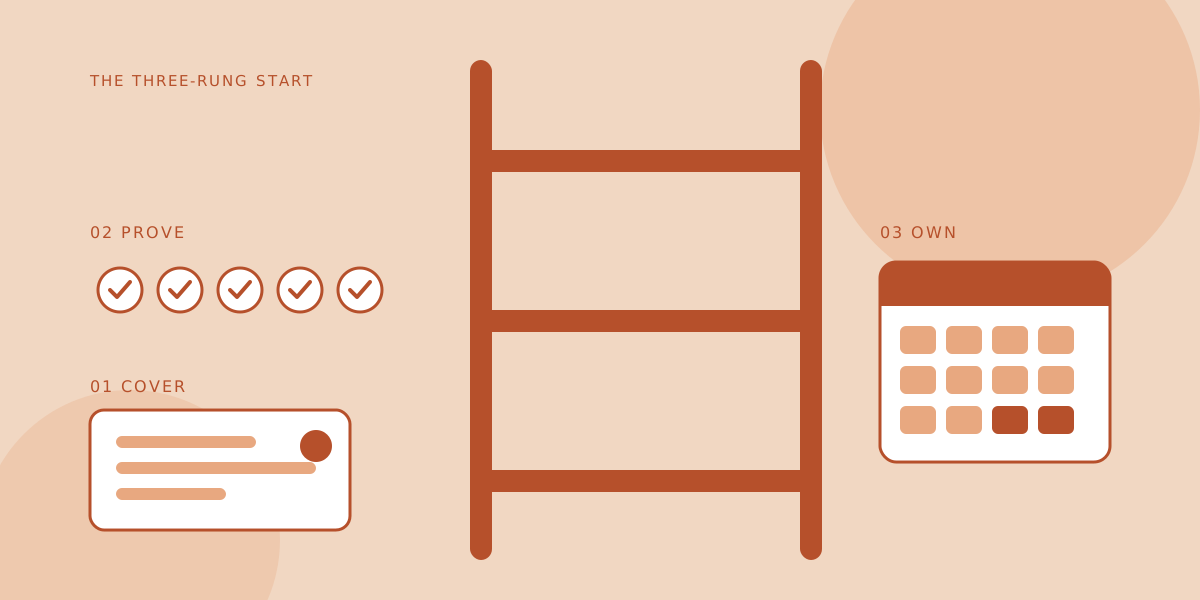
Think of the start of a pet sitting business as a ladder with three rungs. You cannot skip one, and each rung makes the next one cheaper to climb.
Why this order? Picture the reverse. You spend your first month on a logo and a website, land a client, and a dog slips its collar on week two. You have no cover, no first aid training and no reviews to point to. Cover removes the risk that ends the business. Proof earns the right to charge. Ownership turns the clients you earned into income you control.
03 / Rung oneCover the risk before you take a dog.
Insurance first
Insureon’s median figures for pet sitters are about $42 a month for general liability, roughly $500 a year, and about $59 a month for a business owner’s policy, roughly $704 a year, both with $1 million per occurrence and $2 million aggregate limits. That is the price of about twenty $25 visits.
Read the exclusion before you buy. Because of the care, custody and control exclusion, general liability does not pay for injuries to a pet in your care. Animal bailee coverage, usually an endorsement, fills that gap by covering vet bills and legal fees if a client’s dog is hurt on your watch. Our guide to pet sitter insurance walks through the policies, and the dog walking insurance piece covers the walking side.
Insurance also sells. Pet Care Insurance, which sells it, reports that about 80% of nearly 500 pet owners it surveyed said they were more likely to book an insured professional. Treat that as an insurer’s own figure, but notice that clients ask about cover before they ask about price.
First aid, before the first booking
The American Red Cross runs an online pet first aid course that takes about 35 minutes, with in-person classes of up to four hours. Do it in week one. Dog CPR means compressions at 100 to 120 per minute, pressing one third to one half the width of the chest. You will probably never use it. The client who asks “what would you do if…” will remember that you can answer.
Paperwork, kept short
- An EIN. It is free from the IRS and keeps your Social Security number off client invoices.
- A business license check. The BLS notes that many states require a business license for self-employed animal care workers. State registration typically runs $50 to $300, according to Pet Care Insurance. Check your state and your county.
- A zoning check for overnights. Boarding dogs in your home can trigger permits, zoning rules or HOA limits. Ask before you advertise it.
- A separate bank account. Cheap, boring, and the first thing your accountant will ask for.
On structure, a sole proprietorship is fine to begin with. An LLC keeps business and personal money apart, but its protection against claims about your own care of a dog is limited, so insurance does the heavy lifting.
Every client gets one page before the first visit: vet name and phone, a signed line authorizing emergency treatment up to a stated spending limit, feeding and medication notes, escape risks, and how you will handle the key.
That page is the difference between a calm emergency and a 2am argument about who pays.
Where certification fits
Certification is a credential, not cover, so it comes after the first three items. Pet Sitters International’s CPPS exam has 100 questions, an 80% passing score and a $275 application fee. NAPPS certification costs $245 for members and $395 for non-members, takes about four to six weeks, needs a 75% score, and asks for 30 continuing education hours every three years. Neither is legally required. Buy one once you have five paying clients and want to stand out, not before.
Add it up. Insurance at about $500 plus state registration of $50 to $300 puts the first year at roughly $550 to $800 before any certification. That is the real startup number, and it is smaller than most guides suggest.
04 / Rung twoProve it works with five bookings and three reviews.
Your goal on this rung is not income. It is evidence: five paid bookings, three written reviews, two clients who book again. Everything else on the ladder depends on that evidence.
Where do the first five come from? Three places work. Neighbors and friends of friends are the warmest, so tell them you are insured and ask for the first booking. Local groups and the front desks of vets and groomers are next. The third is a marketplace. Rover requires you to be 18, treats you as an independent contractor, and runs a background check, and its 20% fee means a $25 walk pays you $20. Use a platform as a proof engine, not a home. Its reviews follow your name.
No dog of your own? That is not a barrier. TrustedHousesitters points beginners toward looking after a friend’s pets, co-sitting alongside an experienced sitter, and volunteering at a shelter. Ten hours at a shelter gives you more handling stories than most applicants have.
Three habits turn bookings into proof:
- Run a 20-minute meet-and-greet before every new client. Watch how the dog handles the leash and the door, and ask the owner six questions about triggers, meds and routines.
- Send a photo update during every visit. Owners who see the dog are owners who write reviews.
- Ask for the review within 48 hours, with a direct link, while the dog is still happily asleep on the sofa.
On price, hold your floor. A first-booking discount is fine once. A $12 walk teaches a client that $12 is the price, and raising it later will cost you the relationship. If you want help setting that floor, the five-line rate card is a good place to start.
05 / Rung threeOwn the client, not just the booking.
Here is the math nobody puts in the beginner guides. Say you run six visits a day, five days a week, at $25 each. That is $750 a week. Through a platform charging 20%, you keep $600. Direct, you keep $750. The difference is $150 a week, or $7,800 a year, and it comes entirely from who owns the relationship.
Owning the client does not mean poaching. Read the terms of any platform you use before you move a booking off it, and build your own channels instead: a Google Business Profile, a one-page site with a booking link, and a referral card you hand to every happy owner. Clients who find you directly are yours from the first visit.
Then build the base of the calendar from recurring visits. A Tuesday and Thursday walk for the same dog, week after week, is worth more than five one-off holiday bookings because you can plan around it. Publish a rate card so every quote comes from the same five lines. Once bookings, payments, keys and care sheets stop living in text threads and a notes app, a scheduling tool such as PackMonty keeps them in one place. The tool matters less than the habit of writing everything down.
You will hit a ceiling. Around 30 visits a week, one person is full. You can raise prices, cap your calendar, or hire. If you are heading toward the third option, our guide to starting a dog walking business in the U.S. covers the next stage. Whether a helper counts as a contractor or an employee depends on your state, so ask an accountant before you hire anyone.
06 / Worked exampleAna’s first 90 days on the ladder.
Ana Ruiz lives in Columbus, Ohio, has no pet of her own, and works retail mornings. This is an illustration, not a promise, but every number in it comes from the sections above.
At $25 a visit, 14 visits is $350 a week gross. She keeps all of the 9 direct visits ($225) and $20 of each of the 5 platform visits ($100), so $325 a week. All 14 on the platform would have netted $280. Ana did not work harder. She climbed in order.
07 / What not to doFour mistakes that stall the ladder.
- Buying the certificate before the policy. A $395 credential does not pay for an injured dog. Bind insurance first.
- Pricing to win the first review. Discount once, then raise it. Cheap clients rarely become full-price clients.
- Letting the platform hold your client list. If every client belongs to an app, you rent your income. Collect names, numbers and care sheets from day one.
- Skipping the vet authorization. You will meet the one dog that needs a vet at 9pm. Decide who pays before that night, not during it.
08 / Take this with youOne thing to do this week.
Get a quote for general liability with animal bailee cover, and book the 35-minute first aid course. That is rung one started, for roughly the price of twenty $25 visits, and nothing else on the ladder works without it.
Marcus still keeps the thank-you card from that first beagle. It sits on a shelf above a rate card with five lines on it. He says the card taught him to start. The card is what taught him to stay.
– DS, Portland, with a first aid card in the glovebox