Juniper was out cold by 8:44. Lights went down at 8:40 on her first night in the boarding wing, and four minutes later the two-year-old Border Collie was flat on her side, paws going, a thin whine coming through the run door every few minutes until well past midnight. The overnight note read “slept great, very settled, lots of dreaming.” Tess, who owns the place, read it the next morning and frowned. Juniper had spent the afternoon being bumped by a pushy doodle in play group and the evening pacing the fence line. Settled was not the word.
Every boarding operator has read a note like that. Every night-shift kennel tech has watched a row of sleeping dogs twitch and paddle and woof at nothing, and wondered what was going on in there. Most articles about dog dreams stop at the wondering. That is fine for a pet owner on a Sunday afternoon. It is not enough for someone responsible for twenty-six dogs overnight, because what a dog does in its sleep is one of the few welfare signals you get for free, and most facilities are reading it backwards.
This piece covers what the science actually supports about dog dreams, how to tell a dream from a medical emergency at 2am, and why the dog that crashes fastest after a hard day may be the one you should worry about. Then it gives you three lines for the overnight sheet.
01 / The short answerWhat dog dreams actually are.
Yes, dogs dream. Nobody can prove it the way you could prove it with a person, because nobody can wake a dog and ask. But the evidence stacks up from three directions.
The sleep architecture matches. Dogs move through drowsiness, slow-wave (non-REM) sleep and REM sleep, the rapid eye movement stage in which people report their most vivid dreams. Electrical activity in the canine brain during REM looks strikingly like ours. Dogs just do it in shorter loops. A classic observational study of household dogs recorded around 23 sleep-wake cycles across an eight-hour night, averaging about 16 minutes asleep and 5 minutes awake each time. Your dogs are not sleeping through. They are sleeping in laps.
Animals replay their day. In 2001, researchers at the Massachusetts Institute of Technology recorded the brains of rats running a maze, then recorded them again during REM sleep. The same firing patterns came back, in sequence, so precisely that the team could tell where in the maze the sleeping rat was. The rats were not dreaming about rats in general. They were dreaming about that maze, that afternoon.
Take the brakes off and they act it out. During REM, a region of the brainstem called the pons stops the large muscles from moving, which is why you do not sprint out of bed when you dream of running. When researchers disabled that brake, first in cats and later in dogs, the animals got up while still asleep and performed organized behavior. Cats stalked and pounced. Dogs did, in the words of the research, doggy things. Pointers pointed. Guarding breeds guarded.
So what do dogs dream about? The honest answer is their day, weighted by what mattered to them. Psychologist Stanley Coren, professor emeritus at the University of British Columbia, reported that size changes the rhythm: a Toy Poodle may show dream activity every ten minutes or so, while a Golden Retriever sized dog dreams less often but for longer stretches. Harvard psychologist Deirdre Barrett has argued that because dogs are so attached to their people, owners almost certainly turn up in those dreams too. Blue Cross, the UK animal welfare charity, lands in the same place.
Here is the part none of the owner-facing articles mention, because it is not their problem. For the nights a dog spends with you, the day being replayed is the one your facility gave it. The play group, the fence line, the stranger with the leash, the dog in the next run. That makes dog dreams an operational topic, not a cute one.
02 / SignsDog dreams or a seizure: how to tell at 2am.
The visible signs of dreaming are consistent across every source worth reading: eyes moving under closed or half-open lids, breathing that turns fast and irregular, twitching whiskers and lips, paws paddling as if running, soft barks, whines, muffled woofs and the occasional tail thump. Dreaming usually shows up roughly twenty minutes after a dog drops off, once the first slow-wave stretch has passed, and each REM burst lasts a few minutes.
The problem for your overnight staff is that a focal or generalized seizure can look, from the doorway of a dark run, a lot like a vivid dream. Train every person who does night checks on the difference. It takes five minutes and one printed card.
| Dreaming | Possible seizure | |
|---|---|---|
| Muscle tone | Loose, floppy twitches | Stiff, rigid or rhythmic jerking |
| Say its name | Stops, wakes within seconds | No response |
| Duration | Seconds to ~3 min, in bursts | Often 1 to 3 min, continuous |
| Other signs | Soft woofs, whines | Drooling, urine or stool loss |
| Afterward | Normal, maybe sleepy | Confused, wobbly, pacing |
| Action | Log it, leave it | Time it, film it, call the vet |
The single most useful test is responsiveness. A dreaming dog comes out of it when something reaches it: its name, a clap, a door. A seizing dog does not. There is also a rare condition, REM sleep behavior disorder, in which the pons fails to hold the muscles still and dogs thrash, bark, bite at the air or run into walls during sleep. Those dogs also wake easily and are normal within a minute, which is how vets separate it from epilepsy. If a boarded dog shows either pattern, it goes on the owner handover and in the file, and any suspected seizure gets a call to your on-call vet the same night.
03 / The boarding problemWhy a hard day makes loud dog dreams.
In 2017, a team of Hungarian researchers led by Anna Kis published a study in Proceedings of the Royal Society B that every boarding operator should know about. They fitted sixteen pet dogs with non-invasive EEG sensors and let them nap for up to three hours after one of two experiences. The pleasant one was petting and ball play. The unpleasant one was a mild dose of the ordinary stresses of dog life: a short separation from the owner, a stranger approaching in a threatening way, a person who suddenly stopped responding.
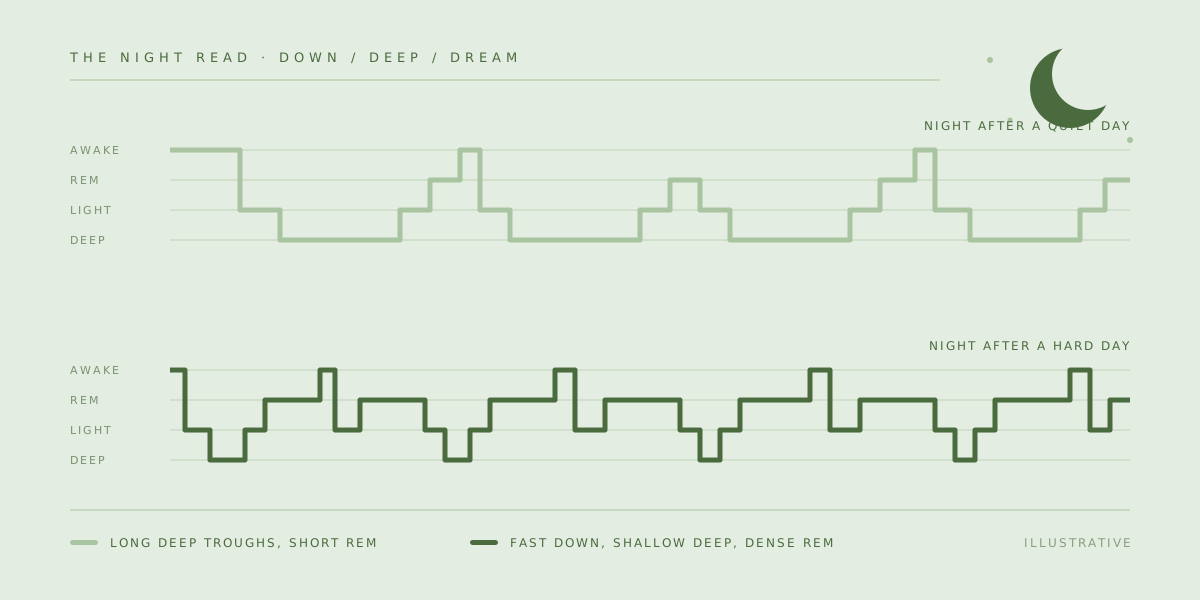
After the stressful session, the dogs fell asleep roughly twice as fast. Then they spent about twenty fewer minutes in deep sleep, and that time did not go to being awake. It went to REM. More dreaming, less of the restorative slow-wave sleep underneath it.
The dog that goes down fastest after a hard day is not necessarily the calmest dog in the room.The finding, applied to a boarding wing
Put that next to what your night staff write down. A dog that drops in four minutes and dreams hard all night reads, to a tired human, as a dog that is comfortable. The research says it can equally be a dog that is using sleep to get away from the day, and not getting much deep rest out of it.
Two more findings sharpen the point. The same research group has shown that dogs need time to adapt to a new sleeping place: in a 2020 study in the Journal of Sleep Research, dogs napping in the same room on three separate occasions showed a first-night-effect-like pattern, with the first session looking different from the later ones. And a 2025 polysomnography study in Animals found that dogs sleeping away from home slept better with their owner present than with a friendly stranger: they fell asleep sooner, slept more efficiently and got more deep sleep. A boarded dog is, by definition, in a new place without its owner. Worse sleep on night one is not a sign that something is wrong with your facility. It is the baseline.
The welfare link runs the other way as well. A 2016 study of rescue shelter dogs by Owczarczak-Garstecka and Burman, published in PLOS One, found that dogs who managed more rest during the day also showed less repetitive behavior, were more often rated relaxed by staff, and scored more optimistically on a cognitive bias test. Rest is not just recovery. It is one of the few things you can see from the outside that tracks how a dog is actually doing on the inside.
04 / The frameworkThe Night Read: Down, Deep, Dream.
You cannot put EEG sensors on boarders. You do not need to. The three things the research measured have visible proxies, and your overnight staff are already standing in the right place to see them. The Night Read is three lines per dog per night.
- Down. Minutes from lights-out to the dog lying flat with eyes closed. Write the number, not a word. Under five minutes after a demanding day is a flag, not a compliment. Over forty-five minutes of pacing is a flag too.
- Deep. On each scheduled check, is the dog in long, still, slow-breathing sleep, or up and resettling? Count the times you see it standing. Some waking is normal, because dogs sleep in laps. What you are watching is whether the stillness stretches out as the stay goes on.
- Dream. Visible dreaming on a three-point scale: quiet, busy or loud. Add one word for the tone: play (paddling, soft woofs, tail thumps) or distress (whimpering, crying, growling). Busy-play is a normal dog. Loud-distress that does not ease is information.
The rule that makes it work: compare the dog to itself, not to the room. A toy breed will always log more dreaming than a Great Dane, because of the rhythm Coren described. A young dog processing a new place will always log more than a twelve-year-old regular. None of that is a problem. The signal is the trend across a stay. Night one is expected to be bad. Night three should look better than night one on at least two of the three lines.
The Night Read never triggers a change to the dog’s bed. It triggers a change to the dog’s day.
If the lines are not improving by night three, look at what happened between 3pm and lights-out: who the dog was grouped with, how the last hour went, whether the final interaction of the day was a pleasant one or a stressful one.
That last point comes straight from the 2017 study. The pleasant pre-sleep condition was nothing clever: petting and a ball. Most facilities end the day with the least pleasant things in the schedule, because that is when there is time. Nail trims, meds, the bath the owner requested, the loud group turnout before kennelling. Move those earlier. End every dog’s day on five minutes of something it likes.
05 / ApplicationOne dog, three nights.
Back to Juniper. Tess runs a 26-run boarding and daycare facility outside Asheville with a night tech on from 8pm to 6am doing checks every two hours. After that first note, she added the three lines to the overnight sheet. Here is what Juniper’s stay looked like.
Night one. Down: 4 minutes. Deep: up and resettling on three of five checks. Dream: loud, distress. Taken alone, that is a classic hard first night in a new building without her people. Tess did not change anything about the run. She changed the next afternoon: Juniper came out of the big play group, where the doodle kept pinning her, and into a four-dog group of older, steadier dogs. Her last fifteen minutes before lights-out were a slow walk around the yard with the same tech who would do her overnight checks.
Night two. Down: 18 minutes, most of it lying awake but calm. Deep: up on two of five checks. Dream: busy, play.
Night three. Down: 12 minutes. Deep: still on all five checks. Dream: busy, play.
Juniper did not dream less by night three. Border Collies dream a lot, and she had more interesting days to replay. What changed was the shape of the night: a slower, calmer drop-off, longer stillness and a tone that sounded like running rather than crying. That is the pattern the research predicts when the day improves. At pickup, Tess told the owner which group Juniper had done well in and booked her into it for the next stay.
For a solo sitter doing overnights in a client’s home, the same three lines fit on a phone note, and they make a far better morning update than “slept well.” For a 60-run facility, they are three extra columns on a sheet your night staff already fill in. Either way, it is about thirty seconds per dog per check. If your team already tracks care notes in a boarding workflow, that is where these belong, attached to the dog rather than the night.
06 / Anti-patternsFour ways the night shift gets it wrong.
- Reading fast sleep as settled. This is the big one, and it is the whole reason this article exists. A dog that drops in minutes after a rough afternoon may simply be checking out. Log the number, look at the day, and judge the trend.
- Waking a dreaming dog to comfort it. Kind instinct, bad idea. The American Kennel Club, PetMD, Blue Cross and Purina all say the same thing: let sleeping dogs lie. A dog pulled suddenly out of REM can be disoriented for a moment, and a disoriented dog in an unfamiliar run, with a stranger’s hand coming at it in the dark, is how kennel staff get bitten. If distress looks severe, say the dog’s name from outside the run and wait.
- Treating every twitch as a nightmare. Whimpering in sleep does not reliably mean fear, and PetMD is right that sleeping vocalizations sound different from waking ones. One loud night is noise. Three loud-distress nights in a row is data. Do not call an owner at 7am because their dog cried in its sleep once.
- Doing night checks with the overhead lights. Dogs cycle roughly every twenty minutes, and many of those cycles end in a brief waking point. A bright overhead light and a clanging door on every check turn natural wake points into full arousals across the whole wing. Use a dim red or low-level torch, soft-close doors and the same route every time.
07 / TakeawaysTake this with you.
If you do one thing this week, add three columns to your overnight sheet: Down, Deep, Dream. Do not change anything else yet. Run it for two weeks and look at your first nights against your third nights. The dogs whose nights do not improve will almost all turn out to have something in common in their afternoons.
What surprised me most, reading the research for this, was how directly dog dreams reflect the day. Not in some mystical sense. Mechanically. The brain replays what happened, and how hard the day was changes how much deep sleep the dog gets underneath the replay. We spend a lot of energy in this industry on what boarded dogs do while we are watching. The night tells you how that day actually landed.
Write and tell me what your night sheets show. I suspect the first-night numbers look similar across facilities, and that night three is where the good ones pull ahead.
– DR, Portland, with Beech twitching on the office floor