Ninety seconds. That is how long Juniper's evaluation lasted at Harbor Dogs in Tacoma, and it was the most useful ninety seconds the building had all month. Juniper, a two-year-old doodle, stood rigid while the handler lifted her ear flap, then lifted a lip so slowly nobody would have called it a snarl. The handler, Rosa Delgado, put the lead down and said the sentence every evaluator should be allowed to say: not today.
Juniper and Rosa are a composite, but the scene is not. It plays out in some form in most daycares every month, and the interesting part is what Rosa did next. She did not argue with the owner and she did not finish the test to be polite. She stopped at the first red sign, wrote one sentence on the record and booked a vet check.
A dog temperament test does not need to be long to be right. It needs to answer one narrow question, in a fixed order, with rules for stopping. Most facilities have a walk-through and no rules. This piece gives you the rules.
01 / DefinitionsTemperament, behavior and the door.
Search for dog temperament and most of what comes back is a breed chart for someone choosing a puppy. That is a different job. A chart predicts a litter. You are deciding about one dog standing on your lead, and the breed on the form tells you very little about whether it will tolerate a stranger touching its mouth.
Three terms get used interchangeably, and your staff should not use them that way. The American Kennel Club describes temperament as individual differences in behavior that are biologically based: the tendencies a dog arrives with. Behavior is what the dog actually does on a given day, which temperament, learning, health and the room all feed into. Personality, as the research literature uses it, is the pattern you see when someone who knows the dog rates it across many situations.
For an operator, the working split is simple. A temperament test is the check at the door: can this dog share a room today? A personality profile is how you place a dog once it is through the door, and we cover that in the dog personality test guide. Mixing the two is how a facility ends up with a forty-minute audition that tries to do both jobs and does neither.
02 / The limitsWhat twenty minutes can and cannot see.
Be honest about what a short test is. It is a small sample of one dog, in an unfamiliar building, handled by strangers, with the owner either in the lobby or in the room. Research on shelter behavior evaluations, including the 2016 analysis by Patronek and Bradley, found that single-session tests are poor at predicting which individual dogs will go on to cause serious incidents. Your intake is gentler than a shelter, but the arithmetic carries over.
Here is that arithmetic with made-up but plausible numbers. Say you evaluate 200 dogs a year, and 3 of them will ever have a serious incident in your care. Say your test is good: it flags 90% of the dogs that will go on to have one, and wrongly flags 10% of the ones that will not. It catches 2.7 of the 3. It also flags about 20 dogs that were never going to be a problem. That is roughly 22 flags, and fewer than 1 in 8 of them is a true positive.
Two things follow. First, a decline is a weak prediction, so a decline needs a path back: a referral, a training plan, a re-evaluation date. Second, the test should be designed to catch what it is good at catching, which is the obvious. Dogs that cannot be handled safely. Dogs that cannot recover from a startle. Dogs that go straight to a fixed stare at another dog. Those show up in minutes. The subtle cases belong to the trial day and the personality profile.
The American Temperament Test Society is the best-known formal model. It runs ten subtests in five categories, uses trained evaluators, and is built for adult dogs of at least 18 months. It is a good template for standardizing your stimuli. It is not built for a ten-month-old rescue with no history, tested by one evaluator on a Tuesday morning. You need a version that works for that dog.
03 / The frameworkThe Three-Gate Evaluation.
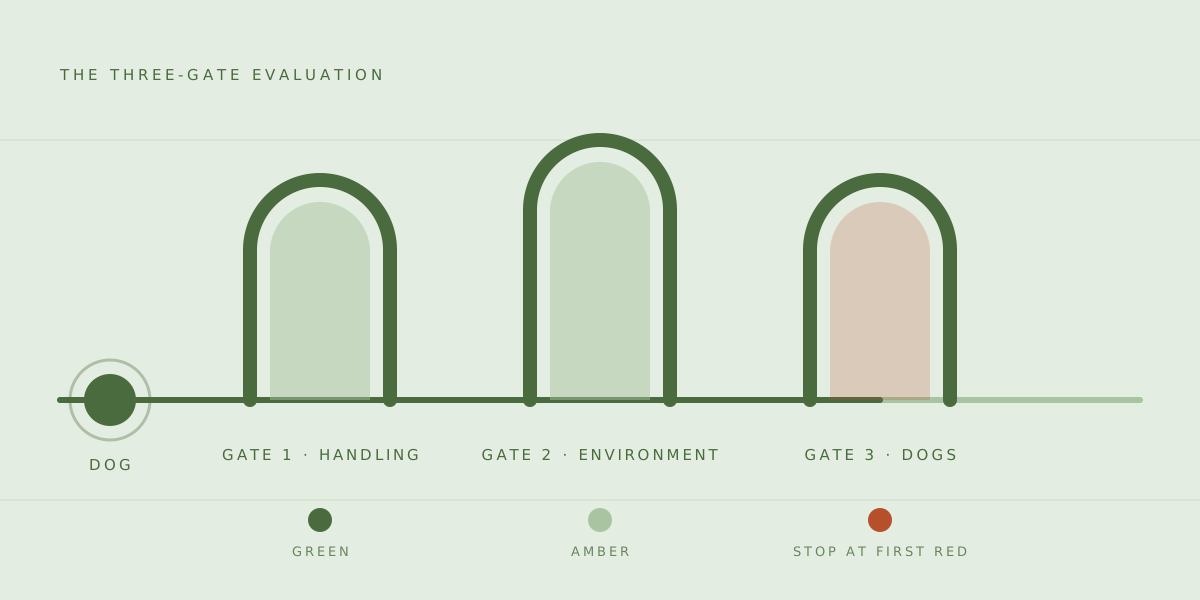
The Three-Gate Evaluation is the version I used for years and have seen work in buildings of eight dogs and eighty. It has three gates in a fixed order, because each gate protects the next. A dog that cannot be handled should never be walked into a room. A dog that cannot recover from a noise should not be introduced to other dogs. Stopping at the first red sign is not rudeness. It is the design.
| Gate | What you do | Green | Red |
|---|---|---|---|
| 1. Handling ~4 min | Collar, paws, ears, mouth lift, towel wipe, a brief hug-style restraint | Soft body, tolerates each step, takes a treat between steps | Freeze with a hard stare, lip lift, snap, or mouthing that increases with pressure |
| 2. Environment ~4 min | Unfamiliar surface, a metal bowl dropped at ten feet, an umbrella opened, owner out of sight for 60 seconds | Startles, then recovers in under 30 seconds and re-engages | Cannot recover, bolts, or redirects onto the handler |
| 3. Dogs 6 to 8 min | Barrier greeting, parallel walk at 20 then 10 feet, then 90 seconds loose with a settled staff dog | Loose body, play bows or sniffing, breaks eye contact on its own | Fixed stare, stiff approach, snap with no warning, or cannot disengage |
A few details make the difference between a gate and a ritual.
One evaluator, one room, one order. If the order changes, you cannot compare Tuesday's dog with Friday's. Pick a room the dog has not been in, keep it quiet, and use the same stimuli for every dog. Do not test near mealtimes, and do not test intact dogs when a female is in heat. Those are the basic safety rules from breed-club protocols for a reason.
Use a tester dog, not a volunteer. Gate 3 only works with a settled, sociable adult that belongs to staff and has been chosen for this job. Using the first friendly dog in the building turns the evaluation into a coin toss with a bystander.
Read recovery, not reaction. Almost every dog startles at a dropped bowl. What you are timing is how long it takes to come back. A dog that jumps and is sniffing the floor in ten seconds is a green. A dog still trembling at the 45-second mark is an amber at best.
The evaluator who runs the test writes the decision before the owner asks for it. If you decide while the owner is watching, you will negotiate. If you decide first, you will explain.
04 / DecisionsPass, trial day or not today.
A test with two outcomes forces staff to make a bad choice, because most dogs are not clean passes or clean fails. Give them three.
- Pass. Green on all three gates. The dog starts with a normal first day in a small group, and the handler scores the personality profile after three visits.
- Trial day. Amber on one gate, no reds. Typical ambers: slow recovery from a startle, or over-arousal in Gate 3 that settled after one break. The dog attends a supervised half day in a group of no more than four, with a written review at the end.
- Not today. Red on any gate, or amber on two. This is a decline for now, not forever. The owner gets a referral (trainer, veterinarian, or both), a plain-language reason, and a date after which you will re-evaluate.
Write the rule on the wall of the evaluation room. Staff apply rules more consistently when they can point at one. They also stop absorbing the owner's disappointment as a personal failure, because the decision came from the sheet.
Back to Juniper. Gate 1 went red at the lip lift, which meant Rosa never reached the other gates. The record read, in full: “Gate 1 red. Stiffened and lip lift during ear handling. Not today. Vet check for ear and mouth pain, re-evaluate in three weeks.” Three weeks later the vet had treated an ear infection and Juniper cleared all three gates. That is the best outcome for a decline, and it only happens when the decline has a next step.
A decline with a date on it is a service. A decline without one is just a door.Field Notes, on writing the re-evaluation date
05 / Special casesPuppies, seniors and rescues.
The three gates are built for healthy adult dogs with some history. Three groups need adjustments, and none of them should get a one-session verdict.
Puppies and adolescents. Breed-club protocols split puppy and adult tests at around five months, and the formal adult test starts at 18 months. Between those ages there is no standard, and dogs change fast. Treat anything under 18 months as a trial day with a written review, not a verdict, and re-score after any growth spurt or change in behavior.
Seniors. A lip lift on a ten-year-old is more often pain than temperament. Ask about hips, teeth and ears before you read anything into Gate 1, and make a vet check the first step of any decline.
Rescues with no history. You are guessing about everything the form leaves blank. Run the evaluation over two short visits on different days instead of one long one, and give the dog a quiet half day before you start. A rescue that is shut down on day one can look calm, which is its own warning.
06 / Anti-patternsFour ways this goes wrong.
- The forty-minute audition. Longer is not better when the extra time is the dog getting tired, hungry and overwhelmed. Twenty structured minutes plus a trial day beats forty unstructured ones.
- Testing in the playroom. A room full of the dog's future housemates is not neutral. Use a space the dog has never been in, so you measure the dog and not the territory.
- Letting the owner coach. An owner who is feeding treats, talking and hovering changes the result. Ask them to wait in the lobby for Gates 1 and 3, and be in the room only for the separation step in Gate 2.
- Treating a pass as permanent. A green sheet is a snapshot. Re-evaluate after any incident, injury, change of home or surgery, and note it on the record with the date.
07 / TakeawaysTake this with you.
If you do one thing this week, write the three outcomes on a sheet and put it on the wall of your evaluation room: pass, trial day, not today. Then add one rule beneath it that says the test stops at the first red sign. That alone turns a ritual into a gate.
The surprise, when you start writing decisions down, is how rarely your staff disagree about the clear cases and how often they disagree about the ambers. That disagreement is the signal. It tells you which dogs need the trial day and which staff need a second pair of eyes.
Tell me what your ambers look like. I am collecting examples from facilities of different sizes, and the startle-recovery times are more varied than I expected.
– DR, Portland, between the evaluation room and the front desk