Thirty minutes. That is what the booking says, and it is what Marisol’s client wrote in the notes field for Waffles, a nine-year-old English bulldog, in July in Denver. Fifteen minutes in, Waffles sat down on the pavement and declined to continue. Marisol, who runs five walkers, had trained her team to finish the block. That day she learned the block was the wrong thing to finish.
Ask how long to walk a dog and every source gives a number. None of them agree, and almost none are written for the person who has to put a number on an invoice. If you walk dogs for a living, you need one answer you can apply to a bulldog, a border collie and a four-month-old puppy before 9am, without a vet on the phone.
This piece gives you the published numbers, shows why no single one survives contact with a real route, and sets out the Four Dials: a short method for deciding how long each dog walks, and what to do when the dogs in one group need different things.
01 / The numbersEvery source gives a different answer.
PetMD says most dogs can tolerate a daily 20 to 30 minute walk if they are in good body condition, and that healthy dogs can manage up to two hours. Chewy Education puts adult dogs at roughly 30 to 90 minutes of total daily exercise. A March 2026 Newsweek piece quotes one veterinarian at 30 to 90 minutes a day and another at one to two hours. Academy Animal Hospital goes by breed group instead, and the spread is wide.
Puppies get their own rule. Chewy and Woofie’s both cite about five minutes of walking per month of age, and Newsweek’s vet says up to twice a day. A two-month-old gets two 10-minute walks. A four-month-old gets 20 minutes, split across the day.
02 / The problemWhy one number fails on a real route.
Read those figures side by side and the trouble is obvious. A 20 minute walk is right for a bulldog and an insult to a herding dog. A 90 minute walk is fine for a fit lab and dangerous for the same lab at 11 with sore hips. The ranges overlap, the sources do not say which to apply when a dog is two things at once, and none of them deal with weather beyond a warning. Adopt a Pet suggests shorter outings above 80°F, and Firehouse Veterinary suggests exercising before 8am or after 8pm in hot weather. Neither tells you how much shorter.
Owners can live with that, because an owner watches one dog. You can’t. You hold a route with eleven dogs on it, three walkers, and a menu that says 30 minutes or 60. The menu is the real problem: it turns a welfare decision into a billing decision, and the clock wins.
Don’t ask how long dogs should walk. Ask what stops this dog, today, and set the length from that.
03 / The frameworkThe Four Dials.
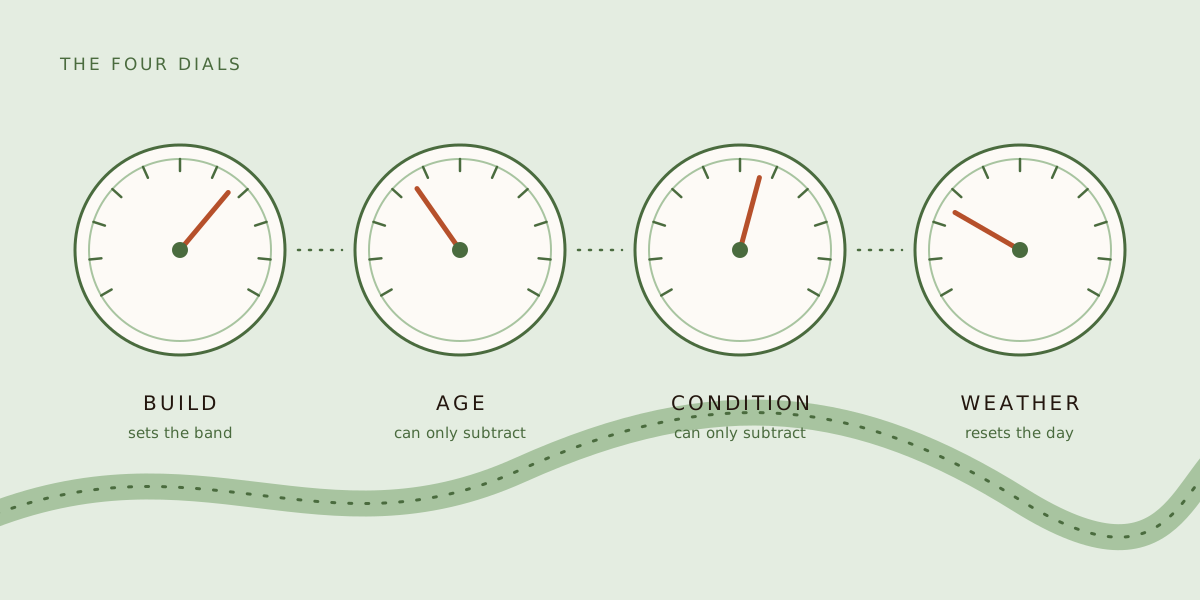
Every dog on your route has four dials that set a walk. You read them in order and you stop at the first one that says no.
Dial one: build. Breed group and snout. This sets the band, the range of minutes the dog’s body is built for. Use the table above as the starting point and treat a mixed breed as whichever group it moves like.
Dial two: age. Puppies take the five-minute rule. Seniors take whatever their joints allow. Neither dial can raise the band, only cut it.
Dial three: condition. Body weight, health, and how fit the dog is today. PetMD notes that an overweight or obese dog may struggle to walk even 10 minutes without breaks. A dog coming back from an injury sits here too.
Dial four: weather. Heat, pavement, humidity. This one resets the day, not the dog. The same bulldog gets 25 minutes in April and 12 in July.
The rule that makes it work: build sets the band, and the other three dials can only pull the number down. Nothing in age, condition or weather makes a dog need more exercise than its build calls for, so you never have to argue upward. You start at the top of the band and the dials take minutes away.
04 / Dial oneBuild sets the band.
Start with the flat-faced dogs, because they are where walks go wrong. A pug or bulldog moves air through a short airway, and the table puts them at 20 to 30 minutes. Chewy lists French bulldogs, pugs, Boston terriers, Shih Tzus and Pekingese as breeds that need shorter, less frequent walks. For these dogs the band is the ceiling, in every season.
At the other end, a border collie or a husky does not get tired by 30 minutes, and a 30-minute booking leaves it under-exercised before the walker has locked the door. Sporting, working and herding dogs are the 60 to 120 band. If your menu tops out at 60 minutes, those dogs are being sold a walk that fits your schedule, not their body.
Mixed breeds are the common case on a real route. Don’t guess from the label. Watch how the dog moves in its first week: a dog that pulls hard and keeps scanning at minute 40 belongs in the upper bands, and a dog that heads for the shade at minute 15 does not, whatever its DNA test says.
05 / Dials two and threeAge and condition only subtract.
The five-minute rule is the one piece of puppy guidance that three sources agree on. Use it as a cap per walk, not a target, and keep puppy walks on forgiving surfaces. Newsweek’s Dr. Elena Shirley suggests short bursts, and she is right that a puppy’s walk is mostly sniffing, not mileage. A four-month-old tops out at 20 minutes, so in a group walk the puppy goes home at minute 20, not minute 30.
Seniors are less tidy. There is no age cutoff in the sources. Dr. Karyn Collier, quoted by Newsweek, says a fit senior can manage about an hour and an arthritic one needs shorter sessions. Scout’s guide for walkers puts seniors at 20 to 30 minutes. Both are right, which is why age is a dial and not a chart. The condition dial decides.
Condition is where you earn your fee. PetMD gives you the single most useful field test in the whole genre: a dog that slows down about 25 to 30 minutes into a walk may be tired. Call it the return-leg test. On the way home, is the dog still pulling, or is it tracking behind you? If it is behind you, that was the dog’s length, and today’s walk is the next one shorter. Write the minute it slowed in the dog’s notes. After three walks you have a number that no article can give you.
06 / Dial fourWeather resets the day.
Weather is the dial you turn without asking the owner. Adopt a Pet’s guidance flags 80°F as the point where outings should get shorter, and Firehouse Veterinary’s summer advice is to go before 8am or after 8pm, carry water, and avoid hot pavement. Put the back of your hand on the pavement. If you can’t hold it there, the dog’s paws can’t either.
Make the rule a policy, not a judgment call, because judgment calls get made at 1pm when the route is behind. A workable version: above 80°F, flat-faced and heavy-coated dogs get a 10-minute potty round at most, and the rest of the route moves to early or late slots. Our dog overheating guide covers the warning signs, and it is worth putting in front of every new walker.
One more rule from Adopt a Pet that dog walkers forget: leave about an hour between a meal and exercise. A midday walk for a dog fed at 11 is a bad idea in any weather.
07 / The blockA 30-minute booking is not a 30-minute walk.
Here is the operator problem none of the competing articles touch. A booking is a block of time. A walk is what is left after the clip-on, the door, the water bowl and the paw wipe. If the handover takes five minutes at each end, a 30-minute block holds 20 minutes of walking, and for a bulldog that may be exactly right. For a collie it is a third of what it needs.
So price and describe the block honestly. Sell 30 minutes as a maintenance walk, the right length for small, flat-faced and senior dogs. Sell 60 as a working walk for terriers, scent hounds and sporting breeds. Then add a short, cheap top-up for the dogs whose band sits above whatever their group walk gives them. Our piece on dog walker pricing has the rate maths. The point here is that length stops being a menu you defend and becomes a recommendation you make.
08 / ApplicationMarisol walks three dogs on one route.
Back to Marisol. Her 10:30 group has three dogs, and the old rule would have given all of them the same 30 minutes. With the dials, it works like this.
Waffles moves to a 7:30am potty round and a 12 minute evening walk. Pip walks the first 20 minutes of the group and is dropped home. Juno gets a 60 minute walk at 7am, before the heat, with a 10 minute top-up at 5pm. The group walk as a single 30-minute block no longer exists, and nobody has complained. Marisol’s revenue per dog barely moved, because she sold the top-up and the evening visit as separate stops.
The group rule that holds up: the walk runs at the length of its weakest dog, and the stronger dogs get a top-up. Never the reverse. A group that runs to the strongest dog’s length is how a puppy ends up at minute 45.
09 / Anti-patternsFour ways walk length goes wrong.
- Don’t finish the block. The clock is a billing unit. If a dog is done at minute 15, the walk is done, and you still charge for the booking.
- Don’t sell two lengths. A menu of 30 and 60 forces every dog into one of two boxes. Offer the top-up and the potty round so the length can match the dog.
- Don’t let heat be a judgment call. Set a number, above 80°F, and a rule. Tired walkers make bad calls at 1pm.
- Don’t trust the owner’s number alone. Owners guess, usually high for a dog they feel guilty about and low for a dog they love. Time the return leg and write down what you see.
10 / TakeawaysTake this with you.
Pick one dog tomorrow, preferably the one whose notes just say “30 minutes”. Look up its band, run the three subtracting dials, and time the return leg. Write down the minute it slows. Do that for your ten oldest clients this week, and you have rebuilt your route notes around evidence instead of habit.
The number on the booking was never the walk. The walk is whatever the dog can do well today, and your job is to know that number better than the owner does.
– DR, Portland, with a stopwatch and a very patient cattle dog