Seventy-five pets died in a boarding kennel fire in Georgetown, Texas in 2021. The building had no sprinkler system, and nobody was in it after hours. The owners who had dropped those dogs off assumed, entirely reasonably, that a business charging money to keep an animal overnight kept a person there overnight. Texas now requires kennels to get that assumption signed in writing before you leave. Most states still do not.
Dog boarding is overnight care for a dog somewhere other than the dog's own home, provided for a fee. That is the entire definition, and it is close to useless on its own, because it stretches from a licensed resort with a night manager and a standing account at an emergency vet to a stranger's spare room booked through an app forty minutes ago. Both are dog boarding. Both are legal. They are not the same product, and the price difference between them will not reliably tell you which is which.
This is written from the other side of the counter. PackMonty builds the software that boarding and dog walking businesses run on, which means the version of this industry we see is the intake forms, the overnight rotas and the incident logs rather than the photography. What follows is what dog boarding looks like from there: the six things the word covers, what a night genuinely costs in 2026, and the five questions worth asking before you hand anyone a leash.
01 / The definitionWhat the word actually covers.
The useful line to draw is not between kennels and hotels. It is between boarding and sitting, and it is drawn by geography rather than by quality.
Boarding means your dog travels. It sleeps in a building or a home that belongs to somebody else, alongside other people's dogs, on somebody else's schedule. Sitting means your dog stays put and the care comes to it, either in drop-in visits or with a sitter living in your house for the duration.
That distinction carries a regulatory consequence most owners never see. Commercial boarding premises are frequently licensed, permitted and inspected. New York City requires a Small Animal Boarding Establishment Permit for any business housing three or more dogs, including an inspection and a supervising manager holding an Animal Care and Handling Certificate. Delaware requires a kennel license above four dogs. Missouri boarding kennels hold an ACFA license and are inspected at least annually. Inspectors typically look at sanitation records, vaccination documentation, enclosure sizes, staff-to-dog ratios and written emergency plans.
In-home sitting, by contrast, usually sits outside all of that. There is no single federal standard, and there is no national dog boarding law: state, county, city, zoning and animal control rules all apply in layers, and a state license does not answer a city question. This is worth knowing not because unlicensed care is bad care, which it frequently is not, but because a license is the one piece of evidence you can verify without taking anyone's word for it.
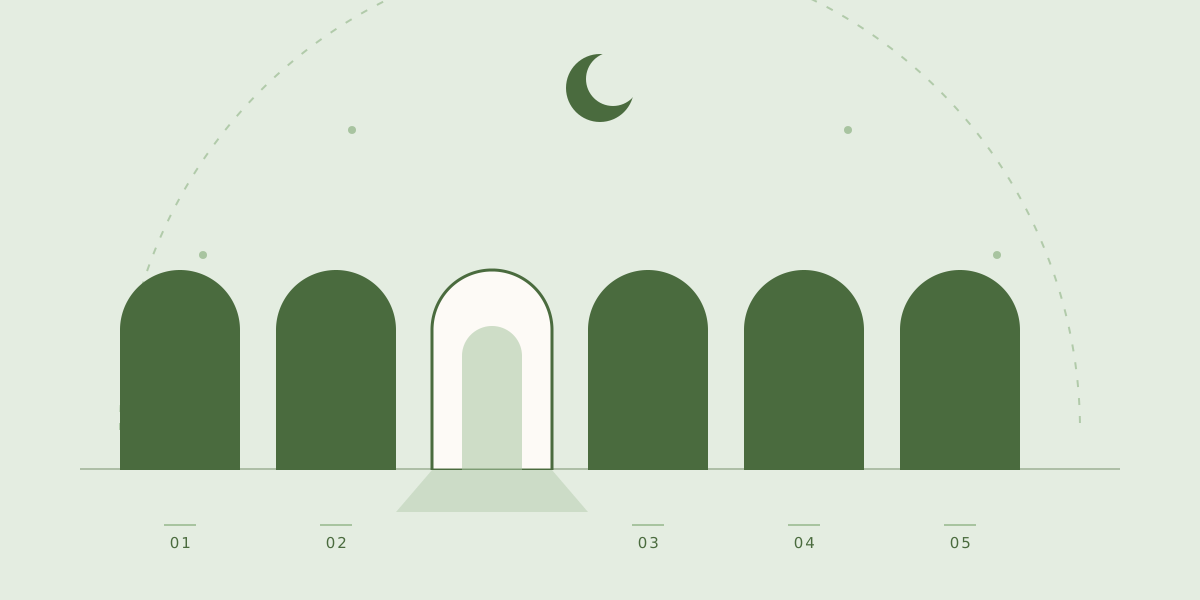
02 / The six typesSix products, one word.
Every guide lists these. Fewer say who each one is actually for, which is the only part that matters.
Traditional boarding kennels
Purpose-built runs, usually indoor with an attached outdoor section, one dog or one household per run. Staff handle feeding, cleaning and potty breaks, with playtime either included or sold separately. The reputation for concrete and steel is thirty years out of date at the better end of the market, where heated floors, raised beds and group exercise sessions are now normal.
Best for: dogs who want space and quiet rather than company, dogs on a strict routine, and anyone paying attention to budget. Least suited to: genuinely anxious dogs, for whom a run they cannot leave amplifies whatever they arrived with.
Daycare with overnight boarding
Structured group play through the day, then a private sleeping space at night. This is the fastest-growing shape of the industry and the one most people picture when they imagine their dog enjoying itself while they are away.
Best for: social, high-energy dogs who already do well in groups. Least suited to: dogs who have never been assessed in a playgroup. Any facility running group play should temperament-test before the first overnight, and one that does not is telling you something.
Luxury pet hotels and resorts
Private suites, real beds, webcams, one-to-one enrichment, grooming and spa add-ons. Staff ratios are usually better, often around one person to four dogs on the floor.
Best for: long stays, dogs that need individual attention, and owners who will genuinely feel better watching a camera. Worth checking: whether the premium buys supervision or decor. Those are different purchases and they photograph identically.
Veterinary boarding
Kennels inside or attached to a clinic, with medically trained staff on the premises during the day. Less common than it was, because the space is worth more to a busy practice as treatment capacity.
Best for: dogs on complex medication, post-surgical recovery, seniors with unstable conditions, and anything where a vet in the building outweighs a play yard. The catch: many clinics have nobody on site overnight, which is a strange thing to discover about the medical option. Ask.
In-home boarding with a host
Your dog stays in a private house with a host who may be taking one dog or several. Booked through a marketplace or found locally. Most hosts are not licensed and many are not insured, because in most jurisdictions nothing requires them to be.
Best for: senior dogs, dogs who do not enjoy other dogs, dogs who need a sofa rather than a run, and anyone whose dog has failed a group assessment. The trade: one caretaker, which means a home environment and also means that if that person is out for three hours, your dog is alone for three hours.
Board and train
An extended stay, typically one to three weeks, combining overnight care with structured training. Priced per program rather than per night, commonly $1,500 to $4,000 for the block.
Best for: a specific, nameable behavior problem and an owner willing to do the handover work afterward. Least suited to: anyone hoping a facility will return a different dog. It returns your dog with new habits that you then have to maintain.
03 / The moneyWhat dog boarding costs in 2026.
The national average sits at roughly $40 per night, inside a normal range of $25 to $85. Averages hide everything interesting, so here is the spread by type.
- Traditional kennel: $25 to $55 per night. Typical week $140 to $175, typical month $460 to $720.
- In-home host: $15 to $50 per night, driven almost entirely by the host's experience and reviews rather than by anything structural.
- Daycare and boarding combined: $55 to $80 for a day and night together, since the day is a separate product being bundled.
- Luxury hotel: $75 to $95 per night, reaching $525 to $675 a week and $950 to $2,600 a month.
- Veterinary boarding: $35 to $45 a night for a healthy dog, $40 to $55 where medication or isolation is involved.
- Board and train: $1,500 to $4,000 for a one to three week program.
Three things move that number more than anything on the price list. Location is the largest single factor, with dense metro pricing running well above the national figures. Dog size matters at most facilities because a large dog occupies a larger run. And holidays change the arithmetic completely.
Holiday surcharges of 25 to 50 percent are standard and 100 percent is not unheard of, so a $50 night becomes $75 to $100 over Thanksgiving or Christmas. Minimum stay requirements and non-refundable deposits appear at the same time.
None of that is opportunism. A boarding facility has a hard capacity in runs, and holiday weeks are the only period where every run sells at once. A cancelled Christmas booking on three days' notice is a run that cannot be resold, in the one week of the year the business depends on. The deposit exists because the inventory is perishable.
Which leads directly to the booking window. For an ordinary week, one to two weeks ahead is fine. For Thanksgiving, book by mid-October. For Christmas and New Year, book by early November. Popular facilities fill three to four weeks before the date, and at the most sought-after ones a reservation three or four months out is unremarkable.
Every boarding brochure is a photograph of the daytime. What you are actually buying happens at two in the morning.Field Notes · Care & welfare
04 / The frameworkThe Night Shift Test.
Tours happen at eleven in the morning. The floor has been cleaned, the dogs are in a play group, and a staff member who is good with people is walking you around. Nothing you are looking at is wrong, and almost none of it is the thing that decides how the stay goes.
Nearly everything that goes badly in boarding goes badly between the evening lock-up and the morning feed. A dog stops eating. A dog gets loose in a corridor. Something bloats. Something catches fire. That window is when the fewest people are watching, and it is the window nobody markets.
The Night Shift Test is five questions that all describe the same twelve hours. They take about half an hour to ask and they sort facilities faster than any amount of touring.
One: who is physically in the building at 2am
There are four honest answers. An owner who lives on site. Paid staff who are awake overnight. Someone on call who can get there within a stated number of minutes. Or nobody, with cameras. All four are legal across most of the United States, and all four are defensible for the right dog.
The problem is that only one of them matches what most owners assume they are paying for, and the phrase that hides the gap is 24/7 care, which very often describes camera coverage rather than a human being. Texas is currently the clearest exception to the silence: since September 2023, HB 2063 has required kennels to obtain written informed consent before leaving a boarded animal unattended, carrying a $500 penalty per animal. That law exists because of the Georgetown fire. Everywhere else, the question is yours to ask.
Two: where the dog sleeps and who is next to it
Ask to see the actual room your dog would be in, not a representative one. Then ask what is on either side of it. A reactive dog placed next to a barker is a bad night for both, and good facilities group deliberately by size, age and temperament rather than by whatever run was free.
Ask about doors, too. Double-door entries and secured perimeters are the difference between a dog that slips a collar and a dog that slips a collar and reaches a road.
Three: what gets written down overnight
This is the question that separates the top decile from everyone else, and it is the one nobody asks. A facility that checks dogs at intervals overnight has a log. Ask what goes in it and ask to see a blank copy.
The specific things that matter are food intake, water consumption and stool quality, because those three are how a problem announces itself before it becomes visible. A dog that has not eaten by the second dinner is a dog somebody should already have flagged. Facilities that record it catch that on night two. Facilities that record nothing find out at pick-up.
Four: who can authorize veterinary care, and up to what amount
You want three things on the intake form before you leave: a named person with authority, a named clinic they actually drive to, and a dollar ceiling under which nobody has to reach you first.
The ceiling is the part owners skip and it is the part that matters most, because the entire premise of boarding is that you are somewhere hard to reach. A blank ceiling means a staff member at 3am is choosing between treating without authority and waiting for a voicemail. Pick a number you would be comfortable with, write it down, and confirm which after-hours emergency clinic they use rather than which one appears on the website.
Five: the stop rule
Ask what specifically triggers a call to you, and how quickly. Good answers are concrete: any vet visit, any injury however minor, any refusal of two consecutive meals, any fight. Vague answers about keeping you updated mean the decision gets made in the moment by whoever is on shift, which is exactly when nobody wants to make it.
A facility that answers all five plainly, including the ones with unflattering answers, is usually a better bet than one that answers four beautifully and gets evasive on the fifth. You are not testing for perfection. You are testing for whether they have thought about it and whether they will tell you.
05 / The processWhat a stay looks like, booking to pick-up.
Renata Alvarez runs a 34-run facility outside Sacramento. Her intake process is unremarkable for a well-run operation, which is the point of describing it.
It starts with a tour and a temperament assessment, usually a free half-day. Her staff are watching for how a dog handles a leash handover from a stranger, whether it settles in an unfamiliar space within twenty minutes, and how it reads other dogs through a fence. Roughly one dog in eight comes back as suited to a quiet run rather than group play, and the assessment is how that gets caught before it becomes a bad first night.
Then booking and paperwork. Vaccination records, feeding instructions by weight and time, medication schedules, emergency contacts, the vet authorization ceiling, and a behavior history. That last one is where owners undersell, and it is the field Renata says she would most like people to fill in honestly. A dog that has resource-guarded a bowl once at home is not disqualified. A dog that resource-guards and arrives undeclared into a shared feeding routine is a genuine problem.
Drop-off works best short. Dogs read the goodbye, and a long emotional one raises the baseline they then have to settle down from. Bring their own food, which prevents the digestive upset that a sudden diet change reliably causes, and bring one unwashed item that smells of home.
Then the stay itself, which in most facilities runs on a fixed daily shape: morning potty break and breakfast, late morning play or enrichment, an enforced quiet period after lunch, afternoon activity, dinner, a final potty break, lights out. The quiet period is not filler. Dogs in group settings routinely over-arouse and the scheduled downtime is what stops day three going sideways.
Most facilities now send daily updates with photographs, which is genuinely useful for owners and mildly useful diagnostically, since a dog that looks flat in three consecutive photos is worth a phone call.
At pick-up, ask for the report on eating, drinking and stool rather than accepting that they had a great time. Then expect two or three flat days at home. A tired dog after boarding is normal, and it is a function of interrupted sleep and sustained stimulation rather than of anything having gone wrong.
06 / Anti-patternsWhere boarding goes wrong.
Five failure patterns, and four of them are the owner's rather than the facility's.
Booking on photographs. Facility photography is a solved commercial problem and the correlation between it and overnight practice is close to zero. The five questions above cost nothing and reveal more than any gallery.
Reading a phrase as a promise. 24/7 care, constant supervision and always monitored are all compatible with an empty building and a camera feed. Convert every phrase into a person and a time.
Under-declaring the behavior history. Owners soften the truth about reactivity, guarding, escape attempts and separation anxiety because they are afraid of being turned away. Being turned away is the good outcome. A facility that knows can group correctly; a facility that finds out at 9pm on night one cannot.
Arriving with new things. New food, new treats, new chews, bought out of guilt on the way in. Digestive upset in boarding is caused by diet change far more often than by anything else, and it then gets attributed to stress. Bring exactly what the dog eats at home, portioned and labelled.
Leaving vaccinations to the last week. Vaccines generally need to be administered at least seven days before a stay, and a first bordetella dose usually needs a full two weeks. Rabies, distemper and parvovirus are near-universal requirements, bordetella is standard, and canine influenza is increasingly required in dense markets. Most facilities also set a minimum age of about four months. Checking this in the week before Thanksgiving is how a booking gets cancelled at the door.
07 / Take this with youThe short version.
Dog boarding is overnight care away from home, sold under one word by six businesses that are not doing the same thing. The definition will not protect you and neither will the price. What sorts them is a set of operational answers that any decent operator can give you in half an hour.
- Match the type to the dog, not to the budget. Social and energetic points to daycare-plus-boarding. Anxious or antisocial points to in-home or a quiet run. Medical points to a vet. Getting this right matters more than every other decision combined.
- Book holidays absurdly early. Thanksgiving by mid-October, Christmas by early November, and accept the deposit as the price of a perishable run.
- Run the Night Shift Test. Five questions about the same twelve hours. Take the plain answers over the polished ones.
- Get the vet ceiling in writing. A named person, a named clinic, a dollar figure. It takes one minute at drop-off and it is the single most useful thing on the form.
- Declare everything. The behavior history you are embarrassed by is the one that keeps your dog in the right group.
Boarding done well is genuinely good for a lot of dogs: structure, supervision, company and a break from a house they were going to spend eight hours alone in anyway. Boarding done badly is a building nobody is standing in. The questions that tell them apart are all about the same twelve hours.
Prices quoted are published US figures current in August 2026 and vary widely by state, city, dog size and season. Licensing, inspection and staffing rules for boarding facilities are set at state, county and city level and differ substantially. Vaccination requirements are set by individual facilities and by your veterinarian. Confirm local rules and facility policies directly before booking.