Jordan walked under Rover for two years before going independent in Brooklyn. He filed taxes as a sole prop, paid for an LLC, opened a business checking account, ordered the leashes, the poop bags, the tiny truck magnet that said Jordan's Pack & Co. He didn't buy general liability insurance because — his words — “I'm a one‑guy LLC, who's going to sue me?”
A Goldendoodle named Maple bit a jogger in Prospect Park in his fourteenth month. The jogger needed twelve stitches, a course of antibiotics, and three weeks of physical therapy. The medical bills came to $14,300. Jordan didn't have $14,300. The jogger's lawyer found Jordan's business address through the LLC filing in two minutes.
This article is the layered guide I wish someone had handed Jordan in month one. There are five tiers of insurance cover an American dog walking business needs as it grows, what each one actually does, what each one costs in 2026, and the specifically American landmines — the bonding myth and the 1099 contractor trap — that quietly kill small operators in years two and three. If you're earlier in the journey, our how to start a dog walking business in the US piece covers the 90‑day frame.
01 / The myth“I'm 1099, who's going to sue me?”
The most expensive belief in American dog walking is that being a sole proprietor with a single‑member LLC protects you from liability claims. It doesn't. A single‑member LLC offers some asset protection from contract disputes, but it offers very little against tort claims — injury, negligence, property damage — and absolutely nothing against an unhappy client who decides their dog's seizure was caused by your missed dose of medication.
The second most expensive belief is that classifying your walkers as 1099 contractors gets you out of the insurance question. Wrong in the opposite direction: it puts you deeper into it. We'll get to that in tier four.
The third is that “bonded and insured” means you need a bond. For most American dog walkers in 2026, you don't. We'll get to that too.
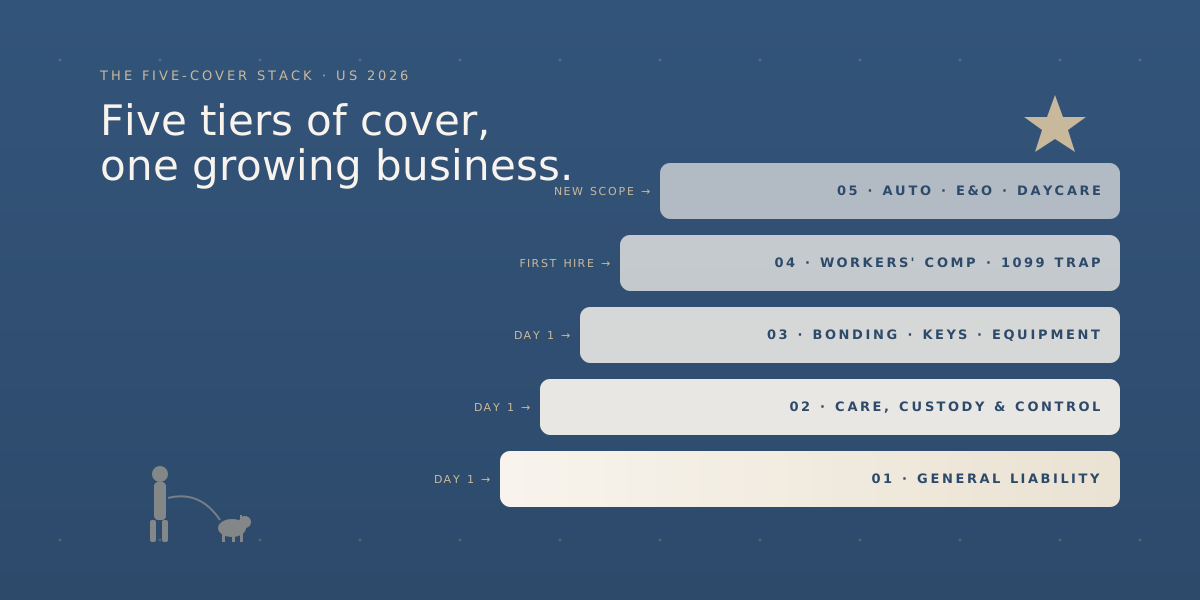
Everything below is the five‑cover stack — a layered, lifecycle‑aware way of reading a dog walking insurance policy. A solo walker on day one needs the first three tiers. A walker who hires their first helper needs the fourth and must navigate the 1099‑versus‑W‑2 question carefully. A walker who adds vehicles, training advice, or doggy daycare needs the fifth.
02 / FrameworkThe five‑cover stack.
Here it is in one block.
Each tier solves a different problem. Each tier has a specific trigger event — something in your business that makes that tier go from “optional” to “now required.” A solo walker working five regular clients in their first six months needs tiers 1–3. The moment they hire one person, tier 4 activates — and the choice of W‑2 versus 1099 has tax, legal, and insurance consequences that compound for years. The moment they add a vehicle, training packages, or daycare hours, tier 5 starts to bite.
The article walks each tier in order. Skip ahead if you've been operating for a year and just want the provider comparison.
03 / General liabilityThe base layer.
General liability (GL) is your insurance against the world outside the dog. It pays out when a third party — anyone who isn't you, your employee, or your direct client — has been injured or had property damaged because of something connected to your business.
The standard 2026 limits are $1 million per occurrence and $2 million aggregate. Some carriers offer $2M/$4M as a baseline (Insurance Canopy is one), and the difference in premium is usually under $100 a year, so most working walkers should default to the higher limit. Commercial real‑estate property managers, vet groups, and many municipal park permit systems now write $2M per occurrence into their vendor paperwork.
What it covers:
- A dog you're walking jumps up at a jogger in Prospect Park and the jogger sprains her wrist.
- A child trips over the leash bundle in your hand on a Brooklyn sidewalk.
- You knock over a planter on a client's neighbor's stoop while loading three dogs into your car.
- A dog in your group damages a client's neighbor's fence trying to get at a squirrel.
What it doesn't cover:
- Anything that happens to the dog itself.
- Anything that happens to property belonging to your client, inside your client's home, while you're on a key‑holder visit.
- Anything an employee of yours does after their probationary day (workers' comp covers their injury; GL covers what they do to others).
- Damage caused by something you advised the client to do.
Each gap is filled by a different tier in the stack below.
“General liability included” on your policy schedule is the floor, not the building. Read tier 2 carefully — it's the one that pays the vet bills.
04 / Care, custody & controlThe layer nobody understands.
This is the tier that catches new operators out because the name is opaque and the cover is critical. Care, custody and control (often shortened to CCC, or sometimes called “animal bailee” cover) is shorthand for: insurance that pays out when the dog you are responsible for is injured, killed, lost, or stolen — or when something belonging to that dog is damaged.
In Jordan's case at the top of this article, the jogger was a third party, so general liability would have applied — if he'd had it. But imagine instead the Goldendoodle had been the one injured: hit by a car, attacked by another dog, escaped and run into traffic. That scenario isn't general liability. The dog isn't a third party. The dog is the whole point of the job. CCC is the tier that pays.
Business Insurers of the Carolinas (BIC), the longest‑running specialist US pet‑sitter insurer, bills its CCC cover as “the broadest in the industry” and includes it within its standard policy for PSI/NAPPS members. Pet Sitters Associates (PSA) includes CCC as standard in its $215 basic membership policy. Insurance Canopy bundles “animal bailee” coverage at $1,000 per incident with a $2,500 annual cap and a $250 deductible — that's a thinner limit than BIC, so worth knowing before you buy.
Real claim scenarios this tier handles:
- A slipped harness on the Brooklyn Bridge — vet bills, lost‑dog recovery costs, an ad in the Park Slope Patch.
- A dog fight in the off‑leash hours at Fort Greene Park between two dogs in your group — both owners look to you for the bill.
- A stolen Labrador from your car while you ran into a deli — police report, lost‑dog rewards, replacement collar and leash.
- A retractable leash snapping and the dog needing emergency dental surgery.
In Insurance Canopy's published claims data, care, custody and control is the most‑claimed tier of any dog walker policy — not general liability. GL claims are larger when they happen; CCC claims are more frequent. Plan accordingly.
If your headline policy says “general liability” and nothing about Care, Custody and Control, you do not have dog walking insurance. You have standing‑in‑a‑park insurance.— PackMonty Field Notes, editorial position
05 / The bonding mythPlus keys and equipment.
Most American dog walking marketing copy includes the phrase “bonded and insured” because it sounds professional. For most operators, the “bonded” half is unnecessary. Here's the actual distinction.
A bond (specifically a fidelity bond or janitorial bond) protects your client from theft or dishonesty by you or your employees. It's an artifact of the cleaning, locksmith, and home‑services trades, where workers routinely have unsupervised access to a customer's high‑value property. The bond pays the client if you steal from them and a court agrees. The bond is not insurance against pet injury, accidents, or your own losses — it's a third‑party guarantee of your honesty.
For a solo dog walker holding a single house key on a single short visit, a $5,000 fidelity bond costs $80–$150 a year. It's cheap. But unless a client specifically asks for it (some high‑net‑worth Manhattan and West LA clients do, especially through property management firms), most walkers don't need to carry one. The “bonded and insured” phrasing is marketing language, not a regulatory requirement, and the working operators I know who carry bonds carry them because one client asked once and they renewed it out of habit.
What you actually need at tier three:
Lost key cover. You hold front‑door keys for fourteen clients. One Friday, you can't find the ring. Locksmith call‑out in Brooklyn runs $180–$280, new locks $80–$200 per door, new keys $5–$15 each. Without key cover, that's an $800 bill out of pocket. Most US pet‑business policies bundle $1,000–$10,000 of key cover as standard. Insurance Canopy and PSA both include it.
Equipment cover. Your car's contents (spare leashes, towels, harness collection, rain gear), plus your phone and tablet. Insurance Canopy bundles $1,000 of equipment cover. PSA offers it as a paid extra. Worth having if you keep more than $500 of working gear in your vehicle.
Cyber/data cover. Newer add‑on, increasingly relevant — if your client list (with home addresses, alarm codes, key locations) is breached or stolen, what's the response. Insurance Canopy offers cyber liability as a $99/year add‑on. For walkers with 30+ clients, worth it.
06 / The 1099 trapWorkers' comp and the ABC test.
This is the tier that quietly destroys small American dog walking operations in their second or third year. The trap has three parts: workers' compensation, the IRS classification test, and your insurance policy. Get any one of them wrong and the other two become very expensive.
Workers' compensation. In every US state except Texas (sort of) and South Dakota (for sole proprietors), if you have employees, you are required to carry workers' compensation insurance. The threshold is one employee in most states — California, New York, Illinois, Massachusetts, Florida, and dozens of others. The cost averages $110/month ($1,320/year) for a small pet care operation, scaling with payroll.
Workers' comp pays for an employee's medical bills, lost wages, and rehabilitation if they're injured on the job — a sprained wrist from a pulling Rottweiler, a fall over an iced sidewalk, a dog bite during a meet‑and‑greet. Without it, the employee can sue you personally, and your state's labor agency can shut you down and fine you.
The 1099 trap. Here's where it gets American. If you classify your walkers as 1099 independent contractors — pay them by invoice, give them a 1099 at year‑end, no payroll withholding — you don't pay workers' comp. You don't pay their unemployment insurance. You don't pay your share of FICA. Sounds great. It's also illegal in almost every case where the walker works only for you, under your business name, on schedules you set, with clients you provide.
The IRS uses a common‑law test (sometimes called the 20‑factor test). California uses the stricter ABC test under Assembly Bill 5 (AB5), signed by Governor Newsom in September 2019 and effective January 1, 2020. Under AB5's ABC test, a worker is presumed to be an employee unless the employer proves all three:
- (A) The worker is free from the company's control over how the work is done.
- (B) The work is outside the company's usual course of business.
- (C) The worker is independently established in the trade.
Test B kills most dog walking operations immediately. If your business is dog walking and your worker walks dogs for your business, the work is not outside your usual course of business. It can't be. The worker is an employee, no matter what 1099 paperwork you signed.
Massachusetts, New Jersey, Illinois, Connecticut, Vermont, and a growing list of other states now use a similar ABC test. The IRS reclassifies workers retroactively all the time — and when it does, you owe the back payroll taxes, the worker's share of FICA, penalties, and interest. The number isn't theoretical: typical IRS reclassification penalties for a small business with three misclassified walkers over two years run $25,000–$80,000.
What this means for your insurance. Your general liability policy excludes coverage for damages caused by your “employees” but treats them as you for claim purposes. If the worker is actually an employee (in the IRS or state sense) but you've classified them as 1099, your insurer can — and will — refuse to defend a claim, because you've failed to declare them. Your workers' comp doesn't apply because you don't have any. Your worker is uninsured, you're personally liable, and the state can come after you for the unpaid premium.
If you're going to hire help in 2026, hire them as W‑2 employees. Add workers' comp. Add them to your general liability as a named insured. Pay the $110/month and sleep at night. The 1099 path looks cheaper for eight months and then becomes catastrophically expensive in month nine.
07 / Tier fiveAuto, E&O, and daycare extras.
Tier five is the “your business has grown into new territory” tier. Three trigger events, three different add‑ons.
Commercial auto
The moment you transport client dogs in your vehicle for payment, your personal auto policy is invalid for that journey. Geico, State Farm, Progressive, Allstate — all of them exclude commercial use unless declared. If you have a fender‑bender on the way to a 7:30am pickup and your insurer learns the trip was business, the claim is refused.
You need either a commercial auto policy or a personal auto policy with a business use rider. Progressive Commercial, Geico Commercial, Hiscox, and Next Insurance all write this cover for dog walkers. The premium uplift is typically $300–$700 a year depending on state. The cost of having a claim refused is the full repair, plus any third‑party claim, plus medical for anyone injured — quickly $20,000+.
Professional liability (E&O)
You need this the moment you start giving advice that a client pays for and relies on. A standard dog walk doesn't qualify. A puppy socialization walk where you guide a new owner through correct leash technique, a board‑and‑train arrangement where you return a dog with claimed behavioral improvements, or a paid behavior consultation does.
Errors & Omissions (E&O) insurance — sometimes called professional liability — protects you when that advice is later blamed for a problem. Insurance Canopy offers it as a $129/year add‑on; Hiscox includes it in some pet‑business policies as standard. Most solo walkers don't need it. Walkers who run training, puppy classes, or board‑and‑train absolutely do.
Daycare and boarding extras
If you offer doggy daycare, overnight boarding, or kennel services, you've stepped into a different regulatory and insurance regime. Premises liability, kennel cover, climate‑control failure, and (in many states) state‑level licensing all become required. A full Field Notes piece on the daycare‑and‑boarding regulatory landscape is coming. The short version: get the state and local licenses first, then update the policy. Backwards order voids cover.
08 / ProvidersUS comparison, 2026 pricing.
Prices are for a solo US dog walker, no claims history, $1M/$2M general liability unless stated. State of operation affects pricing significantly — California, New York, and Texas typically price 10–20% above the national figures.
| Provider | Solo starter | What's standard | Best for |
|---|---|---|---|
| Business Insurers of the Carolinas | $540–$720/yr (industry avg) | $1M/$2M GL, broad CCC, key cover, bonding, workers' comp, commercial auto | PSI or NAPPS members — best per‑dollar full stack |
| Pet Sitters Associates | $215/yr (basic membership + GL) | $2M GL, CCC, $5k bonding, key cover | Solo walkers on a starter budget; $95 per employee/contractor add‑on |
| Insurance Canopy | $154/yr (from $13/mo) | $2,500/$5,000 GL (upgradable), $1k animal bailee, key cover | Online instant quote; thinner CCC limits than BIC/PSA |
| Pet Care Insurance (PCI) | $292/yr ($26.10/mo) | $2M GL, CCC, key cover, equipment | Walkers who want a middle‑tier option without trade‑association membership |
| Next Insurance | from $8/mo (~$96/yr) | $1M GL, optional add‑ons | Side‑gig walkers, weekend operators, app‑managed billing |
| Hiscox | varies; mid‑$300s typical | $1M GL, BOP packages available | Mainstream broker if you want a household name and integrated package |
A few observations from running quotes on each in May 2026:
- BIC is the most expensive but the deepest single‑policy option if you can join PSI ($175/year membership) or NAPPS. The CCC limits are unlimited and the relationship with the carrier matters when you actually need to file a claim.
- PSA is the best entry‑level option at $215 all‑in. The catch is the $95 per‑employee/contractor surcharge, which adds up fast if you grow.
- Insurance Canopy is the cleanest online experience with a real quote in three minutes, which matters when you're setting up your business this week. The animal bailee limits are the lowest in the table, though, so re‑check at year two.
- Next Insurance from $8/month is the cheapest credible option but it's a thin product — fine for a hobbyist or side‑gig, marginal as your full coverage.
Avoid: anyone quoting a “full pet business policy” under $120/year in 2026 without CCC or animal bailee coverage listed on the schedule. It's general liability dressed up as something more.
09 / ClaimsHow claims actually work.
The single most common claim mistake isn't filing badly. It's not filing at all, then renewing the policy the next year without disclosing what happened. American insurance is rebuilt every year at renewal — and material non‑disclosure voids the new year's cover retroactively. The carrier can recover paid claims if they later learn you didn't disclose.
The 30‑day rule. Most US pet‑business policies enforce a reporting window of 30 days from the incident, sometimes shorter. If a dog is bitten, a key is lost, a vase is broken, or a passer‑by is knocked over — you call the insurer's claim line the same day. You don't wait to see if the client complains.
The two‑photo rule. Take a photo of the scene and a photo of the damage or injury. Phone metadata gives you a timestamp. This is the single most useful piece of evidence in a contested claim, more useful than any written statement.
The disclosure trap. When you renew, the carrier asks two questions: “Have you had any claims, losses, or incidents in the past 12 months?” and “Has anything changed about your business?” The temptation to answer “no” to the first because the claim was small and you handled it privately is enormous. It also voids your next policy. Disclose everything.
1. Settled with the client privately, didn't tell the carrier. Voids your next renewal as material non‑disclosure.
2. Classified a walker as 1099, didn't carry workers' comp. When the walker sprains a wrist, you're personally liable and the IRS reclassifies retroactively.
3. Transported dogs on a personal auto policy. Carrier refuses the claim; you pay repair plus third‑party costs out of pocket.
10 / ConclusionOne thing for tomorrow.
The five‑cover stack isn't five separate insurance contracts. It's a way of reading the one policy you already pay for — checking each tier against your actual business and adding what's missing before the claim happens, not after.
If you're a solo walker on day one, you need tiers 1–3 bundled in one policy. PSA at $215/year is the cheapest credible route. BIC via PSI membership is the deepest single‑policy stack if you can afford it.
If you've just hired your first walker, slow down. Read tier 4 again. Choose W‑2, not 1099. Add workers' comp. The premium hurts in month one and saves the business in month nine.
If you're growing into vehicles, training, or daycare, read tier 5 and pick the trigger that applies.
Jordan from the top of this article paid the jogger's medical bills through a payment plan and a second job. He bought $2M general liability the same week and called it cheap. The thing that didn't happen — and the reason this article exists — is the version of the story where he didn't have $14,300 and didn't have a second job and lost the business.
That's the version the stack is designed to prevent.
— Devon Russo, Brooklyn, on a humid Tuesday afternoon