Researchers at Nottingham Trent University and the Royal Veterinary College went through the primary care records of 905,543 UK dogs and pulled out every heat-related illness event they could find. There were 1,259 of them. The finding that made the paper's title was not about temperature. It was about what the dogs had been doing. Exercise triggered 74.2 percent of events. Being shut in a vehicle accounted for roughly one in twenty.
The paper is called Dogs Don't Die Just in Hot Cars, and the reason it matters to anyone running walks for a living is that the public conversation about dog overheating is almost entirely about parked cars, while the actual mechanism is almost entirely about movement. Which is the thing you are paid to provide.
Everything written about spotting an overheating dog assumes you own the dog. You know what its normal panting sounds like. You know it went to bed fine. You have one dog, one leash, and a house forty feet away with air conditioning in it. A walker has none of that. You have six dogs you see for forty minutes a day, no baseline for any of them, a van, a schedule, and a client who is in a meeting.
01 / The triggerThe problem is the walk, not the car.
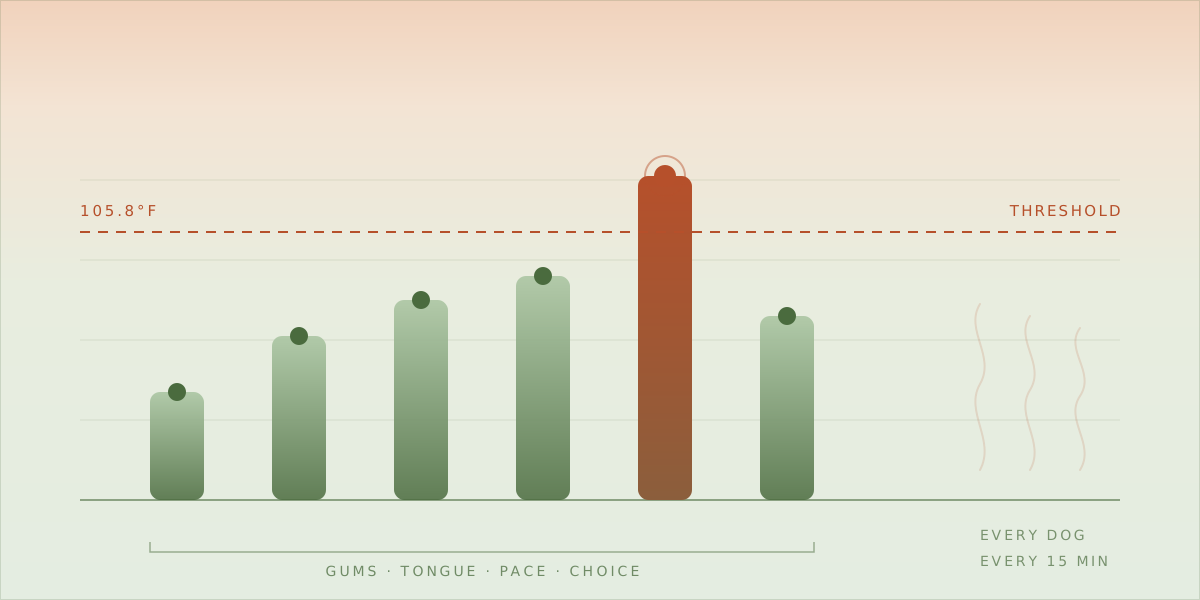
Heat stroke in dogs is a core body temperature at or above 105.8°F, reached through heat rather than infection. Normal sits between 101 and 102.5°F. That gap is about three and a half degrees, and a dog moving on a humid morning can close it faster than most walkers expect.
Dogs shed heat almost entirely by panting, plus a small contribution through the pads of the paws. Panting works by evaporation, and evaporation stops working when the air is already saturated. This is why humidity is the variable that catches people out: a 78°F morning at 30 percent humidity is a normal walk, and a 78°F morning at 80 percent humidity is a different set of conditions wearing the same number.
Exercise makes it worse in two directions at once. The dog generates more heat because its muscles are working, and it loses the ability to regulate its own pace because it is on a leash next to five other dogs. A dog left alone in a yard on a hot day will find shade and lie in it. A dog on a group walk will keep walking, partly because it is being asked to and partly because the pack is moving.
The severity picture is better than the headlines suggest, provided the problem is caught early. Roughly 98 percent of dogs presented to a vet with mild heat-related illness survive. Across all severities the case fatality rate is about one in seven. The entire difference between those two numbers is how long the dog spent above the line before somebody noticed.
02 / The gapYou are reading a dog you have never seen at rest.
Every guide to overheating tells you to watch for excessive panting. That word, excessive, is doing an enormous amount of hidden work, and it assumes a comparison you do not have.
An owner knows that their whippet pants for four minutes after a run and then stops. A walker meets that whippet at 11:40am, three flights of stairs into the day, already excited about the van. There is no resting baseline in the walker's head, only the dog in front of them, and a dog in front of you panting hard is either a normal dog being normal or a dog eight minutes from a problem.
Three practical consequences follow, and they shape everything below.
The baseline has to be recorded, not remembered. Marisol Reyes runs six walkers out of a unit in south Austin, where the summer question is not whether it will be too hot but how many weeks it will stay that way. Every dog on her books has a two-line note on its profile written at onboarding: how it breathes after five minutes of moving in cool weather, and what its gums look like at rest. It takes ninety seconds at the meet-and-greet. It is the only version of a baseline that survives staff turnover.
The comparison is against that dog, not the group. A pug panting harder than a border collie tells you nothing. A pug panting harder than the same pug fifteen minutes ago tells you everything.
The loud dog is rarely the one in trouble. Attention goes to noise, and heat exhaustion is quiet. The dog that has stopped pulling, stopped sniffing and stopped being interesting is the dog to look at, and it is the one a busy walker will look at last.
The dog that draws your eye is the loud one. The dog in trouble is usually the quiet one.Field Notes · Care & welfare
03 / The gateThree numbers before the van leaves.
The worst place to make a heat decision is on a sidewalk at 1:15pm with six dogs attached to you. By then the choice is between finishing a walk you should not have started and explaining to five clients why their dog came home after eleven minutes. The decision belongs earlier, at the point where it is still cheap.
One: the 150 line
Add the air temperature in Fahrenheit to the relative humidity as a percentage. Above 150, group exercise is off. A 78°F morning at 80 percent humidity scores 158 and does not get a walk, while a 92°F afternoon at 25 percent humidity scores 117 and does, with shade and water.
It is a rough instrument and it is not a clinical threshold. What it is good at is being a single number that a walker can check on a phone in four seconds and that a business owner can write into a policy without arguing about it every July. UK operators, working in Celsius, commonly stop normal walks somewhere around 22 to 23°C, which is roughly 72 to 75°F, and drop that to 17 or 18°C for flat-faced and thick-coated dogs. Those are the same instincts expressed differently.
Two: the seven-second pavement test
Asphalt runs far hotter than the air above it. At 77°F air temperature, blacktop can reach 125°F. At 86°F it can reach 135°F, and skin damage can occur in about a minute at those surface temperatures.
Press the back of your hand flat on the pavement and hold it for seven seconds. If you cannot, the route changes to grass, dirt or shade, or the walk moves. Do this at the actual route rather than at the office, because a shaded street and a sun-facing parking lot four blocks apart are not the same surface.
Three: the dog's heat class
Set once, at onboarding, and stored on the dog's record rather than in a walker's head. Three classes are enough.
- Standard. Healthy adult, normal muzzle, normal coat, normal weight. Follows the 150 line.
- Reduced. Flat-faced, thick-coated, senior, puppy, overweight, or on medication that affects heat tolerance. Threshold drops by roughly 20 points, so this dog comes off group walks at 130.
- Indoors only above threshold. Bulldogs, pugs and French bulldogs with a known history, dogs with laryngeal paralysis, tracheal collapse or heart disease. These get a potty break and enrichment, not a walk.
The Royal Veterinary College put numbers on why this matters. Compared with Labrador retrievers, chow chows show roughly seventeen times the odds of heat-related illness, bulldogs about fourteen times, French bulldogs about six and pugs about three. A walker taking a Frenchie and a Labrador out on the same forty minutes is handling two animals with different clocks running.
Every walker who has ever pulled a walk for heat has had the conversation where a client hears cancelled and thinks refund. The fix is to stop cancelling. Publish a hot weather policy that swaps the service instead of dropping it: a fifteen-minute potty break, an indoor enrichment visit, or a reschedule to cooler hours, all at the normal price, with the threshold written down.
Put it in the client agreement in April, not in the group chat in July. A walker applying a policy is in a much better position than a walker negotiating from a hot sidewalk with six leashes in one hand.
04 / The frameworkThe 90-Second Sweep.
On any walk above the line, or on any walk at all with a reduced-class dog in it, you stop the group every fifteen minutes in shade and run four checks on every dog. Four checks at about fifteen seconds a dog covers a group of six in roughly ninety seconds.
The order matters and the completeness matters more. You start with the highest-risk dog rather than the one making the most noise, and you check every dog rather than the one that caught your eye, because the point is to catch a change rather than a crisis.
Gums
Press a thumb against the gum above an upper canine tooth and let go. You are reading two things: color and tack. Healthy gums are salmon pink and wet, and the color returns within about two seconds. Brick red means a dog dumping heat hard through dilated vessels. Tacky or dry means dehydration alongside it. Pale, gray, blue or purple is the emergency end of the scale, and it means the walk has already ended.
Some dogs have pigmented gums where color is hard to read. Check the inner eyelid or the tongue underside instead, and record which one works for that dog on its profile so the next walker does not have to work it out on a hot afternoon.
Tongue
A dog under thermal load does something visible with its tongue. It extends further, widens, flattens into a spatula shape and curls up at the edges, which increases the surface area available for evaporation. It is one of the more reliable early tells and one of the least written about.
Read it as a change rather than a state. A spaniel with a wide curled tongue at minute thirty that had a narrow one at minute fifteen has moved, and the direction is the information.
Pace
Position in the group is a proxy that costs nothing to watch. A dog that started at the front and is now at the back has told you something even while it still looks comfortable. So has a dog that has stopped sniffing, since sniffing is optional behavior and a dog under load drops optional behavior first.
Choice
The most useful ten seconds of a hot walk are the ten seconds after you stop moving. A dog that stands and waits is fine. A dog that walks itself into shade, lies down on cool concrete, or pulls toward water without being asked has made a decision about its own thermal state, and that decision is more accurate than your guess.
The one to watch hardest is the dog that stands still and does nothing at all. Not resting, not seeking, not interested. That is a dog whose attention has narrowed, and narrowing attention is early central nervous system involvement.
Retrievers, working line shepherds and terriers with a ball will run themselves into heat stroke. They do not self-limit, and their apparent enthusiasm reads as evidence that they are fine. A Labrador that still wants the ball at minute thirty-five of a 90°F walk is not telling you it is comfortable. It is telling you it is a Labrador.
For those dogs the sweep is not optional and the walker makes the stop decision, not the dog.
05 / The abortOne dog down, five still on the leash.
This is the scenario no consumer article addresses and every walker eventually meets. A dog in your group crosses from moderate signs into emergency signs. You are four hundred yards from the van. You have five other dogs attached to you, all of them also hot, and one client's dog is now a medical emergency.
The clinical guidance is unambiguous and it is worth stating plainly, because it runs against what a lot of people were taught: cool first, transport second. Cooling a dog before it reaches the clinic has been shown to move survival from roughly 50 percent to roughly 80 percent. Every minute above 105.8°F does more damage, and driving is not cooling.
The older advice that cold water constricts blood vessels and traps heat inside the body has been challenged directly. Work from the Royal Veterinary College published in 2023 found rapid cooling with cold water safe and effective for healthy dogs, and recommended it before transport. For very young, very old, flat-faced or already collapsed dogs, wet the coat thoroughly and use moving air rather than full immersion. Either way, do not spend time hunting for water of the correct temperature. Use what is there.
The sequence that works with a group attached to you:
- Stop everything and get shade. Not the nearest shade in twenty seconds, the nearest shade now. Every dog stops walking, including the five that seem fine, because they are on the same walk in the same conditions.
- Secure the group before you treat. This is the step people skip and it is the one that turns one emergency into two. Tie the five off to something immovable, or clip them to a fixed point, or hand them to whoever is closest and willing. You cannot cool a dog one-handed while holding five leashes.
- Cool the affected dog with whatever water is available. Belly, inner thighs, armpits, neck, paws, where the blood runs close to the skin. Wet the whole coat. On double-coated dogs get the water down to the skin, which takes longer than it looks.
- Keep air moving. Wet fur with no airflow is insulation. Wet fur with airflow is a cooling system. A car with the windows down while moving, a fan, or a folded map works.
- Call while cooling, not before or after. One hand on the dog, one on the phone. Tell the emergency clinic what you are seeing, that you are cooling, and that you are coming. Then call the owner from the road, not from the sidewalk.
- Stop active cooling around 103.5°F or as soon as the dog is visibly more alert. Cooling past that point creates the opposite problem.
- Get the rest of the group home before you drive. The van has air conditioning and the walk is over for all six, not one. If a second walker can take the group, better. If not, the five go home first unless the affected dog is critical, in which case the van goes to the clinic with everyone in it and the schedule falls apart, which is the correct outcome.
Then write it down the same day. Time, conditions, what you saw, what you did, what the clinic said. Not because of liability, though that is real, but because the note is what tells you in September whether the 150 line was set in the right place.
06 / Anti-patternsFive things that make it worse.
Waiting for the panting to stop. A dog that has been panting hard and then goes quiet is not recovering. Panting is the cooling system, and a dog that stops panting under load has usually stopped because it cannot keep going, not because it does not need to. Treat the quieting as an escalation.
Moving the walk later instead of earlier. When a morning slot is too hot, the instinct is to push it to the afternoon. The hottest part of the day is late afternoon, roughly 3pm to 6pm, well after peak sun. Ground surfaces are hotter then than at noon because they have been absorbing all day. Move walks earlier, not later.
Shaving double-coated dogs. Huskies, malamutes, chow chows, Bernese and Australian shepherds have coats that insulate in both directions and protect from sun. Shaved, they lose the insulation, gain direct sun on skin and often grow the coat back badly. Brushing out the dead undercoat is the intervention that works; clipping is not.
Treating water as cooling. Offering a dog a drink is hydration, which matters, and it is not how you drop core temperature. A dehydrated dog overheats faster, so carry water on every walk in summer, and do not confuse a dog having a drink with a dog being cooled.
Believing the dog when it says it is fine. The most common walker error is treating enthusiasm as an all-clear. Drive, excitement and pack momentum all override a dog's own thermal judgment, and the animals with the most drive are the ones that override it hardest. The stop belongs to the person holding the leash.
07 / Take this with youThe short version.
Dog overheating is a walking problem far more than a parked car problem, and the walking is your business. What separates a bad afternoon from a dead dog is almost entirely how many minutes passed before somebody noticed, which makes the whole thing a question of process rather than heroics.
- Record a baseline for every dog at onboarding. Two lines about breathing and gums, on the profile, where the next walker can read it.
- Set the gate before the van leaves. The 150 line, the seven-second pavement test, and a heat class on every dog's record.
- Run the 90-Second Sweep. Gums, tongue, pace, choice. Every dog, every fifteen minutes, highest risk first.
- Cool first, transport second. And secure the other five dogs before you touch the one that is in trouble.
- Write the hot weather policy in April. Swap the service rather than cancelling it, so the decision is already made when the temperature makes it.
The single change worth making this week is the smallest one on that list: add two lines to every dog's profile describing how it breathes when it is comfortable. It costs ninety seconds per dog and it converts excessive panting from a phrase into something a walker can actually measure against.
This article is written for professional dog walking and pet care operators and is not veterinary advice. Suspected heat stroke is a medical emergency: begin cooling and contact a veterinarian or emergency clinic immediately. Figures cited are drawn from Hall, Carter and O'Neill (2020) in Animals, Royal Veterinary College VetCompass research on breed risk and cooling methods, and published surface and vehicle temperature data. Thresholds in this article are operational rules of thumb rather than clinical standards, and individual dogs vary widely.