Three clients told Priya Nair in one week that her price looked high. Each asked the same thing in nearly the same words: what do dog sitters actually charge? Priya runs four sitters out of Austin, Texas, and she had no clean answer, because every answer she found online was a different number.
So she looked. Rover’s national average for a drop-in visit is $21.80. Pet Care Insurance’s rate guide says $20 to $35 for 30 minutes. Time To Pet puts the 2024 U.S. average for a 30-minute visit at $34.12. For an overnight, one guide says $60 to $100 and Thumbtack says $160 to $268. None of those sources is wrong. They are answering different questions.
This piece lays the published numbers side by side, explains why they disagree, and gives you the Five-Line Rate Card: five numbers to write down before you answer that question again. If you want to build a rate up from your own costs, our guide to how much to charge for dog sitting starts at your floor. This one starts at the market and works back to you.
01 / The spreadEvery published dog sitting rate is true for somebody.
Here is the market as six sources report it. Read it once, slowly, because the pattern matters more than any single line.
Look at the overnight figures. They span nearly a factor of three for what sounds like one product: someone staying with a dog for a night. The visit figures are tighter, from about $20 to $35, but even there a New York or San Francisco sitter will not recognize a Houston number. Rover’s own city table has a 30-minute drop-in at $29.76 in San Francisco and $19.61 in San Antonio.
One caution on the data. Rover says its prices are accurate as of September 2025, pulled from its own data, and several of the other guides carry older publication dates under 2026 headlines. Treat every figure here as a reference point, not a quote.
02 / The ladderThe spread is a ladder of sellers, not a range of opinions.
The reason the numbers disagree is that three different kinds of seller sit inside the phrase “dog sitter,” and each source samples a different mix of them.
- The hobbyist. A neighbor, a student, a friend with a free weekend. Adopt a Pet puts hobby sitters at $15 to $30 a visit. No insurance, no backup, no system.
- The platform average. A figure pooled across everyone listed on a marketplace, from a profile created last week to a ten-year veteran. Rover’s $21.80 and Care.com’s $16 to $23 hourly sit here. They are real, and they are pulled down by the sheer volume of newer and part-time sitters.
- The business. A sitter or a team with insurance, a booking system, a backup person and a reason to answer the phone at 7pm. Adopt a Pet puts professionals at $25 to $50 a visit and $75 to $150 a night. Thumbtack’s professional quotes land higher still.
Your clients’ sense of the going rate was formed by the bottom two rungs, because that is what a search shows first. Your costs belong to the third. Pet Care Insurance reckons insurance alone adds 1 to 5 percent to the fees a sitter has to charge, and a policy there starts around $332 a year. Add the backup sitter who covers your sick day and the software you run the week on, and the third rung is not a luxury price. It is the cost of the job.
Hobbyists charge $15 to $30 a visit, platform averages sit near $22, and insured businesses charge $25 to $50 a visit and $75 to $150 or more a night. Decide which rung you are, then price like it.
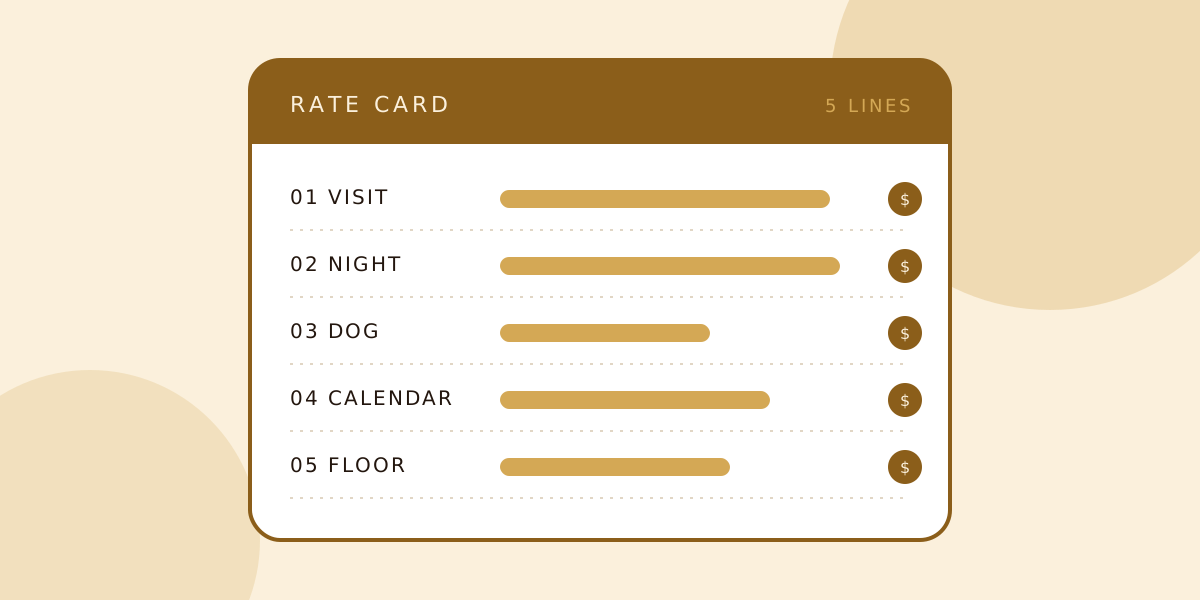
03 / The frameworkThe Five-Line Rate Card.
Every quote you will ever give is some combination of five numbers. If you cannot point to the line a price came from, you improvised it, and improvised prices drift down toward whatever the last client pushed back on.
Line one, the visit. What you charge for 30 minutes at the door, with longer visits derived from it.
Line two, the night. One flat price for an overnight stay, set on its own and never built from visits.
Line three, the dog. The fee for each extra dog, per visit and per night.
Line four, the calendar. The uplift on the dates when everyone wants you at once.
Line five, the floor. The smallest booking you accept and the travel fee beyond your zone.
Five lines fit on an index card. That matters. A rate card you can hold in one hand is a rate card you will actually quote from, on the phone, with a client waiting.
04 / Lines one and twoPrice the visit and the night as separate products.
Start with the visit, because it is the line every comparison reaches for. Anchor it to 30 minutes, the unit Rover, Pet Care Insurance and Time To Pet all report. Then decide the longer lengths by judgment, not arithmetic. A second half hour at the same door saves you a drive, so it should cost the client less than the first. Thumbtack’s example professional in Oceanside, California charges $25 for 30 minutes, $28 for 45 and $32 for 60. Doubling the time added $7.
The night is a different product, and the sources treat it that way. Pet Care Insurance lists overnights at $60 to $100 and 24-hour care at $80 to $150 a day. Adopt a Pet says $75 to $150. Care.com cites a Pet Sitters International average of $96.66. Thumbtack sits above all of them. The honest reading is that a mid-band professional night lands around the high $90s to low $100s, and a premium market or premium service goes beyond.
Never build the night from visits. A night has an evening block, hours of standby and an early start, and pricing it as two visits plus a bonus is how an $80 booking turns into single-digit hourly pay. Our breakdown of overnight dog sitting rates splits a night into three shifts, and our look at what a week of dog sitting costs shows how the two lines combine across seven days.
05 / Lines three and fourCharge for the second dog and for the calendar.
The extra-dog fee is the easiest line to get wrong in both directions. Pet Care Insurance lists $7 to $10 per additional pet, and Care.com lists $5 to $10 per extra dog. A second dog in the same house is much less work than a second client, so the fee should be small. It should not be zero. Free second dogs are a quiet way to give away the margin on your most reliable bookings.
The calendar line is the one that feels awkward until the first December. Pet Care Insurance suggests $5 to $10 more per visit on holidays. Adopt a Pet reports surcharges of 20 to 50 percent on regular fees. Both ranges say the same thing: the days everybody wants a sitter are the days a sitter can say no, so the price rises or the booking goes elsewhere. Rover itself notes only that sitters “might charge extra” in the holiday season, without a number, which tells you how little of the market publishes one.
Publish your list of holiday dates and your uplift before the season starts. A surcharge that appears on an invoice feels like a penalty. A surcharge that was on your rate card in October feels like a policy.
06 / Line fiveThe floor decides which bookings you accept.
The last line is the one the published guides barely mention, and it is the one that protects your week. The floor has two parts. The first is a minimum booking, such as a two-night minimum on holiday weeks. The second is a travel fee, or a flat minimum, for anything outside the zone where your stops cluster.
Published averages hide the drive entirely. A $32 visit across town for a new client can earn less per hour than a $25 visit on a street where you already have three stops. Our guide to in-home dog sitting shows how to draw that zone and what the miles cost. The floor is how you apply it: inside the zone, the card prices apply; outside it, a minimum applies, or you decline.
07 / ApplicationPriya quotes Thanksgiving.
Back to Austin. Priya had been quoting $25 a visit and $75 a night off the first page she found. She sat down with the sources above and placed herself on the third rung: insured, three backup sitters, an app that sends a photo after every visit. Then she wrote the card.
Her $110 night sits just above the Pet Sitters International average of $96.66 and inside Adopt a Pet’s professional band at the upper end. It is far below Thumbtack’s range, and more than twice Rover’s Austin house sitting average of $46.86 a day. That last gap is the conversation she now has on purpose, instead of being surprised by it.
Here is the first real quote off the card. A client wants four nights over Thanksgiving for two dogs.
Compare it with an ordinary weekend: one dog, two nights, $220. Same card, same lines, no improvising. When the Thanksgiving client says it looks high, Priya does not defend a number. She walks them down the card, line by line, and the conversation is about the lines, not about her.
08 / Anti-patternsFour ways a rate card goes wrong.
- Don’t average the sources. Blending a hobbyist figure with a professional one gives you a number nobody charges. Choose a rung first, then read only that rung.
- Don’t quote a “day” without saying what it holds. Rover’s $55.45 a day and Pet Care Insurance’s $80 to $150 for 24-hour care can describe different amounts of work. Say whether the night is inside the day.
- Don’t discount the second dog to zero. It feels generous and it quietly cuts the margin on your best clients.
- Don’t hide the holiday dates. A surprise surcharge costs you the client. A published one costs you nothing.
09 / TakeawaysTake this with you.
Write the five lines on an index card tonight. Fill in the visit and the night first, check them against the rung you actually belong to, and leave the other three lines for tomorrow. The first card will be wrong in places. That is fine. A wrong card you can point to beats a right answer you invent on the phone.
Dog sitters charge somewhere between a neighbor’s $15 and a professional’s $268. The useful question was never what the average is. It is which seller you are, and whether your card says so.
– DR, Portland, with the rate card taped above the desk