Marcus billed $100 for four drop-in visits last Tuesday, and the dull part of the job, the driving, cost him most of it. Four clients in four corners of Columbus, Ohio, 41 miles, almost two hours in the car for two hours with dogs. The Thursday before, he did three visits on one street and cleared more than twice as much per hour.
Same dogs, same $25 visit price, same Marcus. The difference was geography. That is the whole story of in-home dog sitting, and it is why so many sitters who love the work quietly lose money at it.
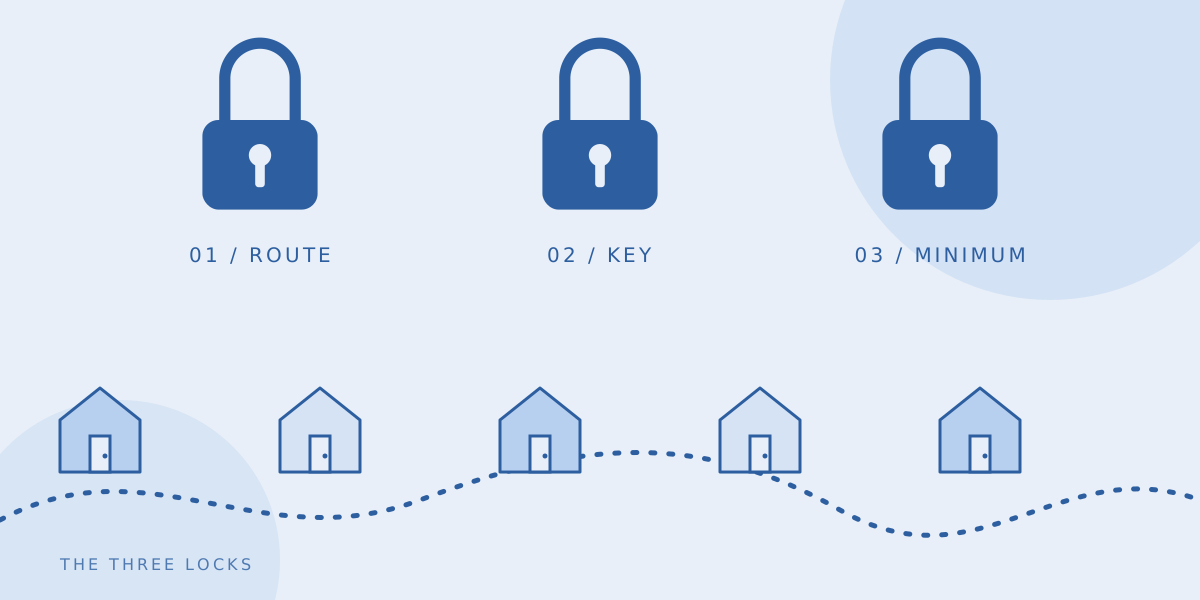
This piece defines the service, shows where the margin really sits, and gives you the Three Locks: a short set of rules for your route, your keys and your minimum booking that turn a pile of visits into a business that pays.
01 / The serviceIn-home dog sitting means you go to the dog.
In-home dog sitting is dog care delivered at the client’s own address. It comes in two shapes. Drop-in visits run from 15 to 60 minutes and cover feeding, a walk, medication and some play. Overnight stays mean you sleep at the house, usually with an evening and a morning block of real work either side of the night.
That is different from boarding, where the dog comes to the sitter’s home. Rover lists the two separately: “Boarding” happens at the sitter’s home, while “House Sitting” and “Drop-In Visits” happen at the owner’s. Operators tend to like the in-home model for four reasons. There is no kennel and no capacity ceiling, so a second walker doubles your day rather than your square footage. There are no dog-to-dog incidents on your own sofa. The dog keeps its routine. And the owner never has to drive anywhere.
The demand is real. The American Pet Products Association puts total U.S. pet industry spending at $158 billion, with $165 billion projected for 2026, and reports that 95 million U.S. households own a pet. What it does not do is tell you which part of that money reaches a sitter who drives between houses.
02 / The moneyThe going rate hides where the money goes.
Those are the numbers your clients have seen. Rover’s Haysville, Kansas page gives a median of $18 a visit and an average of $20, and Care.com’s Cost of Care Calculator puts the average U.S. hourly pet sitting rate at $16.25. They are useful as an anchor and useless as a margin. None of them subtracts the drive.
Here is Marcus’s week with the drive put back in. Mileage is figured at 70 cents, the IRS standard rate for 2025, so check the current figure before you copy this.
Same price, 2.2 times the hourly take. Our piece on how much to charge for dog sitting builds a rate up from your own floor, with typical ranges of $20 to $50 a visit and $75 to $150 a night. This one is about the other half of the problem: arranging your week so the rate you set actually lands in your pocket.
03 / The frameworkThe Three Locks.
Every in-home dog sitting business leaks money in three places: the miles between houses, the keys to those houses, and the small bookings that cost more to serve than they pay. Each leak has a lock.
Lock the route. Sell the street, not the visit. Cluster clients and sell time windows so visits stack.
Lock the key. Treat access to a client’s home as a liability you manage, with a process and a policy behind it.
Lock the minimum. Set a floor under every booking so no visit costs you more than it earns.
None of the three needs software or a second hire. They are rules you write down once and then apply on the phone, which is where most pricing mistakes get made.
04 / Lock oneLock the route: sell the street, not the visit.
Start by drawing a circle. Put your home or your most loyal client in the middle and draw a core zone around it, sized so that no stop in it is more than about ten minutes from the next. Inside the zone your base rate applies. Outside it, you charge a travel fee, or you decline.
Then change what you sell. Instead of “I’ll be there at 12:15,” offer a window: midday means between 11:30 and 1:30. A window lets you sequence the day by geography instead of by promise, and sequencing is where Marcus’s Thursday came from. Clients who need an exact time can have one, priced at a premium of $5 to $10, because an exact time costs you a stacked route.
The trade-off is real. Some owners hate windows, particularly with a dog on medication or a puppy who cannot hold it. Flag those dogs as fixed-time and price them accordingly. Do not let one fussy slot dictate a whole afternoon for everyone else. Our look at how long a dog should walk is a useful companion here, since visit length is the other thing that moves your stack.
05 / Lock twoLock the key: access is the risk you carry.
When you take a key, you take on a different kind of risk from walking a dog on a lead. You hold the ability to enter someone’s home, and a lost key means a rekeying bill and a conversation nobody wants.
Pet sitter insurance is built around this. Pet Care Insurance’s sitter policy, which it says starts at $332.20 a year, lists $2,000 of lost-key coverage to pay for rekeying, up to $100,000 of general liability that can include damage to a client’s home, and animal bailee cover of $2,500 per occurrence and $5,000 aggregate for a pet that is injured or falls ill in your care. Treat those figures as one provider’s starting point and read the exclusions. Our guide to pet sitter insurance at each stage covers what to buy and when.
Insurance pays after the loss. The process prevents it. Four habits cover most of the risk:
- Prefer codes to copies. A lockbox or smart lock code that you change per booking leaves no physical key to lose. Where you must take a key, take one.
- Never write the address on it. Tag keys with a number and keep the lookup in your records, not on the key.
- Keep a key register. Who has it, when it arrived, when it went back. A shared spreadsheet is fine on day one.
- Return or destroy at the end. A key that is not in your possession cannot be lost by you.
06 / Lock threeLock the minimum: no booking is too small to price.
A single 30-minute visit, across town, for a first-time client, is the least profitable thing you sell. Marcus’s Tuesday showed why. The minimum is how you refuse that business politely, or charge what it costs.
Overnights need their own floor, because a night is not one job. It is an active evening, hours of standby, and an early morning, and pricing it as a single line is how a $90 booking turns into $9 an hour. Our breakdown of overnight dog sitting rates splits the night into three shifts and prices each one.
07 / The signingThe meet and greet is where the locks get signed.
Rover recommends a free in-person meet and greet for first-time bookings, and it is the right place to put all three locks in front of a client. Spend 20 minutes. Walk the route the dog will use, see where the key or lockbox lives, and agree the terms. Clients who balk at your minimum or your window will tell you now, before you have driven there twice.
Leave the visit with a written care plan. It should cover feeding amounts and times, medication, vaccination records, the vet’s name and an agreed emergency spending limit, how long the dog can be left alone, whether cameras are running, and what sets the dog off. Owners on one TrustedHousesitters forum thread argue at length over exactly these points, from how many hours a dog can be left to whether a sitter should be told about outdoor cameras. The lesson is to put the answers on paper before the first visit, not to discover the disagreement during it. If you take clients who expect a background check, offer one up front and say so on your booking page.
08 / ApplicationMarcus rebuilds his week.
Back to Columbus. Marcus drew his core zone around four neighborhoods, moved every client to a window, and put a $35 floor under anything outside the circle. Two of the scattered Tuesday clients accepted the floor. One left, and he did not chase her.
The new Tuesday looks like a zone day: six visits across two adjacent streets, billed at $25 each. That is $150 gross. Add about 3 miles of driving ($2.10) and roughly 3 hours 40 minutes door to door, and he nets about $40 an hour, against $18.60 for the scattered version. He still takes the occasional one-off outside the zone. It just costs the client $35.
The part to steal is the order of operations. He fixed the route first because it was free, then the key process because a close call scared him, then the minimum because by then he knew his own numbers.
09 / Anti-patternsFour ways in-home sitting goes wrong.
- Don’t take far-flung visits at the base rate. One out-of-zone booking can wipe out the margin on the three stacked visits beside it.
- Don’t promise exact arrival times by default. A clock time is a premium product. Sell windows first.
- Don’t leave keys lying around with addresses on them. A key ring on the passenger seat with the street name written on it is a liability with a handle.
- Don’t skip the emergency spending limit. If a dog needs a vet at 2am and you cannot authorize treatment, you will make the call anyway, with nothing in writing.
10 / TakeawaysTake this with you.
Pull your last ten visits tomorrow and write down the drive minutes next to each one. Divide what you billed by the total time, driving included. That number is your real hourly rate, and it is almost always lower than the one you quote yourself.
In-home dog sitting does not pay because the dogs are easy or the rates are high. It pays when you decide where you will drive, who holds the keys and what you will not do for less than it costs. Lock those three and the rest is just good dogs.
– DR, Portland, with a lockbox code I change every time