Priced a night at ninety-seven dollars and then lost the whole evening to a dog who wouldn’t settle? That is the overnight problem in one sentence. The number clients quote you, the average overnight dog sitting rate, treats a night as a single product. It is three. There is an active evening, there are eight or nine hours of sleeping in somebody’s spare room or your own, and there is a morning that starts before you want it to. Price those as one flat figure and you will be wrong in a different direction every time the dog changes.
So the useful answer to what to charge for overnight dog sitting is not a figure. It is a method that produces a figure for this dog, in this home, on this date. Clients searching for rates want a number to anchor on, and they should get one. Operators need the method behind it, because the anchor is only a starting point.
This piece gives you both. First the 2026 bands, so you know where the market sits. Then the Three-Shift Night, a way of building the rate from what the night actually contains, with a worked quote you can copy on Tuesday.
01 / The benchmarkWhat overnight dog sitting costs in 2026.
Published rate guides agree on the shape of the market even where they disagree on the dollars. A professional, insured sitter who stays in the client’s home charges $75 to $150 a night. A casual or hobby sitter works at $40 to $75. Calday’s 2026 analysis of 237 independent pet sitting businesses across 42 states puts the average in-home overnight at $97, and Pet Sitters International’s member survey lands in the same place at about $97 for a stay of roughly 12.8 hours.
The split that matters most is where the dog sleeps:
Geography moves every row. Marketplace listings for overnight sitting run from about $30 in Oklahoma City to the high $80s in Oakland, with San Francisco, Los Angeles and New York clustered between $45 and $87. An independent professional in a high-cost metro will sit at the top of the in-home band. A sitter in a small Midwest town may sit at $65 and be fully booked.
That last number is worth a pause. Many sitters see a $65 listing and forget that after the platform’s cut and the tax reserve most guides put at 25% to 30% of income, the night pays well under half of what the client thinks they are paying. Independent operators don’t pay the commission, but they do carry liability insurance, bonding and software, which run roughly $300 to $600 a year for cover and $20 to $50 a month for tools. The rate has to carry all of it.
02 / The problemWhy a night is never a flat number.
Four things go wrong when an overnight is priced as a single flat rate, and none of them is carelessness. They come from treating a night as one unit of work when it contains very different kinds of work.
Asleep is not free
The common objection to a high overnight rate is that the sitter is asleep for most of it. That is true and beside the point. For those eight hours the sitter cannot book another client, cannot drive anywhere, and cannot leave. They are on call. Nobody expects a fire station to charge the same hourly rate for a night shift asleep as for a call-out, but nobody expects it to work for free either.
The evening is the real work
The part of an overnight that costs you is the first two hours. Arrival, the feeding, the walk, medication, the play session that decides whether the dog settles at 10pm or paces until 1am. A flat rate hides how much of the night is spent here, which is why the same $97 feels fine for an easy retriever and punishing for a young shepherd.
The morning blocks your day
A 6:30am walk and breakfast means your first morning slot is gone. If you run daytime visits, an overnight client costs you the early run as well as the night. Operators who forget this price the night correctly and then wonder why their Wednesdays feel thin.
Dogs differ more than nights do
A second dog, a senior dog on medication, a puppy who needs a 3am trip outside: each one changes the awake time, and awake time is the only part of the night that scales. A flat per-night rate with a $5 “extra dog” line ignores that.
Price the awake hours at full rate and the sleeping hours as standby. A second dog adds to the first, not the second.
03 / The frameworkThe Three-Shift Night.
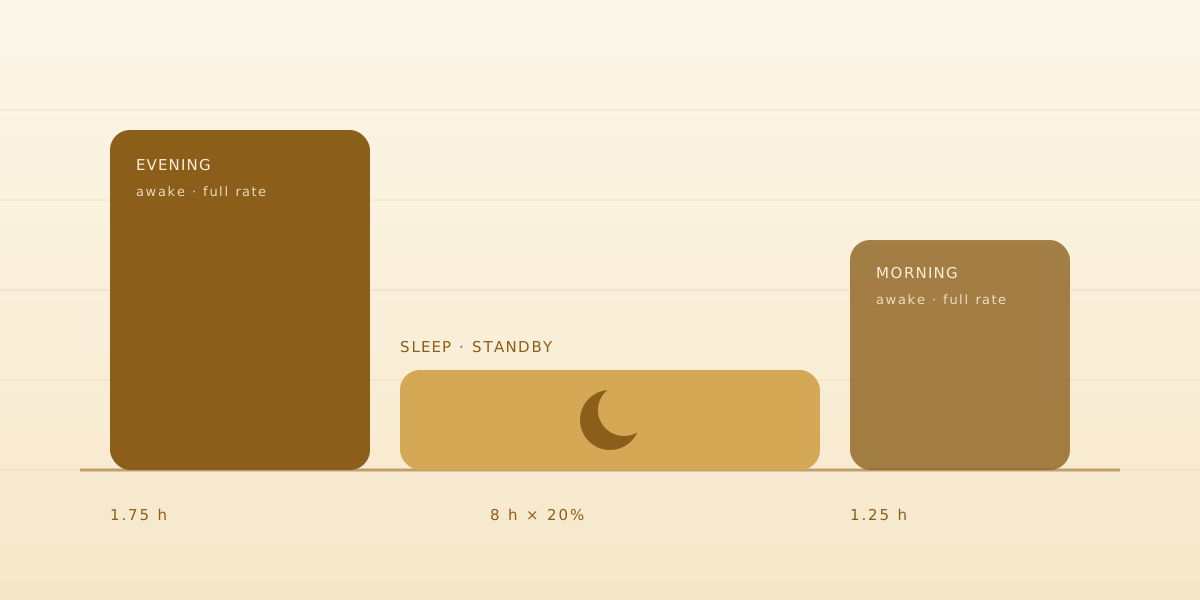
The fix is to stop pricing a night and start pricing its shifts. Call it the Three-Shift Night. Every overnight booking has an evening shift, a sleep shift and a morning shift, and each has its own price logic.
Shift one: the evening
From arrival to lights out. Feed, walk, play, medicate, tidy, settle the dog. Time it on a typical booking and you will usually land between one and a half and two and a half hours. Price it at your occupied-hour rate: the hourly figure you need for every hour a dog has your full attention. If you have never worked that number out, the Occupied-Hour Rate Card starts from your real costs, not a marketplace average.
Shift two: the sleep
Lights out to first alarm, roughly eight hours. The dog is settled and you are on site. This is standby time, and it is priced as a fraction of your occupied-hour rate, because you are on call but not working. A fraction of 20% is a sound starting point for an in-home night. Raise it for dogs who wake you, drop it for dogs who sleep through.
Shift three: the morning
First alarm to departure. Toilet break, breakfast, a walk, tidy up, lock up. Usually an hour to an hour and a half, priced at the occupied-hour rate again. If you walk the dog before leaving for another job, the morning is your most efficient shift. If you stay until the client’s alarm clock, you have sold two shifts back to back.
A flat night rate is a guess about how awake the dog will be. The three shifts make you measure it.Devon Russo, Field Notes Editor
The Three-Shift Night gives you a rate that tracks the dog rather than the calendar. A calm senior who falls asleep at 8:30pm costs you a short evening. A young herding breed who needs two hours of exercise and a midnight reset costs you a long one. The framework prices the difference without you having to argue it.
04 / Where the dog sleepsIn their home or in yours.
Everything above assumes you stay in the client’s home. Plenty of operators do the reverse and host the dog. Overnight sitting in the sitter’s home is cheaper for the client because it removes the standby cost. You are home anyway, so you aren’t giving up your evening and your early morning in the same way.
It is not free for you. You carry wear on your floors, your own insurance, your own cleaning, and the risk of an unfamiliar dog meeting yours. A workable rule: price the sitter’s-home night at about 65% of the in-home night. Most of the saving comes from the sleep shift nearly disappearing, and the evening and morning still cost you real time. Published ranges back this up, with sitter’s-home nights at $50 to $85 against $75 to $150 in the client’s house.
Say which one you are quoting. Clients comparing a $140 in-home quote with an $80 hosted quote are not comparing prices. They are comparing two different services.
05 / ApplicationMarcus quotes Hannah’s Thanksgiving.
Marcus runs a three-sitter overnight and drop-in business in Denver. His occupied-hour rate is $28. He times his evenings and mornings across a dozen bookings and finds a typical in-home night is 1.75 hours of evening and 1.25 hours of morning, with eight hours of sleep between. In October, Hannah calls: two dogs, one a 9-year-old beagle who needs a late walk, away Wednesday, November 25 for three nights. Thanksgiving is Thursday the 26th.
Hannah has read that the average overnight is $97. Marcus builds the ledger.
Then the booking itself. The beagle adds a second dog, and a second dog adds 15 minutes of awake time to the evening and 15 to the morning. That is half an hour at $28 an hour, so $14 a night. No sleep shift is added, because a second dog sleeps through it.
That is $155 a night on average, well above the $97 Hannah expected. Marcus sends the ledger with one sentence: two dogs, one of them a senior, on the night most sitters have already turned down. Hannah asks about the sitter’s-home version. At 65%, a hosted night is $84 for one dog, and Marcus is willing to host the beagle but not both dogs together. She books the in-home stay. The conversation was about her dogs, not about the $97.
The same method scales down. A solo sitter quoting a single night for one dog runs the same three lines. What changes is how many shifts you can staff, not how you price them. Booking software that stores your occupied-hour rate and modifiers, PackMonty included, can build the ledger for you, but a notepad does the job if the lines are right.
06 / The modifiersSecond dogs, medication, and holidays.
Modifiers are where overnight quotes leak. Written as separate lines, they read as care. Folded into one number, they read as a markup. The published ranges give you a sense of the market, and the Three-Shift Night gives you the reasoning behind your own.
Additional dogs
Most price guides list a second dog at $5 to $10 a night, with $10 to $15 for dogs with special needs. Those numbers are fair for easy dogs. Marcus charges $14 because he did the arithmetic on awake time. If you add the extra dog to the evening and morning shifts only, you will land close to your own real cost.
Medication, puppies and seniors
Medication adds $5 to $15 per visit in most guides, and puppies or seniors carry about $5 more. Overnights are different from visits because the sitter is already there. Charge for the doses that need real handling, such as injections or a pill wrapped in food the dog refuses, and not for a daily tablet in a bowl.
Holidays
Holiday premiums run from 20% to 50% across the guides, with 20% for standard holidays and 50% for the Christmas and New Year’s weeks. Apply the percentage to the night and modifiers together, as Marcus did, and apply it only to the nights that fall on the holiday. A flat $10 on a $129 night is not a premium. It is a rounding error. Publish the dates on your rate sheet so nobody has to ask.
07 / Anti-patternsWhat not to do with an overnight rate.
- Don’t price sleep at zero. The sleep shift is where your margin goes. A sitter who gives away eight hours of standby time is working a 12-hour shift for a two-hour rate.
- Don’t copy the average. $97 is a mean of very different businesses. It includes insured operators in big metros and hobby sitters in small towns. Use it as a sense check, not a price.
- Don’t compete with the friend-and-neighbor rate. Friends charge $20 to $40 a night, and the clients who call a professional want insurance, a backup, and someone who notices a dog is off its food. Price for that.
- Don’t take a booking without a deposit and a cancellation window. A holiday overnight cancelled the week before is a night you can’t resell. Ask for half up front on any booking over two nights.
- Don’t forget what you pay the person doing the night. A rate that looks generous to the client can still underpay your sitter. Check the night against the 45% Line before you send it, and use the overnight rate calculator if you want a second method to compare. For longer stays, the Week Ledger covers the eighth-day problem.
08 / TakeawaysTake this with you.
If a client asks what you charge for overnight dog sitting, give them the band, then build the shifts. Time your last ten evenings. Write down your occupied-hour rate. Price the sleep as standby at 20%, and list every modifier on its own line. The first quote you send this way will probably be higher than the client expected. It will also be the first one they don’t argue with.
A night has three shifts. Price all of them.
– DR, Portland, timing the evening walk