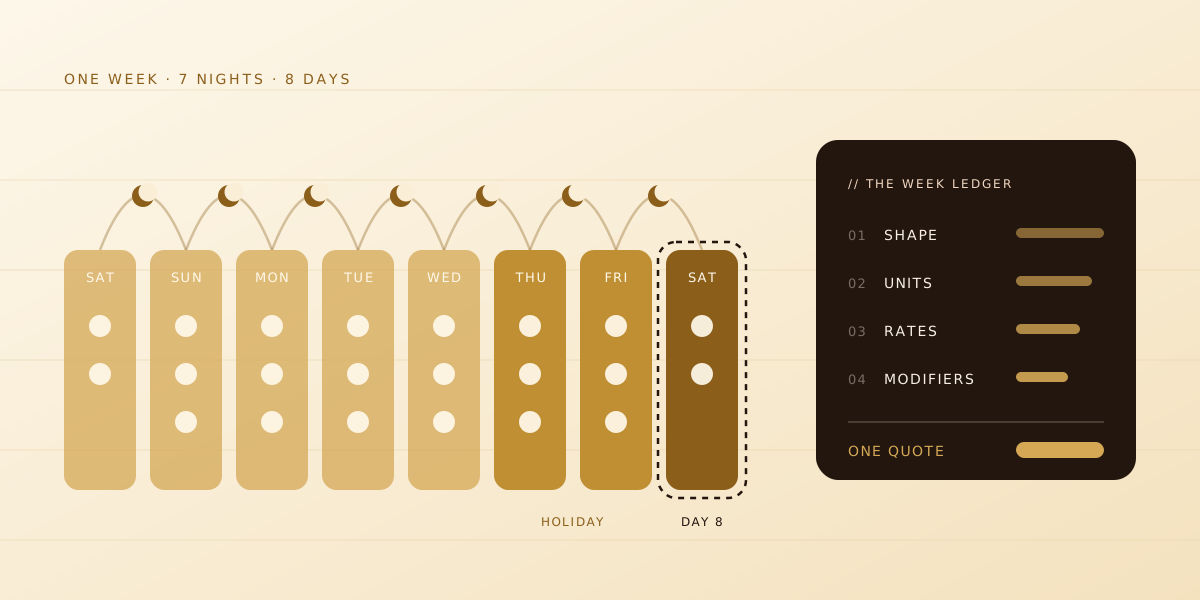
Seven days at forty dollars. That is the quote most clients have already worked out in their heads before they call you, and it is almost always wrong. Not because forty is a bad number, but because nobody has decided yet what a day means: two visits, three visits, a sitter sleeping over, or a dog staying at someone else’s house. Each of those is a different product with a different weekly price, and the gap between the cheapest and the most expensive is more than a thousand dollars.
So when someone asks how much to pay a dog sitter for a week, the useful answer is not a single figure. It is a short menu, built from the real number of visits and nights on the calendar. That is what clients are searching for, and it is what an operator should be able to produce in five minutes on the phone.
This piece does both. The first section gives the 2026 weekly bands, so a client or a new sitter has a real number to anchor on. The rest shows how to turn those bands into a quote for one specific dog, one specific week, without leaving money on the table or scaring the client off.
01 / The short answerWhat a week of dog sitting costs in 2026.
Professional dog sitting in the US is priced in units: a visit of about 30 minutes, or a night. Pet Sitters International’s latest member data puts the average visit at $25.49 and the average overnight at $96.99 for a stay of roughly 12.8 hours. On Rover, the median dog sitting visit in a market like Indianapolis is $20, with most bookings between $13 and $33, and Rover’s own figures put house sitting with a dog at about $55 a night nationally. Marketplace prices run lower than independent professional businesses because the sitter is usually a side-gig earner rather than an insured, staffed operation.
Multiply those units across a real week and you get these bands:
The low end of each band is a quiet suburb or small town with an uncomplicated dog. The high end is a coastal metro, a second dog, or a sitter with insurance, a background check, and a business behind them. Cost-of-living does most of the work: Rover’s house sitting nightly rate runs from the low $50s in Columbus and Virginia Beach to the high $80s in Oakland.
That middle number is the one clients never ask about. An average overnight covers about 12.8 hours. The other 11 or so hours a day, the sitter is at their day job or asleep at home, and the dog is alone. Across seven days that is close to 78 hours, which is why the overnight-plus-midday band exists, and why a client comparing “overnight” quotes from two sitters may be comparing two very different weeks.
02 / The trapsWhy weekly dog sitting quotes go wrong.
Most bad weekly quotes come from three habits, and none of them is greed or carelessness. They come from treating a week as a single product when it is really a stack of small ones.
The eighth day
A client who leaves Saturday morning and comes back the following Saturday evening is booking seven nights. They are also booking eight calendar days of care. The departure day needs a midday and an evening visit. The return day needs a morning and a midday visit. Quote “three visits a day for seven days” and you have priced 21 visits for a booking that actually needs 22, and you will find out on the second Saturday, standing in someone’s kitchen, unpaid.
The hourly week
Care.com’s city cost pages show a weekly dog sitter rate, for example $706 in Corvallis, Oregon, as of October 2026. Read the small print: that figure is a starting hourly rate of $17.65 multiplied by a 40-hour week. It is a wage for someone employed in your home, not the price of a week of pet sitting, and clients who anchor on it are either going to overpay a drop-in sitter or think a professional overnight service is a rip-off. When a client quotes a Care.com number, ask which product they actually want.
The invisible miles
Three daily drop-ins for a client 12 miles from your base means 21 round trips, roughly 504 miles across the week. At the IRS business mileage rate of 76 cents a mile for the second half of 2026, that is about $383 of driving cost hidden inside a quote that might only be $600 in total. A per-visit rate that works across town does not work at the edge of your territory.
Never quote a week as a daily rate times seven. Count the units on the actual calendar, departure and return days included, and price each unit on its own.
03 / The frameworkThe Week Ledger: one quote, four lines.
The fix is a short ledger you fill in for every booking longer than four nights. It works whether you are a solo sitter or running fifteen people, and it takes about as long as the phone call. Call it the Week Ledger.
- Pick the shape. Drop-ins only, overnight only, overnight plus a midday visit, or boarding at a sitter’s home. Ask how long the dog is comfortable alone, not what the client hopes to spend. A senior dog or a puppy usually rules out drop-ins-only.
- Count the units. Lay out the calendar from departure to return. Count every visit and every night. This is where the eighth day shows up.
- Price each line. Visits at your visit rate, nights at your night rate. If you don’t know your own floors, the Occupied-Hour Rate Card and the overnight rate calculator both start from your real costs, not a marketplace average.
- Add the modifiers as separate lines. Extra dog, medication, holiday dates, distance beyond your normal radius. Written out, they read as care. Folded into one big number, they read as a markup.
The ledger ends with a single total, but the client sees every line. That matters more than the arithmetic. A client who can see that $110 of the total is their second dog does not argue about the $110. A client who sees one unexplained number argues about all of it.
Clients don’t push back on a price they can read. They push back on a price they have to trust.Devon Russo, Field Notes Editor
04 / ApplicationKeisha’s Thanksgiving quote, worked in full.
Keisha runs a six-sitter drop-in and overnight business in Raleigh. Her realized rates are $28 for a 30-minute visit and $95 for an overnight, close to the national professional averages. In October, Dana calls: two dogs, one of them a 13-year-old Lab on twice-daily medication, away Saturday, November 21 to Saturday, November 28. Thanksgiving falls on the 26th.
Dana’s own math is three visits a day at $28, times seven: $588. Keisha builds the ledger twice, once for each shape that suits a senior dog.
Dana’s $588 was $240 short of the cheaper option before a single modifier was argued over. Keisha sends both ledgers with one sentence of advice: at 13, the Lab is better off with someone in the house overnight, and Shape B costs $241 more for a dog who is never alone for more than a few hours at a stretch. Dana books Shape B. The conversation is about her dog, not about the price.
The same ledger works at a smaller scale. A solo sitter quoting a five-night, one-dog booking runs the identical four lines and might only fill two of them. What changes with size is how many shapes you can offer, not the method. Booking software that stores your unit rates and modifiers, PackMonty included, can build the ledger for you, but a notepad does the job if the lines are right.
05 / The discount questionShould a full week of dog sitting cost less?
Clients often expect a weekly rate to be cheaper than seven separate days, the way a hotel works. Sometimes it should be. Usually it shouldn’t.
A week-long booking saves you money in exactly two situations. The first is when it fills dead time, such as a seven-night overnight in late January, when your sitters would otherwise be idle. The second is when the client is on an existing route, so the extra visits add almost no driving. In both cases a discount of 5% to 10% on the unit lines, never on the modifiers, is a fair trade for a guaranteed week.
A holiday week saves you nothing. Demand is at its peak, your sitters are giving up their own Thanksgiving, and every slot you sell to one client is a slot you can’t sell to the next caller. Keisha discounts seven-night bookings by 5% from January through March and after Labor Day. She never discounts November or December, and she says so on her rate sheet so nobody has to ask.
06 / Anti-patternsWhat not to do when you quote a week.
- Don’t quote a daily average times seven. It misses the eighth day, it hides the modifiers, and it gives the client a number you will have to walk back.
- Don’t sell overnight-only to a dog that can’t be alone for 11 hours. A cheaper quote that ends with an accident on the rug, or a dog that stops eating, costs you the client and the review.
- Don’t compete with the friend-and-neighbor price. Four in ten owners already use someone they know. The ones who call you want insurance, a backup sitter, and someone who will notice the Lab is off her food. Price for that.
- Don’t forget what you pay the person doing the week. A weekly quote that looks generous to the client can still underpay your sitter. Check the overnight line against the 45% Line before you send it.
07 / TakeawaysTake this with you.
If a client asks how much to pay a dog sitter for a week, give them the band first, then build the ledger. Count the real calendar, price each unit, and show the modifiers as their own lines. The first quote you send that way will probably be higher than the client expected. It will also be the first one they don’t argue with.
A week is eight days. Price all of them.
– DR, Portland, counting Saturdays twice