Somebody asks what you charge for dog sitting, and you hear yourself say “twenty-five a visit” because that is what the sitter two streets over charges. Three months later you are booked solid, driving forty minutes a day between clients, and the money doesn’t add up. You didn’t price your visits. You priced your neighbor’s.
The question of how much to charge for dog sitting has two honest answers. One is a range, the going rate for your kind of service in your kind of town, and clients deserve to see it. The other is a number only you can work out, because it depends on how far you drive, what your insurance costs, and what you need to take home after tax. Most pricing guides give you the first answer and stop.
This piece gives you both. First the 2026 bands, so you know where the market sits. Then the Three-Number Quote, a way of setting a price that clears your costs, sits where professionals sit, and flexes for the dog in front of you. There is a worked example you can copy on a Tuesday morning.
01 / The going rateWhat dog sitting pays in 2026.
Published rate guides disagree on the dollars but agree on the shape. Pet Care Insurance, a specialist insurer for pet businesses, puts a 30-minute drop-in at $20 to $35 and a one-hour visit at $30 to $50. Time To Pet’s rate calculator puts the national average for a 30-minute dog sitting visit at $34.80 and a 60-minute visit at $46.87. Pet Sitters International’s 2026 State of the Industry Survey, answered by nearly 1,000 professional businesses, has average visit fees running from $20.64 for 15 minutes to $46.26 for an hour.
Location moves every line. Care.com’s posted hourly rates for dog sitters run from about $13 in San Antonio to $22 in Seattle, and its national pet sitter average sits between $16.68 and $22.57 an hour. Those are hourly wages for the time on site, though, not visit prices, which is why they look low next to the table above. A sitter in a small Midwest town may charge $22 for a half hour and stay full. A sitter in Brooklyn may charge $40 and still have a waiting list.
02 / The problemWhy the app number is the wrong anchor.
Search for what to charge and the top results are a Reddit thread, a Facebook group, and a marketplace price page for a single city. That’s where most new sitters set their first rate. It’s also where the numbers are lowest.
Rover’s own June 2026 data for Wichita, Kansas, shows drop-ins at $14 to $20 and house sitting at $30 to $50 a night, against a national marketplace figure of about $40 a night for overnight care. PSI’s professional average for the same overnight is $96.66. The gap isn’t greed on one side or desperation on the other. It is two different products. A marketplace sitter is often working part time, from home, without a business license, a commercial insurance policy or a tax bill they have planned for. PSI says it plainly: gig sitters can offer rates that are unrealistically low because they don’t carry the same overhead, so they are not a fair comparison for a professional business.
There is a second problem with the forum route. PSI also warns that service providers discussing specific prices with each other, including in online groups, can run into anti-price-fixing law. Reading published rates is fine. Agreeing a rate with the other sitters in your town’s Facebook group is not something you want in writing.
The market tells you the most a client will pay. It never tells you the least you can accept. You have to build that number yourself, and you build it first.
03 / The frameworkThe Three-Number Quote.
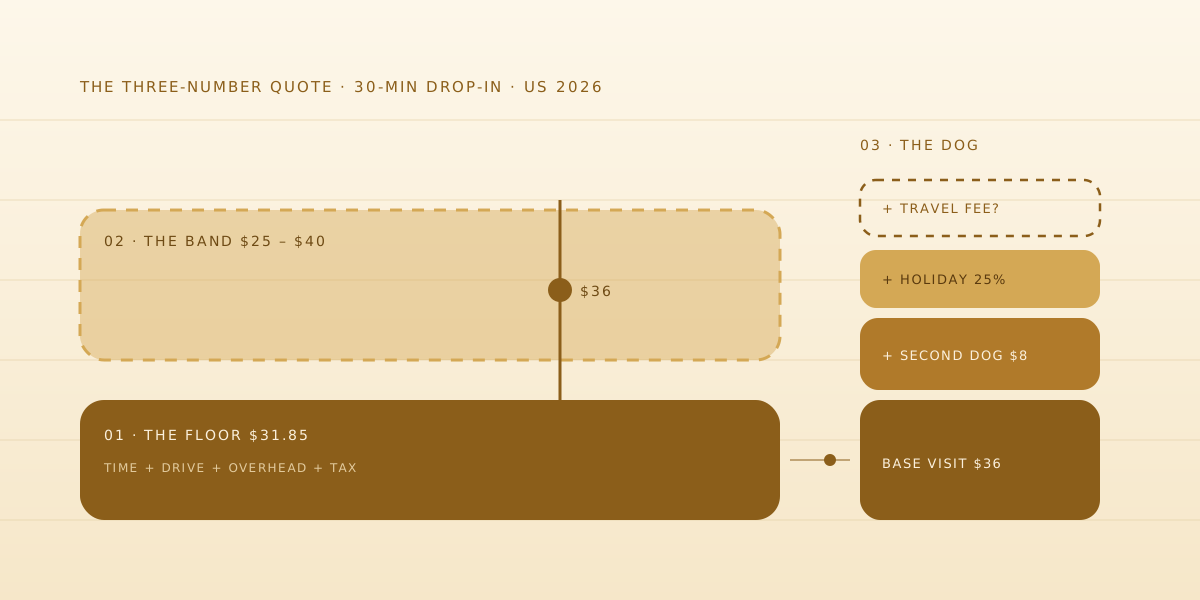
Every dog sitting price we’ve seen hold up over a few years comes from three numbers, worked out in this order.
1. The floor. What one visit costs you to deliver: your time including the drive and the update message, your mileage, your share of overhead, and the self-employment tax on what you earn. Below the floor you are paying to work. The floor is yours alone, so nobody else’s rate card can give it to you.
2. The band. What insured, professional sitters charge in your area for the same visit length. The band is a sanity check, not a target. If your floor sits comfortably inside it, price at least 10% above the floor and wherever in the band your experience and reviews earn. If your floor sits above the top of the band, the answer is not to drop the price. It’s to change the visit: tighten your service area, raise your minimum, or sell a different length.
3. The dog. The lines that belong to this booking and not to every booking: a second dog, a giant breed, insulin, a holiday, a client outside your zone. They sit on the quote as separate lines, so your base rate stays the same for everybody and the client can see exactly why their total is what it is.
The order matters. Sitters who start with the band almost always end up under their floor without knowing it. Sitters who start with the floor know within ten minutes whether a client, a neighborhood or a service is worth taking.
04 / The floorBuilding the floor, line by line.
Meet Tasha. She runs a solo dog sitting business in Columbus, Ohio, in her third year, mostly 30-minute drop-ins with a few overnights. She wants to take home $28 an hour before income tax. Here is her floor for a standard half-hour visit.
Each line has a reason. Time is the full block the visit takes out of her day, not the 30 minutes the client books. Time To Pet’s own worked example makes the same point: a 30-minute visit with 15 minutes of travel is 45 minutes of your time. The 5 minutes of admin covers the photo, the update text and the note in the client file. Skip it and you work for free on every single visit.
Self-employment tax is the 15.3% Social Security and Medicare charge a sole proprietor pays on net earnings, which works out close to 14% of profit in practice. Adding 15% to the wage is a round number that covers it. Mileage uses the IRS 2026 business rate of 72.5 cents a mile, which is a fair estimate of what driving actually costs once fuel, insurance, wear and depreciation are in. Overhead is everything you pay whether or not you work today: liability insurance, which starts around $330 a year for a sitter policy, plus scheduling software, phone, website, a first aid course, and the marketing that keeps the calendar full.
Tasha’s floor is $31.85. Her band, for an insured sitter in a mid-sized city, runs from about $25 to $40. So her floor sits inside it, and she prices the half-hour drop-in at $36, 13% above the floor and just over the national average.
Now run the same sum for a client nine miles out. The drive becomes 30 minutes and 18 miles. Time goes to 65 minutes, the wage line to $34.88, mileage to $13.05. The floor for that visit is $50.93. At $36 she loses money every time she goes there. The fix is a travel fee of about $18 for anything outside her core zip codes, or a polite no. The visit length was never the problem. The drive was.
The hour-long visit tells a different story. Seventy-seven minutes of time puts the floor at $47.95, and 10% on top is $52.75. The national average for a 60-minute visit is $46.87. Tasha lists the hour at $52 and offers clients two 30-minute visits at $72 instead, which most dogs prefer anyway: two potty breaks beat one long one.
05 / ApplicationTasha quotes Thanksgiving.
In early October, Jordan asks Tasha to cover Thanksgiving. Three days, Thursday to Saturday, three 30-minute visits a day. Two dogs: a 70-pound shepherd mix and an elderly beagle who takes a pill with breakfast. Jordan has seen “$20 to $35 a visit” online and is expecting something around $225.
Two choices in that quote are worth copying. The pill is free, because a pill in a lump of cheese fits inside a half hour; an insulin injection or a post-surgical dressing would not, and would get its own line. The holiday premium applies to Thursday only, the day Tasha is actually giving up, and to the second-dog charge as well as the base. Applying 25% to all three days would have added $99 and invited the argument she is trying to avoid.
Jordan’s $225 guess and Tasha’s $429 quote are both “the going rate.” One is nine visits at an app price. The other is nine visits, two dogs and a holiday, priced by someone who has to drive there. Because every line is visible, the conversation is about the lines, not about whether Tasha is expensive.
06 / The dog linesSecond dogs, big dogs, holidays and distance.
The dog number is where most pricing guides spend their time, and the published ranges are consistent enough to use as a starting point.
- Additional dogs: $5 to $10 per extra dog per visit. Don’t double the rate; the drive, the overhead and most of the visit are shared.
- Special care: $5 to $20 per visit for injections, mobility help, post-surgery care or a dog that needs two people’s worth of attention. If it adds time, sell a longer visit instead.
- Large or difficult dogs: many sitters add a premium above 50 to 70 pounds, or for reactive dogs that need separate walks. Be specific in writing about what triggers it.
- Holidays: 20% to 50% across published guides. Use 20% to 25% for Thanksgiving, Memorial Day and the Fourth of July, and 50% for Christmas Eve to New Year’s Day. Publish the dates.
- Travel: a flat fee for anything outside your core zone, sized from the floor sum above. For Tasha that’s $18.
- Short notice: a same-day or next-day booking fee of $10 to $15 is common, and fair when it means rearranging a route.
If you hire, the base rate has to carry one more thing: your sitter’s pay. PSI’s pricing benchmarks, shared by pet business bookkeeper Anne-Marie Kaden, put labor at 45% to 50% of revenue, overhead at 20% to 30% and profit at 20% to 30%. At $36 a visit, that leaves $16 to $18 for the person doing it. Check it against the 45% Line before you post the job.
07 / Anti-patternsWhat not to do with your dog sitting rate.
- Don’t copy the cheapest sitter on the app. They may be working without insurance, a license or a tax plan. Their rate is a hobby rate, and it’s not your competition.
- Don’t price by the minute on site. A 15-minute visit with a 20-minute drive is a 35-minute job. If your 15-minute rate is half your 30-minute rate, your short visits are losing money.
- Don’t charge for every pill and bag of poop. PSI and Time To Pet both point to time-based pricing as the industry norm. Itemizing small tasks makes clients feel nickel-and-dimed. Charge for time, and sell more time when a dog needs it.
- Don’t hide your rates. Clients who can’t find a price move on to the next website. Publish the base rates and the common add-ons, and add “starting at” if you need room for complicated dogs.
- Don’t sit on an old rate. Mileage alone went up again in 2026. Review the floor every January, raise prices with a month’s notice, and keep new rates steady for at least a year.
- Don’t forget the overnight is a different sum. A night has an evening, a long standby stretch and an early morning. Price it with the Three-Shift Night, not by multiplying a drop-in, and use the Week Ledger for stays of seven nights or more.
08 / TakeawaysTake this with you.
If you want to know how much to charge for dog sitting this week, do one thing first: time your next ten visits door to door, including the drive and the text afterwards. That one number will tell you more about your price than any rate table. Put it through the floor sum, check where it lands in the professional band, and keep the dog lines on their own rows. For a deeper version of the same idea with an hourly rate card, the Occupied-Hour Rate Card takes it further.
The going rate is where you check your answer. It is never where you start.
– DR, Portland, with the mileage log open