Nobody who has ever stood in front of a shelter cage has asked the question they actually meant. The card says one hundred and seventy-five dollars. The kitten inside is eleven weeks old, asleep in a cardboard box with her paw over her face, and the question forming in your head is not what does she cost. It is can I afford this. Those are different questions with wildly different answers, and only one of them is printed on the card.
So here is the direct answer first, because that is what you came for. How much does a kitten cost? In the United States in 2026, adopting one runs about 50 to 225 dollars. Buying a pedigree kitten from a breeder runs 500 to 3,500 dollars or more. And the first full year, all in, lands somewhere between 1,200 and 2,300 dollars for most people who adopt.
Now the useful answer. That first-year figure has a range of more than a thousand dollars around it, and almost none of that range is caused by the kitten. It is caused by three or four ordinary decisions made in the two weeks after she comes home, mostly by people who did not realize they were deciding anything.
01 / The stickerThe number on the card is the smallest one you will pay.
Adoption fees in 2026 sit roughly where they have sat for a few years: about 50 to 175 dollars at most US shelters and rescues, with plenty of variation at the edges. Kittens sit at the top of the range, usually 150 to 225 dollars, because they are the easiest animals in the building to rehome. Adult cats run 75 to 125. Seniors run 25 to 75, and during kitten season, roughly May through November, a lot of shelters drop adult and senior fees further or waive them entirely because the building is full.
What matters more than the fee is what it buys. A shelter adoption fee normally covers the first vaccines, the spay or neuter, deworming, flea treatment, a microchip, and a FeLV and FIV test. A rescue fee usually covers the same. That is several hundred dollars of veterinary work bundled into a two-figure price, and it is why a waived-fee kitten during an overcrowding event is not a lower-quality animal. The medical work already happened. The shelter is simply no longer charging you for it.
A breeder kitten is the opposite trade. Prices run 500 to 3,500 dollars, clustering at 800 to 1,800 for common breeds like Siamese and Maine Coon and above 2,000 for rarer mutations like the Devon Rex, Sphynx and Lykoi. The purchase price typically includes an exam and some early vaccines. It typically does not include the spay or neuter, and it does not include the microchip. So the higher sticker buys you less of the first-90-day program, not more.
Never compare two acquisition prices without asking what each one includes. A 175-dollar shelter kitten and a 1,200-dollar breeder kitten are not 1,025 dollars apart. Once you add the surgery and the chip the breeder fee did not cover, they are closer to 1,500 apart.
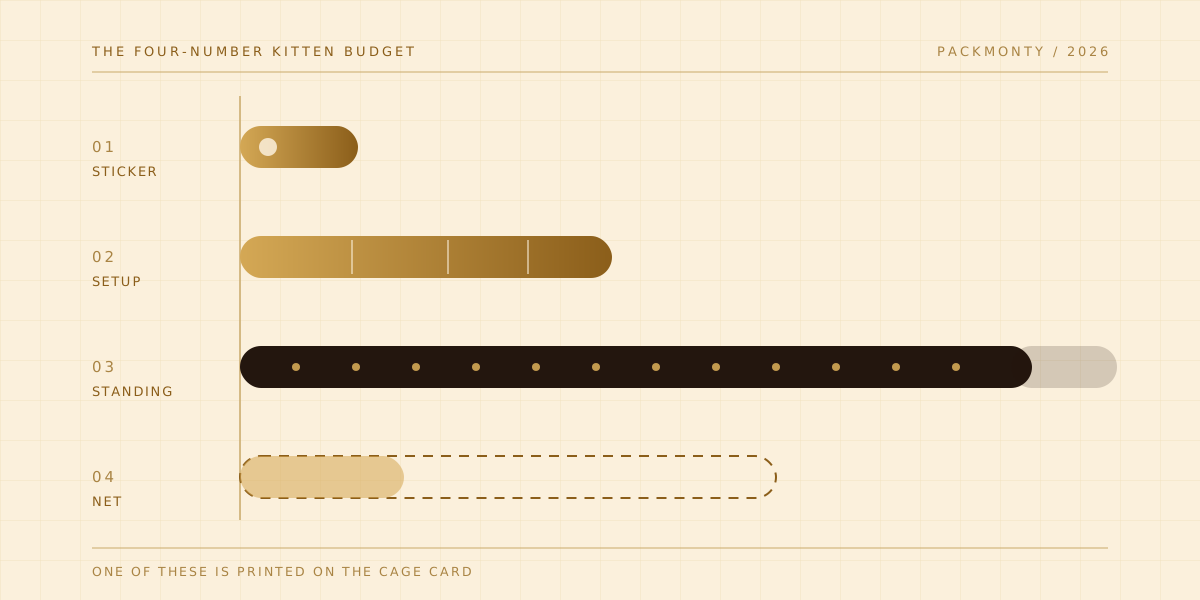
02 / The frameworkThe Four-Number Kitten Budget.
Every cost article on the internet gives you one giant table and leaves you to work out which rows are one-time, which are recurring, and which are the ones you can still do something about. That is backwards. Costs behave differently depending on when they land and whether you still have a choice, so group them that way.
Four numbers. Write them on four lines.
The reason to separate them is that they respond to completely different things. The sticker responds to where you look. The setup responds to which clinic you walk into. The standing order responds to habits you are about to form and will not revisit. The safety net responds to a decision you make once and then forget, which is exactly why so many people never make it.
03 / Number twoThe first ninety days cost more than the kitten.
This is the part that makes a kitten different from an adult cat, and it is the part the one-big-table articles blur. A kitten arrives with an unfinished medical program attached to her, and the program runs on a schedule she sets, not you.
The core of it is the FVRCP vaccine, which protects against feline viral rhinotracheitis, calicivirus and panleukopenia. It is not one shot. It is a series of three, given at six to eight weeks, ten to twelve weeks, and fourteen to sixteen weeks, and the protection comes from finishing it rather than starting it. Rabies goes in at twelve to sixteen weeks. Somewhere in there she needs a FeLV and FIV blood test, deworming, and her first parasite prevention.
Three separate visits, each with its own exam fee of 40 to 70 dollars at a private clinic. That fee is charged whether she gets one shot or three, which is the single most useful piece of arithmetic in this article.
| First 90 days | Private clinic | Low-cost or shelter clinic |
|---|---|---|
| FVRCP, per dose (3 doses) | $25 – $70 | $15 – $25 |
| Rabies, one dose | $25 – $100 | $15 – $30 |
| Exam fee, per visit | $40 – $70 | often waived |
| FeLV and FIV test | $25 – $60 | $20 – $40 |
| Deworming and first parasite prevention | $50 – $200 | $25 – $60 |
| Spay (female) | $300 – $500 | $50 – $150 |
| Neuter (male) | $200 – $400 | $25 – $100 |
| Microchip | $10 – $60 | $10 – $25 |
| Starter supplies, one-time | $125 – $500 | $60 – $150 |
Look at the spay row. Three hundred to five hundred dollars at a private practice, fifty to a hundred and fifty at a low-cost clinic, for the same surgery on the same animal. CareCredit's national averages land at 322 dollars for a spay and 212 for a neuter, and urban coastal markets like New York, Los Angeles and Seattle run 20 to 35 percent above that. One phone call to a spay and neuter program moves the first-year total by three hundred dollars, and it is the same operation, performed by a licensed veterinarian, usually by someone who does dozens a week.
The kitten is not what makes the first year expensive. The first ninety days are.Field Notes · Pricing
Two things worth knowing before you book any of it. Ask your clinic about a kitten package, because many bundle the three vaccine visits, the test and the deworming into one price and drop the repeat exam fees. And if you adopted from a shelter, ask exactly which doses she has already had and get it in writing, because starting the series over is a real and common way to pay twice.
The starter supplies are the part everybody overspends on and nobody regrets underspending on. A kitten needs a litter box, litter, a scoop, food, bowls, a carrier, a scratching surface and a couple of toys. That is 125 to 200 dollars of genuinely necessary equipment. The heated bed, the ceiling-height cat tree and the self-cleaning litter robot are the difference between the 500-dollar version and the 150-dollar version, and the kitten is famously indifferent. Buy the carrier properly. Everything else can wait until you know her.
04 / Number threeThe standing order runs for fifteen years.
Here is the number that dwarfs everything else and gets the least attention, because it arrives in small pieces.
For a healthy indoor cat in 2026, budget 65 to 125 dollars a month. Food is 20 to 80, litter is 15 to 48, parasite prevention is about 20 to 30, and the annual exam plus boosters works out at another 15 to 30 once you spread it across twelve months. Insurance, if you carry it, adds about 21 dollars for a kitten and 25 to 35 for an adult cat. Rover's 2026 survey of a thousand US pet owners puts the all-in monthly figure wider, at 70 to 305 dollars, with the top of that range driven by premium food, chronic medication and paid pet care.
Multiply the middle of that by a cat's actual lifespan and the shape of the decision changes completely. Ninety-five dollars a month across fifteen years is a little over seventeen thousand dollars. Rover puts the lifetime range at 10,785 to 54,270 dollars, and at a full twenty years it reaches 72,595. The 175 dollars on the cage card is roughly one percent of what you are agreeing to.
And it is rising faster than the rest of your budget. US veterinary prices sat 53.4 percent above their 2019 level in July 2026, against 13.3 percent for pet supplies. Veterinary services have averaged about 6.5 percent annual inflation since 2019, the highest of any consumer category tracked, against 3.8 percent for the national CPI. Whatever the vet costs this year, assume it costs more next year, and plan the standing order with that slope in it rather than a flat line.
There is one line in year one that adult-cat budgets do not carry. A kitten under about six months cannot be left alone for a weekend the way a settled adult cat can, which means the first trip you take after she arrives is a paid trip. Drop-in visits run 22 to 44 dollars a day and overnight in-home care runs 35 to 70 a night, and a kitten usually needs two visits a day rather than one. If you travel three times in her first year, that is a real line item. We wrote about what a professional cat visit is actually for from the other side of the door, and the short version is that you are paying for someone trained to notice when something is different, not for someone to fill a bowl.
05 / Number fourThe safety net is the number people skip.
An emergency veterinary visit in 2026 runs 145 to 900 dollars before anything happens. If surgery is involved, add three to four thousand. Forty-four percent of US pet owners have neither insurance nor an emergency fund, and fifty-five percent say rising costs have already affected the level of care they can give.
Those two facts sit next to each other for a reason. The bill does not arrive on a convenient Tuesday. It arrives at eleven at night on a holiday weekend, and the decision it forces is not really financial.
You have two honest options and one dishonest one. Insurance is the first. Accident and illness coverage for a kitten averages about 21 dollars a month in 2026, which is the cheapest a cat will ever be to insure, and premiums climb steadily with age. Self-insurance is the second: open a separate account, stand an order of 30 to 50 dollars a month into it, and do not touch it. Over a year that is 360 to 600 dollars, which covers a routine emergency visit and most of a dental.
The dishonest option is deciding later. Later is where the pre-existing condition rule lives. No policy covers a condition that showed up before you enrolled, so the month you finally buy insurance because something worried you is the month that thing becomes permanently excluded. Insurance bought before the first symptom is insurance. Insurance bought after it is a subscription to cover everything except the thing you were worried about.
06 / WorkedOne kitten, two households, a 2,900-dollar gap.
Marisol Quintero adopts a nine-week tabby from a Denver shelter in March 2026 and calls her Beans. The fee is 175 dollars, and it covers the first FVRCP dose, deworming, the FeLV and FIV test and the microchip. The spay is not done yet because Beans is too small.
Marisol makes three decisions in her first fortnight with the kitten. She books the remaining vaccines at the shelter's own low-cost clinic. She books the spay there too, for 95 dollars. And she enrolls Beans in an accident and illness policy at 21 dollars a month while Beans is still, medically speaking, a blank page.
Now run the same kitten through a household that made every one of those calls the other way. Same tabby, same age, same city. This household buys a pedigree kitten instead at 1,200 dollars, uses the private practice down the street for the vaccine series and the spay because it is nearer, buys the full starter kit, and decides to think about insurance next year.
Sticker 1,200. Setup: three exam fees at 55 dollars, three FVRCP doses at 45, rabies at 60, the test at 45, deworming at 90, the spay at 385, the microchip at 40, and 420 of supplies, which is 1,405. Standing order, the same 936 for the year, because food and litter do not care where you shop for surgery. Year one lands at 3,541 dollars against Marisol's 1,718, and nothing about the animal is different.
Two-thirds of that gap came from the sticker, which is a legitimate choice and nobody should be talked out of a breed they want. The other third, about 950 dollars, came from three phone calls that were never made. Over eighteen months the insurance decision compounds on top of it, because by the time that household enrolls, Beans's counterpart has a note in her file about a urinary episode, and urinary tract disease is now excluded for life.
07 / Anti-patternsFour ways a kitten budget breaks.
“The adoption fee is the cost.” It is about one percent of the cost. This is the error the whole article exists to fix, and it shows up most often in people who were talked into a free kitten from a neighbor's litter. A free kitten has had none of the first-90-day program. She is the most expensive acquisition on the list, not the cheapest, and the bill simply arrives in April instead of March.
“She is an indoor cat, so we can skip the last vaccine.” The FVRCP series works because it finishes. Panleukopenia is durable in the environment and travels on shoes, and an indoor kitten who never leaves the apartment still meets whatever came home on the doormat. Skipping the third dose saves about 45 dollars and puts a 1,500-dollar hospitalization on the table. Rabies is not optional either, and in most states it is not legally optional.
“We will sort out insurance once she is settled.” Settled is the problem. Every week you wait is a week in which she can develop the one thing you most want covered, and the exclusion is permanent. If insurance is not for you, fine, but make that an actual decision with a savings account attached rather than a postponement that quietly becomes a decision anyway.
“We will figure out travel when we travel.” Booked pet care sells out first for exactly the weeks you are most likely to be away. Sitters take holiday bookings four to six weeks ahead and often longer, and a kitten needs two visits a day rather than one. Pricing that in November for Thanksgiving is not a budget exercise, it is an availability one.
08 / Take this with youThe short version.
How much does a kitten cost? About 175 dollars to adopt, roughly 1,200 to 2,300 for the first year, about 65 to 125 a month after that, and somewhere between eleven and fifty-four thousand across her life. The wide ranges are honest. They are also mostly under your control.
- Write the four numbers down separately. Sticker, setup, standing order, safety net. One glued-together total hides the only number you can still change.
- Call a low-cost spay and neuter clinic before you book anything. It is the single largest controllable line in year one, worth roughly 300 dollars, for identical surgery.
- Ask for a kitten package and ask what the shelter already gave her. Bundled visits drop repeat exam fees, and written records stop you paying for the same dose twice.
- Make the insurance decision in week one, either way. Enroll, or open a savings account and stand an order into it. What does not work is waiting.
- Budget the standing order with a slope, not a flat line. Veterinary prices have risen about 6.5 percent a year since 2019. Assume next year costs more than this one.
If you only do one thing before you bring her home, do the second one. Find your nearest low-cost spay and neuter program, ask their price and their waiting list, and write both numbers on the same piece of paper as the adoption fee. That single comparison will teach you more about what a kitten actually costs than any table on the internet, including this one.
Figures in this article are drawn from 2026 published US veterinary pricing guidance, CareCredit national surgical averages, Rover's 2026 Cost of Cat Parenthood survey of 1,000 US pet owners, Chewy's 2026 cat cost guide, Petfinder and Adopt a Pet adoption fee guidance, Insurify and NAPHIA 2026 pet insurance premium data, and US Bureau of Labor Statistics veterinary services price indices to July 2026. Prices vary considerably by state and by clinic and change over time. Marisol Quintero and Beans are a composite example and the arithmetic in that section is illustrative. Nothing here is veterinary, financial or insurance advice, and no article replaces a conversation with your own veterinarian or a read of your own policy documents.