Sara runs a four‑walker pack in Portland. Last Tuesday she had eleven minutes between her one o'clock drop‑in and her one‑thirty group walk. She spent eight of those minutes teaching her one‑thirty client's anxious shepherd to touch a closed fist with his nose. By Friday, the dog was sitting calmly at the door before she clipped the leash. A behaviour that had been taking five minutes of coaxing was now happening on its own.
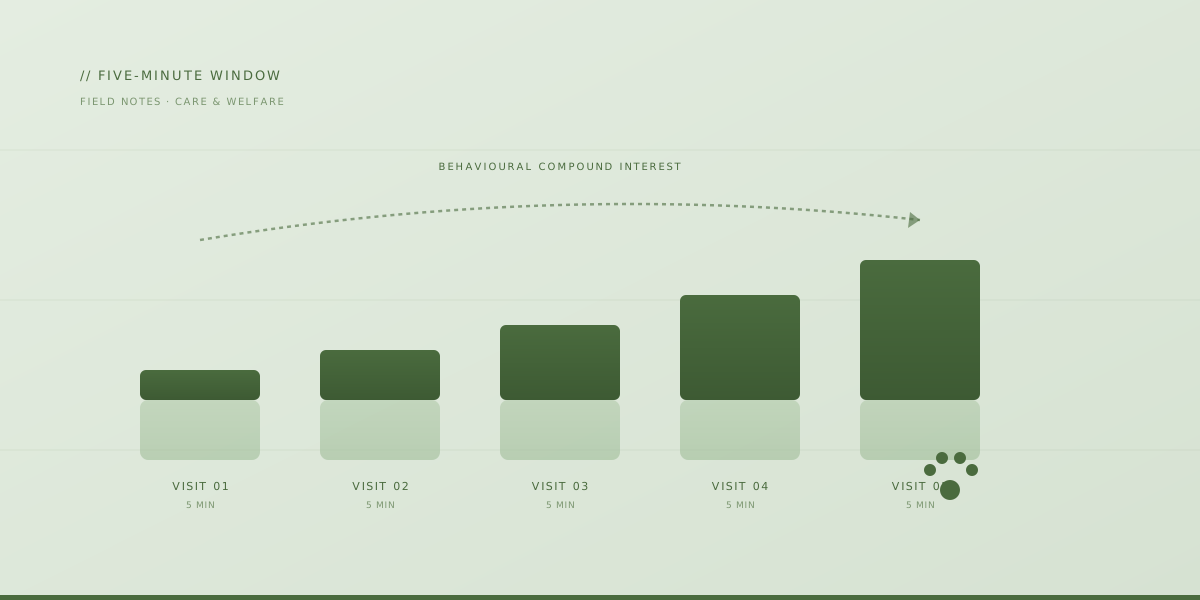
The trick was not the point. The trick was the wedge. Sara had taken five minutes of recurring slack time and turned it into compound behavioural interest. The dog now greets her at the door, walks more politely, and finishes visits calmer. None of that is because she taught him a clever party trick. All of it is because she taught him that her presence meant attention, repetition, and reliable rewards.
There are roughly sixteen million Americans who professionally walk or sit dogs, by the AKC's 2024 industry estimate. Almost none of them think of themselves as trainers. Most think trick training belongs to dog trainers and their clients. That framing leaks money, about twelve minutes per visit of unbillable slack time by our read across the operators we talk to, and it leaves the cheapest behavioural lever a walker has on the table.
This is the operator‑to‑operator version of trick training. Eight tricks that fit a walker's actual day, the five‑minute slack window framework that makes them stick, and the anti‑patterns that turn well‑intentioned tricks into bad habits. If you are earlier in the journey, our how to start a dog walking business US piece covers the first ninety days.
01 / The windowThe five‑minute trick window.
Look at a typical drop‑in visit. Thirty minutes scheduled, but you are physically inside the home for roughly twenty‑four once you account for the front door, the harness, and the walk‑out. Of those twenty‑four minutes, about five are slack. The dog is hovering for treats, you are checking the schedule on your phone, the harness is off and you are filling the water bowl. Most walkers do not notice these moments. The best ones use them.
The five‑minute trick window has three properties that make it valuable.
- It is recurring.Every visit contains one. Drop‑in, group walk, boarding shift. The window is built into the rhythm of the job.
- It is distraction‑light. The dog is already in the room with you. No traffic, no other dogs, no squirrels. The conditions for learning are better here than they are on the walk itself.
- The behaviour transfers. What the dog learns in the slack window does not stay there. It shows up on the walk, at the door, at the next handover, at the kennel.
The framework has three steps and that is the entire system.
The trap most operators fall into is trying to layer too fast. A dog learning four tricks at once learns none of them. The owner is confused, the walker burns out on the framework, and within two weeks the slack window is back to thumb‑scrolling Instagram. One trick. Five visits. Then layer.
02 / The listThe eight tricks worth your slack moments.
These are ordered foundation first, application last. Each builds on the previous and unlocks a different operational use case. Most walkers will get through the first three within a month and the full eight within a quarter, working one client at a time.
1. Touch — the foundation
Hold a closed fist with a treat inside. The dog sniffs, touches with their nose, gets the treat. Add the cue word “touch” once they are reliably touching. This is the single most useful trick on the list because everything else builds from nose‑to‑target. Use it pre‑walk to settle the hovering, mid‑walk as a leash‑pull reset, and post‑walk to send the dog back inside calmly instead of bolting.
2. Sit — the calm anchor
Most dogs already know this. The reframe for operators is to use sit as a reset, not a position. Cue sit at every transition: at the door before clipping the leash, at the curb before crossing, at the door before greeting an arriving owner. A dog who is sitting cannot also be jumping, lunging, or barking. The sit is the behavioural off‑ramp.
3. Watch Me — eye contact on cue
Hold a treat at your face, cue “watch me,” reward when the dog makes eye contact. This is a quiet game‑changer for nervous or reactive dogs. Instead of waiting for the dog to react to a passing cyclist, you cue watch me three seconds before the trigger arrives. The dog learns to default to you when something is up. This single trick has, in our read, reduced lead pulling and reactivity on more group walks than any other behavioural intervention.
4. Spin — the loose‑leash reset
Hold a treat near the dog's nose, lure them in a full circle parallel to the ground. Cue “spin” once the motion is consistent. Spin is a lower‑stakes alternative to sit when you do not want the dog to plant. If the dog is locked onto a squirrel on the walk, a cue of spin breaks the visual fixation and rewards re‑engagement with you. It is also a useful warm‑up before a structured training session.
5. Paw — the greeting trick
Hold a closed fist near the dog with a treat inside, wait for them to paw at your hand, reward and add the cue. The applied version: when arriving at a client's door, ask the dog for paw instead of letting them jump. It does not replace polite greeting training, but it gives the dog an alternative behaviour to offer. Paw also makes a strong photo for the daily client report.
6. Wait — the impulse‑control trick
Wait is different from stay. Wait means pause, then go on my cue. Teach it by putting a treat on the floor, covering it with your hand, saying “wait,” then releasing with “okay” once the dog holds for a beat. The applied uses are everywhere: at the door before going outside, at the curb before crossing, before clipping the leash off in a fenced yard. A dog with a reliable wait is a dog that has dramatically lower bolt risk through open doors.
7. Place — the settle station
This one is for boarders and sitters more than walkers. Train the dog to go to a designated mat or bed on cue. Lure them onto the mat with a treat, reward, add the cue “place” or “mat,” build up duration. Place gives boarding dogs a designated calm spot in an unfamiliar environment, which lowers pacing and barking around staff handovers. Owners who board regularly will often ask you to teach this one specifically.
8. Find It — the scatter game
Scatter five to ten small treats in the grass or a corner of the room. Cue “find it.” The dog sniffs them out one at a time. The mental work involved in low‑intensity scent searching is roughly equivalent to ten minutes of physical walking for a high‑energy dog. Use it as a leashed walk break for the dogs who would otherwise pull for the whole hour, or in a boarding pen for a hyper dog during a calm‑down window.
If you remember only one trick from this list, remember Touch. Every other behaviour on this list builds from a reliable nose‑to‑target. The first two weeks with a new client should be five minutes of touch per visit, no exceptions. Layer the rest from there.
03 / ApplicationHow to slot tricks into a visit.
These are three concrete patterns from the operators we work with. The detail matters: tricks are not a separate slot from the visit, they are inside the visit, replacing slack time you were already paid for.
Drop‑in visit (30 min)
Minutes zero to two: arrival, harness on. Minutes two to twenty‑two: walk. Minutes twenty‑two to twenty‑five: trick window, today's trick. Minutes twenty‑five to twenty‑seven: water, settle, departure prep. Minutes twenty‑seven to thirty: leave. The trick window sits in the calm post‑walk recovery when the dog is most receptive.
Group walk (60 min)
For multi‑dog group walks, the rest stop is the natural window. Three or four dogs leashed in a shaded spot at minute forty‑five. One at a time, cue a trick, reward, rotate. The other dogs watch and learn by observation. Group walks are actually the highest‑leverage trick environment because the dogs see each other earn rewards for calm behaviour, which is its own form of social learning.
Boarding (whole day)
Three windows per day. Morning yard time before food: five minutes of touch or sit. Afternoon nap recovery before the second walk: five minutes of place. Evening calm‑down before bed: place again, with longer duration. Over a five‑day boarding stay that compounds into fifteen training sessions across a dog who has nothing else to do.
Tricks are not the point. The behavioural compound interest is.— PackMonty Field Notes, editorial position
A walker who teaches eight foundation tricks across the first sixty visits with a new client has a different relationship, and different leash behaviour, than one who does not. The investment is five minutes per visit. The return is the next two hundred visits.
04 / MistakesAnti‑patterns: where walkers go wrong.
Five patterns we see repeatedly across operators just getting started with tricks on visits. Each of them is easy to fix once you know to look for it.
- Treating every visit like a class.If every interaction with the dog is “training,” the dog gets exhausted and the relationship turns transactional. Tricks should be about five minutes per visit, not twenty‑five. The rest of the visit is the walk you were hired for.
- Teaching new tricks without owner consent.Some owners want their dog trained on specific cue words. If you teach “paw” with a different word than the owner uses, you create confusion for the dog and frustration for the household. Always ask at onboarding which cues to use or avoid. Most owners are delighted you offered.
- Using human food as treats.Cheese, sausage, ham, these are not safe across all dogs and many have allergies or dietary restrictions. Use the owner's approved training treats or bring your own dog‑safe option (freeze‑dried liver works for most). Check the dog's health notes in your client record before every new visit.
- Picking tricks the dog is not built for.Asking “sit pretty” of a twelve‑year‑old Labrador with hip dysplasia is not a training failure; it is an injury waiting to happen. Skip back‑flips, sit pretty for short‑backed breeds like Corgis and Dachshunds, and any trick involving jumping for senior or large‑breed dogs. Stick to behaviours the dog can perform safely with nothing but you and a treat pouch.
- Rewarding the wrong moment. If the dog barks excitedly during a trick and you give the treat anyway, you have just paid for barking. Wait for the calm version of the behaviour before the reward, even if it takes ten extra seconds. The dog learns from what you mark, not from what you intended.
Teaching foundation tricks during a walk or sitting visit sits comfortably within the scope of a general liability policy. Once you start charging specifically for training services or offering reactivity protocols, you should add Errors and Omissions cover because you are now selling advice the client relies on. We covered the full cover stack in our dog walking insurance US article.
Five minutes a day. Eight tricks across a quarter. One client at a time. The maths is small and the compounding is large. The dogs settle faster, walk politer, and stay calmer through transitions. The owners notice and recommend you. The operator difference, in our read, between the walker who lasts three years and the walker who burns out at eighteen months is rarely the route plan or the rate sheet. It is usually whether the slack time was used.
Devon Russo
US Field Notes Editor · BrooklynRan a four‑walker independent dog walking operation in Brooklyn for six years after leaving Rover. Has watched every junior walker on her team learn touch faster than they learn the route. Field Notes is the operator‑to‑operator publication she wishes had existed in year one.