Watch any walker pick up a bouncing young Labrador and you are already watching dog training techniques at work, whether the walker chose them or not. The dog jumps; a knee comes up, or a treat comes out to settle it. The dog pulls; the leash tightens, or the walker stops dead and waits. Every one of those moves teaches the dog something that sticks. The only real question is whether you decided what it learned, or the dog did.
Here is the thing almost every guide on this topic gets wrong for our purposes. They are written for owners, or for trainers building a class business. You are neither. You see the dog for forty-five minutes, maybe three times a week. The owner and their trainer own the curriculum. You are the substitute teacher who has the class in the hardest room in the building: outside, on a leash, with squirrels.
But reinforcement does not wait for the owner to book a class. It happens on your watch, every walk, at the speed of about half a second. Marisol, who runs a six-walker operation in San Diego, put it to me plainly: “I stopped calling it training because it scared my clients. I call it handling. It is the exact same six things.” This is those six things, and the small number of rules that make them work.
01 / The premiseYou are training whether you mean to or not.
A dog does not know the difference between a lesson and a walk. It learns from whatever happens right after it does something. If it jumps and gets a face, it jumps more. If it pulls and the walk continues, it pulls more. Reinforcement is not a service you opt into on a booking form. It is closer to gravity: always on, indifferent to your intentions, and quietly shaping the dog in your care every single day.
That reframes the job. You are not deciding whether to train the dogs on your books. You are only deciding whether the training is deliberate or accidental. Accidental training is how a walker ends up with a dog that mugs the treat pouch, barks at the leash, and body-slams the next client at pickup. None of that was taught on purpose. All of it was taught.
Keep the middle number in your head, because it is the one most walkers get wrong. Timing beats technique every time. A perfectly chosen reward delivered three seconds late teaches the dog nothing you intended, and often teaches it something you did not. Half a second is the whole game.
02 / The choiceTwo methods, and only one you should use.
Strip away the marketing and there are two families of dog training techniques. Reward-based methods add something the dog wants after a behavior you like, so the behavior happens more. Aversive methods add something the dog dislikes, or take away something it wants, to make a behavior happen less. Balanced training mixes the two. Dominance training, the old idea that you must act like the pack's alpha, is a subset of the aversive camp built on a theory of captive wolves that the original researcher spent his later career trying to retract.
For an owner training their own dog, this is a real debate they get to have. For you, handling a dog you do not own, it is not. The evidence is one-sided and the liability is worse.
The American Veterinary Society of Animal Behavior's 2021 position statement on humane dog training recommends reward-based methods for all training and behavior modification, and states flatly that there is no role for aversive training in behavior modification. A 2020 study of 92 companion dogs across seven training schools in Portugal found that dogs trained with aversive methods showed more stress-related behavior, panted more, and had higher post-session cortisol than dogs trained with rewards, and were more “pessimistic” on a follow-up cognitive test. That is the science. The business case is even simpler: an aversive correction on a client's dog is a welfare risk, an insurance problem, and a conversation with the owner you do not want to have.
On a dog that is not yours, the ceiling is reinforcement and the floor is management. You reward what you want and you arrange the environment so the dog cannot rehearse what you do not want. You never punish. If a dog is hard enough that you feel you need to, that is a referral, not a technique.
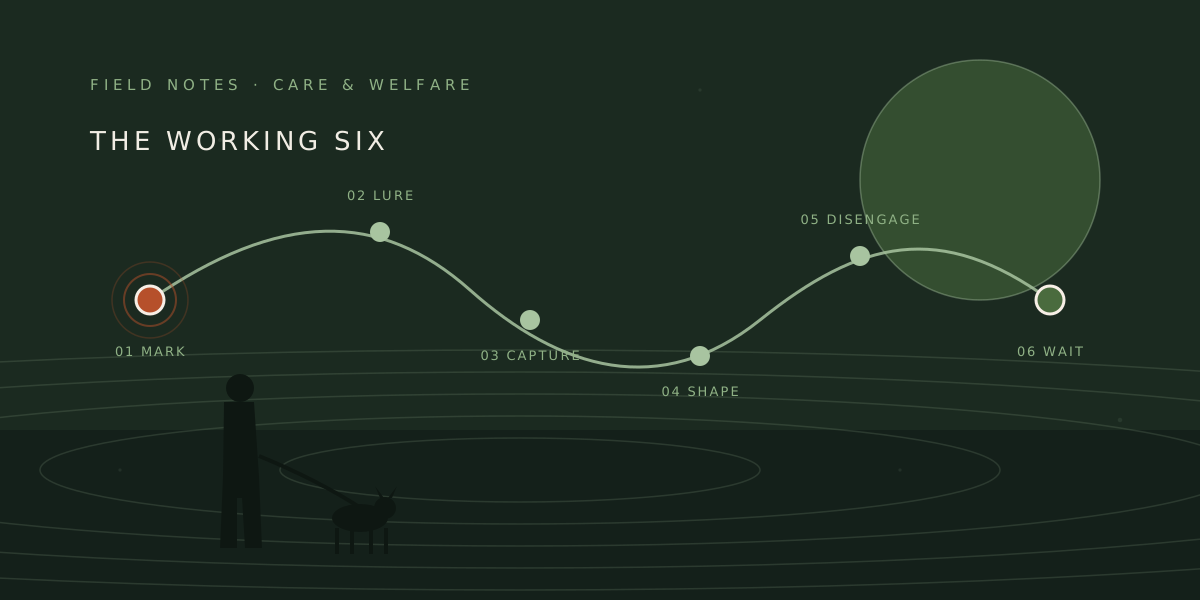
03 / The frameworkThe Working Six.
Six reward-based dog training techniques cover almost everything a walker actually does on a leash. The first four are how you build a behavior. The last two are how you keep a dog safe. Learn them as a set, because the skill is not in any one of them, it is in reaching for the right one without thinking.
1. Marking
The foundation, and the one that makes the other five work. A marker is a sound, a click or a crisp “yes,” that tells the dog the exact instant it did the right thing. Then you pay. The click buys you time: it freezes the correct moment so your treat can arrive a beat later without confusing the dog. Pick one marker, use it identically every time, and never mark without paying. A verbal “yes” usually beats a clicker on a walk, because you already have too much in your hands.
2. Luring
Move a treat and the dog's nose follows it into position. Lift it over the head and the dog sits; lower it to the floor and the dog lies down. Luring is the fastest way to get a new shape, and the easiest to overuse. Fade the food out of your hand by the fifth repetition or you build a dog that only works when it can see the snack, which is worse than useless at pickup.
3. Capturing
Wait, watch, and pay a behavior the dog offers for free. The dog sits at the curb on its own; mark and pay. It settles on the grass during your phone call; mark and pay. Capturing is the best technique for calm, because calm is not a trick you can lure, it is a state you can only catch. Most walkers never use it, which is why most walkers have loud dogs.
4. Shaping
Build a behavior too big to lure in one move by paying small steps toward it. Loose-leash walking is the classic: you cannot lure “forty-five minutes of a slack leash,” so you pay a step of slack, then two, then five. Shaping asks for patience, but it is how you get the behaviors that actually make a walk easier instead of the ones that only look good on video.
5. The disengage
The safety technique for the leash. Named “Look at That” by trainer Leslie McDevitt in her Control Unleashed work, it flips a trigger into a cue. The dog notices the dog across the street; you mark that look and pay, and the dog turns back to you for the next treat. Do it enough and the sight of the trigger becomes the cue to check in with you, not to launch. It is the difference between a reactive dog you dread and one you can route around a problem.
6. The threshold wait
Impulse control at every doorway, gate, curb, and car door. The dog holds position until you release it. This is the technique that prevents the single worst thing that happens on our watch: the bolt through an open door into traffic. It also happens to be the easiest to fold in, because a walk is nothing but a series of thresholds.
Every walker can name a fancy trick. The ones I trust can pay a dog for doing nothing at all, at the exact right second.– Marisol R., six-walker operation, San Diego
04 / The applicationFold them into the stops you already make.
The mistake is to think this means running training sessions on a walk you are paid to deliver. It does not, and you should not. The owner is paying for a walk. What you do instead is fold single repetitions into the stops the walk already contains. A forty-five minute route has eight or nine of them: the front door, the elevator, the curb, the crossing, the gate to the park, the water break, the curb home, the door back in. Each one is a free repetition of the wait, and a chance to mark and pay a check-in.
One rep per stop is enough. You are not drilling; you are keeping known behaviors sharp in the one environment where they matter most and are hardest to hold. Here is what that looks like across a single ordinary walk.
That last line matters more than it looks. A one-sentence note to the owner, “paid Cooper for waiting at the door and for two calm settles,” does two things. It shows the owner you are adding value they did not ask for, and it keeps you and the owner reinforcing the same things instead of pulling in two directions.
05 / The rewardWhat actually pays: praise, treats, and freedom.
A reward only reinforces if the dog actually wants it, and that is not a given. There are three types of currency on a walk, and the best walkers read which one a particular dog is buying with. Food is the fastest and the one most walkers default to, but plenty of dogs will work harder for something else. Praise and attention, delivered with real warmth, pay a velcro dog more than another dry treat ever will. And play or freedom, a thrown ball, thirty seconds of tug, or simply permission to go sniff a hedge, is often the highest-value reward a walk can offer, because it uses the environment you are already standing in.
Which currency works depends on the dog, not the breed, though breed is a useful prior: a working-line breed may value a game of tug over any treat, while a nervous rescue may find a stranger's hand alarming and value distance most of all. Watch the dog's health and appetite too. A dog that ignores treats today might simply be full, or a little off-color, and pushing food on it teaches nothing. Ask the owner what their dog loves, keep two or three types of reward on you, and let the dog tell you what it is working for. Get the currency right and every one of the six techniques lands harder, because the walk's built-in activities become part of the pay. Pay the right reward often enough and you get the thing underneath every technique: a dog that offers you its attention because being near you is where the good things happen. That is the bond doing the work for you.
06 / The dogThe same six, tuned to the dog in front of you.
The Working Six do not change from dog to dog. How hard you lean on each one does. Breeds differ and individuals differ more, so the technique set stays fixed while the dial settings move with the animal on the end of the leash. A lot of skill is just reading which dial to turn.
Puppies
A puppy on your books is in the most important few weeks of its life. The socialization window closes around sixteen weeks, and the habits a pup forms in it tend to last a decade. With a young puppy you barely use luring or shaping at all. You capture calm, you keep everything tiny and positive, and you make every new surface, sound, and friendly face a good thing. You are not teaching the puppy commands. You are teaching it that the world, and the person holding the leash, is safe.
Newly adopted and rescue dogs
A dog fresh from adoption needs decompression before it needs anything else. Many rescuers use a rough “3-3-3” guide: about three days to stop reeling, three weeks to learn a routine, three months to feel at home. For those first weeks your whole job is management and capturing calm, not commands. Let the dog choose distance from things that worry it. That freedom builds a bond, and trust, faster than any treat, and it is the foundation every later technique sits on.
Adult and senior dogs
With a settled adult, the known cues just need keeping sharp, which is exactly what the fold-in routine does. With seniors, health starts to gate what you ask: an arthritic old dog should not be drilled on sits, and a hard of hearing one needs your hand signals more than your voice. A herding breed may fixate and want extra disengage reps; a scent hound will want its nose down, so you build sniffing into the walk rather than fighting it. Meet the dog where it is.
07 / The basicsThe basics you actually lean on.
You do not need a big repertoire. Five basic commands cover almost everything a walk throws at you, and the Working Six are simply how you keep them sharp: sit (capture or lure), wait (the threshold), leave it (the disengage), come (recall, which you reinforce but never test off-leash on a client dog), and heel or a loose “with me” (shape). Most dog training tips online bury owners under twenty commands. A walker needs these five, working on the first ask.
One piece of advice matters more than any single command: use the exact words and hand signals the dog's family uses at home. A dog that hears “here” from its owner and “come” from you learns that neither word reliably means anything. Consistency across everyone who handles the dog, the owner, the family, the trainer, and you, is the whole difference between a cue that holds under pressure and a habit that never quite forms. Write the household's words into the dog's profile on day one, and you will never train against the people paying you.
08 / Anti-patternsWhat not to do.
Four ways walkers turn good techniques into problems, and what to do instead.
- Marking late. A marker three seconds after the behavior does not reinforce the behavior, it reinforces whatever the dog is doing three seconds later, which is usually looking at your pouch. If your timing is off, slow down and mark fewer, cleaner moments rather than many sloppy ones.
- Using your own cue words. If the owner says “off” and you say “down,” you are training against them for the other one hundred and twenty hours of the dog's week. Ask which words and hand signals they use before you reinforce anything, and write them in the dog's profile.
- Flooding a scared dog. Do not try to fix fear by pushing a nervous dog closer to the thing it fears. That is not a technique, it is how you get bitten and make the dog worse. Read the dog, give it distance, and handle the fear as its own job. We wrote the framework for that in handling a scared dog on a walk.
- Selling training you are not qualified to sell. Reinforcing a known cue is handling. Modifying behavior, starting new behaviors from scratch, or working on aggression is training, and it needs the qualification, the insurance, and the owner's informed sign-off. Blurring that line is how walkers get hurt, sued, or both.
09 / The lineWhere your job ends.
The most useful sentence in this whole piece is a boundary. Reinforcement keeps a skill the dog already has sharp. Training builds a skill the dog does not have yet, or changes an emotional response like fear or reactivity. The Working Six live entirely on the reinforcement side of that line. The moment a dog needs the other side, a real behavior change program for separation anxiety, resource guarding, or aggression, your job is to say so and refer, not to improvise.
That boundary is not a limitation, it is what makes you safe to hire. An owner can trust a walker who knows exactly where handling stops and training begins, because that walker will not quietly make a serious problem worse. It also protects the thing your business runs on, which is a general liability policy that assumes you are walking dogs, not rehabilitating them.
So start with one technique this week. Pick the threshold wait, because you already stop at every door, and a walk hands you the repetitions for free. Get that clean, add the disengage, then the rest. Do it in order and within a month you will be running six deliberate dog training techniques on every walk, and nobody, least of all the dog, will notice you are working.
– DR, at a curb somewhere in Brooklyn, waiting for a release word