Four minutes. That is how long Nadia took to buy her first pet sitter insurance policy, on her phone, at a red light outside a client’s house in Austin. A certificate landed in her inbox before the light changed. She felt, for the first time, like a business.
The policy was a good one for what she was doing. She was one person, visiting dogs in their own homes, three or four a day. It cost less than a month of her car insurance. Then two years later she started letting a couple of regulars board at her place, and nobody told her the policy had quietly stopped matching her week. Nobody ever does.
That is the real shape of pet sitter insurance. It is not one purchase. It is a ladder, and the rung you need depends on three things you can check in a minute: where the animals sleep, who else holds the keys, and whether anyone drives a vehicle with a client’s dog in it. This piece prices all three rungs with published 2026 numbers, shows what to buy on each, and gives you the three questions that tell you when to climb. If you want to read a policy line by line, our Claim-Day Five piece does that. This one is about buying the right policy in the first place.
01 / The priceWhat pet sitter insurance costs in 2026.
Published prices for a solo pet sitter policy cluster in a narrow band. Pet Care Insurance, a specialist insurer for pet businesses, lists plans starting at $17.92 a month, or $194 a year. Insurance Canopy sells a monthly plan at $29.43 ($353.16 a year) and an annual plan at $332.20. Pet Sitters Associates sells a membership with its liability cover built in for $220 a year. Those are three options a US sitter finds near the top of the results when they search.
The last two lines come from Insureon, which publishes the median cost of policies for pet sitters who apply for quotes through it: $42 a month for general liability and $59 a month for a business owner’s policy, a bundle of liability and property cover. Medians from a broker run higher than the entry plans because brokers quote people with employees, vehicles and boarding. That is the point. The price you pay tracks the rung you are on.
02 / The problemWhy the headline price lies.
Compare two quotes at $194 and $353 and the cheaper one wins. It is a trap, and not because the $353 plan is better. The two bundles contain different things, and the pet-specific lines are where the money is spent when something goes wrong.
Take the animal bailee line, which pays when a pet in your care is injured or lost. Pet Care Insurance and Insurance Canopy both list $2,500 per incident and $5,000 a year. Pet Sitters Associates lists $15,000 per occurrence and $30,000 a year. A specialist quoted in Care.com’s pet sitting insurance guide recommends at least $25,000 because vet bills run high. Same product name, a tenfold spread, and the price difference between the plans is smaller than the spread.
There is a second way the headline lies. Marketplace apps offer their own protection for bookings made and paid through them. That protection is tied to the platform booking, so a repeat client you now book directly is outside it, and guidance on these plans generally tells sitters to keep their own cover. Read your plan’s terms in your account before you lean on it, and treat it as a bonus on top of your policy, not a replacement for one.
Do not ask what the cheapest pet sitter insurance is. Ask which lines you need at the size you are today, and what it costs to add the next ones the week you grow.
03 / The frameworkThe Three Rungs.
Pet sitting businesses we’ve seen tend to sit on one of three rungs. You move up when something you do changes, never because of a birthday or a renewal letter.
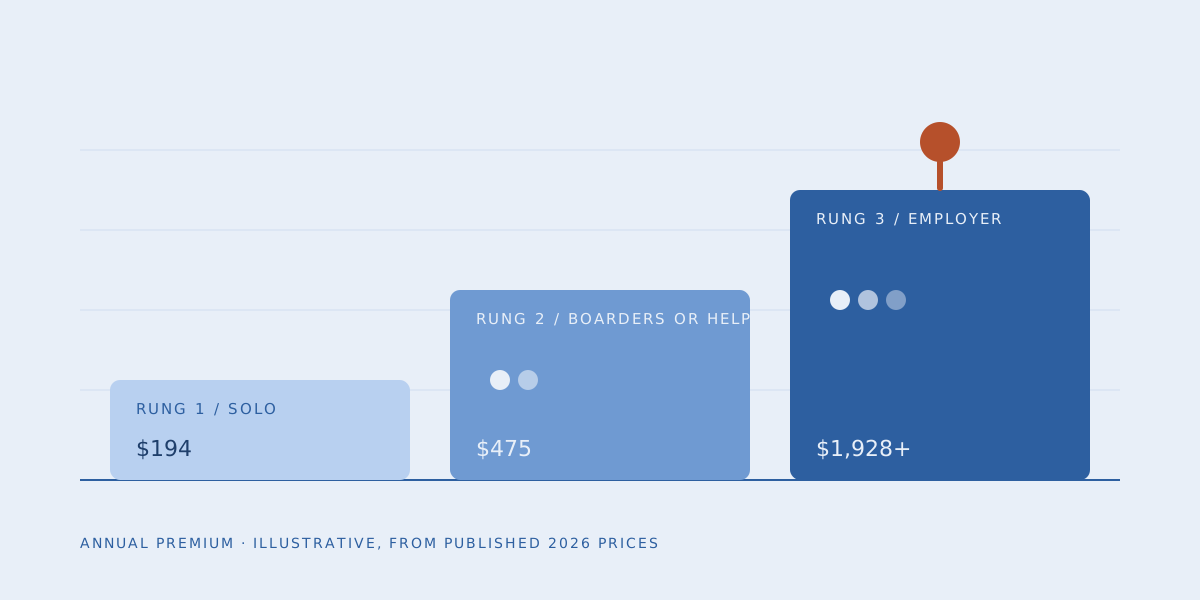
Rung one: solo. One person, visiting animals in their own homes. You need general liability, animal liability, animal bailee, a vet expense line and lost key cover. This is the $194 to $353 policy, and it is plenty.
Rung two: boarders or helpers. Dogs sleep at your place, or one other person works under your policy. Now you need in-home boarding cover, the helper named on it, and a hard look at the pet-count limits. Add-ons are priced per location and per person, and in one published price list a rung two stack comes to about $475 a year.
Rung three: employer. You pay people. You need a business owner’s policy, workers’ compensation and, if staff drive client dogs, commercial auto. This is a broker conversation, and the three medians together come to $4,870 a year.
The three climb triggers are the questions from earlier, asked every time you say yes to a new booking. Does a dog sleep somewhere I control that is not the client’s home? Does anyone but me hold a client’s keys? Does a vehicle carry a client’s dog? One yes and you are on the next rung, whether the policy says so or not.
04 / Rung oneSolo: four lines to find.
On rung one you are buying simple cover, and the work is in checking that four lines exist before you pay. Each one answers a specific bad day.
- General liability, $1 million per occurrence. The client’s guest trips on the dog you were walking, or the leash wraps a visitor. The plans above list a $2 million annual limit, and Insurance Canopy and Pet Sitters Associates list $1 million per occurrence.
- Animal bailee. The dog you are caring for gets hurt or gets out. This is the line with the widest spread, from $2,500 to $15,000 per incident. Pick the higher limit if the price difference is under $100 a year.
- Vet expense, regardless of fault. A dog slips on the client’s stairs while you are there. Nobody was negligent, but the vet bill is still real. Published limits run from $1,000 to $2,500 per incident, with a $250 deductible on some plans.
- Lost key liability. You lose a client’s key and the locks have to be changed. Published limits are around $2,000 to $2,500, and often included.
If those four are there, the rest of the page is detail. Bonding is a separate product that covers theft of client property, and it is cheap: Care.com cites $50 a year for a $5,000 bond and $100 for $10,000. A bond is not insurance, but a client who leaves you alone in a house with a jewelry box will often ask for one.
Buy it from whoever gives you the certificate fastest. For a solo sitter, an instant online plan or an association membership is the right channel, because the value is in having the policy active, not in the negotiation.
05 / Rung twoBoarders or helpers: where the limits bite.
Rung two arrives quietly. A regular asks if their lab can stay while they are away, you say yes, and you have just moved dogs into a building you control. Or your sister covers a Saturday. Neither feels like a business change. Both are.
Entry plans cap what they will do. Insurance Canopy covers five or fewer pets at a time on stays of 30 days or less, and refers bigger jobs to a partner carrier. Pet Sitters Associates limits pet daycare and boarding to ten pets at a time and five overnight. Read those numbers against your busiest weekend, not your average one. A holiday week with six boarders turns a policy that was fine in March into one that does not apply.
That is $475 for a sitter with one boarding location and one helper, which is under a quarter of the $1,928 employer stack and about a tenth of the $4,870 stack with a vehicle. Two details matter more than the total. First, a helper only counts if they are named on the policy. Second, add the clients whose homes you enter as additional insureds if they ask. Pet Sitters Associates charges $15 each, so it is worth knowing the option exists before a landlord or property manager asks.
06 / Rung threeEmployer: where the bill jumps.
Rung three costs ten times rung one. It also stops being a form you fill in on a phone. A business owner’s policy bundles general liability with property cover, a median $704 a year in Insureon’s figures. Workers’ compensation, the cover for injuries to people who work for you, has a median of $1,224. Commercial auto, for vehicles that carry client dogs, has a median of $2,942.
Add the three and you get $4,870. Skip the vehicle and you get $1,928. Those are medians for sitters who applied for quotes, so your own quote will differ, but the shape holds: the vehicle is the most expensive line you can add, and the one people forget until a claim. Workers’ compensation scales with payroll. Care.com puts the rate at about $5 per $100 of payroll, which makes $24,000 in annual pay roughly $1,200 in premium, and it varies by state.
The worker classification question lands here, and it is not one an insurance form can settle. Calling a helper a contractor does not move the risk off you if the arrangement looks like employment, and states define that line differently. Ask your broker how they classify your helpers, in writing, before you assume your general liability covers them. Our Four Triggers piece goes through the hires and vehicles that change a policy, and our dog walking insurance guide covers the same ground for walkers.
07 / ApplicationNadia climbs three rungs in four years.
Back to Nadia. She starts in 2022 as a solo sitter in Austin with eight regular clients. In the table below, the figures are illustrative sums built from the published prices above, not a quote.
She climbs from rung one to rung two on the day she says yes to the first boarder, not at renewal. A phone call to her insurer takes ten minutes and the add-on takes effect that week. She climbs to rung three the Monday her first part-timer starts, and uses a broker for the first time. Her total insurance bill goes from $194 to $1,928, which sounds steep until you see what else changed: she went from eight clients to thirty-odd and from about $18,000 of revenue to about $75,000. At that size insurance is under three percent of revenue, which is where it should sit.
The mistake she nearly made is the one most sitters make. In 2024 she almost left the policy as it was, because it still worked for the clients she already had. The boarding dogs did not exist in the policy’s world.
08 / ProofA certificate is a sales asset.
Insurance gets treated as a cost, and it is also the cheapest trust signal you can buy. A certificate of insurance is the one-page proof that you hold a policy. Insurance Canopy issues one instantly on purchase, and other providers issue them on request.
Put it on your website, attach it to your first reply to a new client, and offer it unprompted to property managers. Clients rarely ask for it. They do notice when you offer. A sitter who says “I’m insured, here’s the certificate” is a different kind of sitter from one who has to look for it.
09 / Anti-patternsFour ways sitters stay on the wrong rung.
- Don’t buy on price alone. A $194 plan and a $353 plan are not the same product. Compare the animal bailee limit and the vet expense line first, then the price.
- Don’t assume the app covers you. Platform protection depends on the booking running through the platform. A client you moved off the app is yours, and so is the risk.
- Don’t climb at renewal. The right time to add boarding, a helper or a vehicle is before the first night, the first shift or the first drive. A policy cannot pay for something it was never told about.
- Don’t let a friend help for free. An unpaid Saturday cover from your cousin is still a person acting for your business. Name them on the policy or don’t use them.
10 / TakeawaysTake this with you.
Do one thing this week. Write down the three climb questions on an index card: where do animals sleep, who holds keys, and what carries a dog. Next to each, write whether your current policy knows about it. If any answer is a yes you haven’t told your insurer, call them tomorrow. It takes ten minutes, and it is the cheapest ten minutes in the business.
The policy that suited the sitter you were last year is not the one you need now. Buy for the business you are running today, and adjust the day it changes.
– DR, Portland, with a certificate of insurance open in the next tab